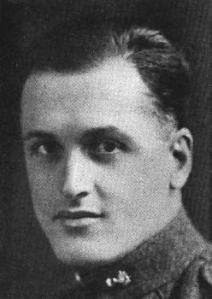
Today is the 130th anniversary of the birth of composer and church musician David McK. Williams (1887-1978), who was born in Wales, but came to Colorado in this country as a child with his family. Some of his earliest musical training was as a boy chorister at the Cathedral of St. John in the Wilderness in Denver, and by age 13 he was the organist at St. Peter's Church in that city.
In 1908 he moved to New York City, where he was organist and music director at Grace Church Chapel and the Church of the Holy Communion (where William Muhlenberg had been rector) with a break to study in Paris (1911-1914) and another to serve in World War I with the Royal Canadian Artillery (his photograph here is from those years).
Not long after his return from Europe in 1920 he became the director of music at St. Bartholomew's Episcopal Church, where he would remain for the next twenty-six years and raise the level of music at that church to become one of the best-regarded in that city. His organ playing, both accompanying the choir and congregation, and in recital, was beloved by his peers, and he was also admired for the force of his personality. He also wrote several hymn tunes (most of them unison settings rather than in traditional four-part harmony - and also still under copyright), anthems and various service music items for Episcopal worship. He served on the committee that produced the Episcopal Hymnal 1940 (which includes six of his tunes).
However, Williams was also openly gay (whatever that would have meant in that time), and was suddenly dismissed from his position in 1946. This would certainly have been known for some time by leadership at St. Bartholomew's, and it's possible that action was not taken earlier because Williams was a close friend and colleague of composer Amy Beach, a parishioner and probably a significant donor to the church (who died in 1944). The congregation was told that Williams had developed hearing problems and would be taking a leave of absence and leaving the city to seek treatment.
Following his forced retirement he remained in New York, in spite of the claims by church leadership, headed the organ department at the Juilliard School of Music and was a faculty member at the School of Sacred Music at Union Seminary. He remained active in church music circles and the local chapter of the American Guild of Organists, where younger people in later years couldn't recall any significant hearing issues.
This 2015 recording of Williams' anthem In the year that King Uzziah died is by the choir of Trinity Lutheran Church in Des Plaines, Illinois, directed by Brad Whaley.
John Knowles Paine, born today in 1839, was the first American composer to be recognized and appreciated by the Europeans (which was important in those times). He was also the first American to write a symphony and the first professor of music at any American university.
He was born in Portland, Maine, where his father operated a music store. He played piano and organ from an early age and after his father's death in 1856, he played a series of recitals to raise the money to travel to Berlin for his musical education. After nearly four years, he returned and was hired as organist at the West Church in Boston. Only six months later he took the position of organist and choirmaster at Harvard University.
His first major choral work, Domine salvum fac, was written for the installation of a new Harvard president in 1863. His organ variations on the Star-Spangled Banner were very popular during the Civil War, and in 1866 his Mass in D had its premiere performance in Berlin. Harvard was impressed; Paine was awarded an honorary degree in 1869 which then made it possible for them to appoint him as an instructor in music. In 1875 he was made a full professor, the first in this country.
Paine continued to compose orchestral, organ, and choral works; he was the first of the Second New England School of composers which included George W. Chadwick, Horatio Parker, and Amy Beach among others. Unlike those colleagues, his major choral works have been recorded, both the Mass in D and his oratorio St. Peter (1872). His other long-lasting composition (at Harvard, at least) is the tune for the Harvard Hymn, which I believe is still sung at commencement ceremonies, and is still in the most recent Harvard University Hymn Book (2007).
Paine also wrote a handful of other hymn tunes which I have come across in recent years, though none that anyone still sings today, and none that are documented at any of the usual hymn websites. However, in the aforementioned St. Peter, he reharmonized three familiar German chorales. This Epiphany hymn by Philipp Nicolai appears in many different hymnals, but you probably have not heard or sung it to this arrangement by John Knowles Paine.
How lovely shines the Morning Star! The nations see and hail afar The light in Judah shining. Thou art my heart’s most beauteous Flower, And thy blest Gospel’s saving power For thee my heart is pining. Thou mine, I thine; Sing hosanna! Heav’nly manna Tasting, eating, Whilst thy love in songs repeating.
Lift up the voice and strike the string, Let all glad sounds of music ring In God’s high praises blended. Christ will be with me all the way, Today, tomorrow, every day, Till traveling days be ended. Sing out, ring out, Triumph glorious, O victorious, Chosen nation; Praise the God of thy salvation.
Oh, joy to know that thou, my Friend, Art Love, beginning without end, The First and Last, eternal! And thou at length —- O glorious grace! Wilt take me to that holy place, The home of joys supernal. Amen, Amen! Come and meet me! Quickly greet me! With deep yearning, Christ, I look for thy returning.
Philipp Nicolai, 1597 translation composite Tune: WIE SCHON LEUCHTET (8.8.7.8.8.7.4.8.4.8) Philipp Nicolai, 1599 harm. John Knowles Paine, 1872
The major work of Paine's later life was an opera, Azara, which was scheduled to be performed at the Metropolitan Opera in 1906. However, the performers, at that time used to singing only in Italian (regardless of the original language of any work) refused to learn a piece in English and the premiere never took place. It was performed in concert at Harvard and elsewhere, but has never been presented in a fully staged production.
P.S. The portrait of Paine above (undated) is by Caroline Amelia Cranch (1853-1931), donated to Harvard Universaity by Paine's daighter-in-law in 1920.
Composer George Whitefield Chadwick was born today in 1854 in Lowell, Massachusetts. Though he dropped out of high school in 1871, the following year he was admitted to the New England Conservatory of Music as a special student. He was successful in his musical studies, and taught music at Olivet College in Michigan after graduation. While there, he became one of the founders of the Music Teachers National Association, and also published some of his first compositions.
He then traveled to Leipzig and Munich for two more years of musical studies; at the time European study was considered a necessity for an American composer. After returning to the US, he went back to the New England Conservatory as a teacher, and eventually becoming its director in 1897, serving for 33 years. He was also the organist at Boston's South Congregational Church and conducted annual choral festivals at Springfield and Worcester.
Chadwick composed in many different forms, including choral music, symphonies and chamber music, and opera. His works were popular in his own time both in this country and abroad; he was thought to be one of the best American composers of the day. He became known as one of the Second New England School of composers, with Amy Beach, Horatio Parker, John Knowles Paine, and others. Each of these composed some hymn tunes, and Chadwick added another handful (a few more than you can hear at the Cyber Hymnal site).
I sought thee, Lord, and afterward I knew Thou mov'dst my soul to seek thee, seeking me. It was not I that found, O Savior true; No, I was found of thee.
Thou didst reach forth thy hand and mine enfold; I walked and sank not on the storm vexed sea. ’Twas not so much that I on thee took hold, As Thou, dear Lord, on me.
I find, I walk, I love, but oh, the whole Of love is but my answer, Lord, to thee! For thou were long beforehand with my soul, Always thou lovedst me.
Author unknown, c. 1880; alt. Tune: PEACE (10.10.10.6.) George W. Chadwick, 1890
This anonymous hymn text may have first appeared in a collection published in Boston titled Holy Songs, Carols, and Sacred Ballads (1880). One subsequent source attributed it to the British poet Jean Ingelow, but apparently there is no consensus on her authorship. Chadwick is said to have written the tune specifically for this text, though other sources say that the text did not appear in an American hymnal until 1903. Of course, it still could have been sung earlier by Chadwick's Boston congregation. The hymn later appeared in several twentieth century hymnals, but nearly always with a different tune. Chadwick's other hymn tunes fared equally badly; I don't believe any of them appear in current collections.
From my own bookshelf, A Book of Choruses for High Schools and Choral Societies (1923) states of Chadwick (admittedly, one of its editors):
Probably no American composer has had a larger influence on the development of music in this country. Mr. Chadwick's works have won a permanent place in the repertoires of orchestras, choruses, choirs, and singers the world over...
Not so permanent, as it turned out. Some of his orchestral and chamber works have been recorded, but almost none of his choral or vocal music.
I've always thought it would be interesting to attend a New England Classical Christmas concert, with choral excerpts from Chadwick's oratorio Noel (1908), Parker's cantata The Holy Child (1893), Paine's cantata The Nativity (1883) and Amy Beach's Christmas pieces Bethlehem (1893) and Constant Christmas (1922). But I've also come to realize that if I ever want to hear it I will probably have to start the choral group myself.
Composer Amy Marcy Cheney Beach was born today in 1867 in New Hampshire. Her musical talent was apparent from an early age; reportedly she sang improvised harmony to her mother's melody line at the age of two, began composing (in some fashion or other) at four, and played her first piano recital at seven.
She composed in many different forms, symphony, opera, chamber music, choral music and songs, and of course a few hymn tunes. Many of her works have been recorded, though there are many more still to be heard by modern audiences.
Last year there were no performances of her choral work available for you to hear on YouTube, but one has finally turned up, her anthem Let this mind be in you (the text taken from Philippians 2:5-11, if you want to follow along). Thanks to the Gallery Choir of St. Peter's Catholic Church, Columbia, SC.
In 1921, Beach first went to stay for a period at the MacDowell Colony in her native New Hampshire, and she returned for many summer stays after that, eventually serving on the board of directors. Even during her final years, when her health rarely allowed her to leave New York, she made an effort to attend the official annual meetings. After her death in 1944, her will granted the ongoing proceeds from royalties on her copyrighted works to the colony.
Today we celebrate the birthday of composer Amy Marcy Cheney Beach, born on this day in 1867. She grew up in New England, then settled in Boston. She was the first significant woman composer in this country, but began her career as a concert pianist in 1883. Only two years later she married Dr. H.H.A. Beach (24 years older than she), and agreed to limit her public performances to one per year, for charity. She turned to composition (a more ladylike pastime, in the doctor's opinion) and became very successful before long, publishing her works under the name of Mrs. H.H.A. Beach.
Her larger works include a symphony, the chamber opera Cabildo, the Mass in E Flat, and several extended choral works. She also wrote many art songs and chamber music pieces, as well as a number of anthems (six of them are available at the Sibley Music Library site). For many years she lived in New England in the summer, and New York City in the winter, where she became an unofficial composer-in-residence at St. Bartholomew's Episcopal Church on Park Avenue.
A comprehensive biography, Amy Beach, Passionate Victorian by Adrienne Fried Block was published in 1998. Having sung some of her music, I was interested to read it, and discovered that she wrote one hymn tune, called NORWOOD, which was published in one hymnal, Worship in Song (1943 or 1941 - references differ). The tune was used for the hymn O God of love, O King of peace by Henry Williams Baker. But I also discovered a footnote that referred to two "sketches" she sold to the editor of that hymnal some years earlier. A little detective work uncovered The Hymnal for Boys and Girls, published in 1935, which contains two more childen's hymns with tunes attributed to Beach: PETERBOROUGH and ST. BARTHOLOMEW'S (naturally). This was somewhat exciting, because the biographer had apparently not uncovered these tunes (they were not listed with Beach's other work) I suppose "sketches" is a bit vague, but I'd guess that she at least supplied the tunes, if not the full arrangements. I also had several pieces of service music by Beach published in an Episcopal collection from the early 1940s which were not listed in the biography either. By now I'd guess that they've aleady been uncovered by the biographer for a maybe-someday revised edition.
Unfortunately, all three hymn tunes are still under copyright and not available for us to hear. Worship and Song, in fact, is quite difficult to locate. I couldn't turn up any performances of her choral music online either (though some is available on CD). Someone should definitely put up their rendition of Peace I leave with you (a short but effective anthem). But here's a piano piece, Scottish Legend, from YouTube, which also includes some opening remarks about Beach.
Also, you can watch operatic tenor Jussi Bjoerling perform one of Beach's art songs, Ah, Love, but a day. I think this is from one of the Voice of Firestone programs from the 1950s. It seems a little over-the-top by modern standards, but it may actually be closer to the performance practice of Amy Beach's time.