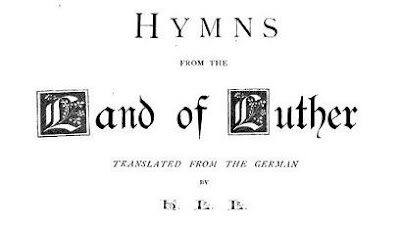
Born today in 1813, in Edinburgh, Jane Laurie Borthwick became interested in translating German hymns into English while traveling in Europe. Upon her return, her father encouraged the work so that she could share the hymn texts that so interested her. Eventually she and her sister, Sarah Borthwick Findlater, compiled a book of their translations titled Hymns from the Land of Luther (1854). Borthwick continued the task of hymn and verse translation in later books as well.
A member of the Free Church of Scotland, Borthwick was also involved in mission and social justice work in several Edinburgh organizations.
Today's hymn is intended for Sunday (Sabbath) worship, once a popular theme but less often seen today.
Hallelujah! fairest morning,
Fairer than our words can say!
Down we lay the heavy burden
Of life’s toil and care today,
While this morn of joy and love
Brings fresh vigor from above.
In the gladness of God's worship
We will seek our joy today;
It is then we learn the fullness
Of the grace for which we pray,
When the word of life is giv’n,
Like the Savior’s voice from heav’n.
Let the day with thee be ended,
As with thee it has begun,
And thy blessing, God, be granted,
Till earth’s days and weeks are done;
That at last thy servants may
Keep eternal Sabbath day.
Jonathan Krause, 1739;
tr. Jane Laurie Borthwick, 1858; alt.
Tune: ORIEL (8.7.8.7.8.7.)
Caspar Ett, 1840
The author of the original German text, Jonathan Krause (1701-1762), was born in Silesia (now Poland) and was for many years the pastor of the Church of St. Peter and St. Paul in Legnica. This may be his only hymn that has been widely translated into other languages.
Six Years Ago: Jane Laurie Borthwick
 Another theme to explore over the next few months is unity and the hymns that have been written about it. The very early Christian church seemed to be one body, though they had their disagreements. Jesus prayed in John 17: 20-21: I ask not only on behalf of these, but also on behalf of those who will believe in me through their word, that they may all be one. Many of the letters to the early churches have to do with their living together as one community.Over time, disagreements would lead to the splintering of one church into many: dozens, hundreds and then thousands of different denominations. This isn't going to go away any time soon; if anything, I believe that the various ecumenical movements that were active thirty or forty years ago never achieved much and most churches are farther apart than ever, divided by differing beliefs and practices both large and small.In spite of all this, there is a strain of thought that believes that the things that unite us are (or ideally should be) stronger than the things that divide us. It may be, though, that unity remains a far-off goal for which we strive, though it will only be achieved in the life to come.This hymn by Jane Laurie Borthwick appeared in her collection Thoughts for Thoughtful Hours (1857) where it was titled Anticipations. The first line was originally And is the time approaching, but as we have seen, hymnal editors generally prefer statements to questions. In some hymnals, the line was even changed to Hasten the time appointed.Now is the time approaching,
By prophets long foretold
When all shall dwell together,
One Shepherd and one fold.
Let all that now divides us
Remove and pass away,
Like shadows of the morning
Before the blaze of day.
Let all that now unites us
More sweet and lasting prove
A closer bond of union,
In a blest land of love.
Let war be learned no longer,
Let strife and tumult cease,
All earth one wide dominion,
The promised reign of Peace.
O long expected dawning,
Come with thy cheering ray!
When shall the morning brighten,
The shadows flee away?
O sweet anticipation!
It cheers the watchers on
To pray, and hope, and labor,
Till every strife be gone.
Jane L. Borthwick, 1857; alt.
Tune: WEBB (7.6.7.6.D.)
George J. Webb, 1837
Borthwick's original text was in four stanzas, but only these three are generally used today, this first stanza being a combination of her first two. The original first stanza ended with these four lines instead of the current four (which were originally the first four of the second stanza):Let every idol perish,
To moles and bats be thrown
And every prayer be offered
To God in Christ alone.
No more moles and bats.This popular tune by George Webb was originally written for a secular song but has been used for many different hymn texts over the years. Though Webb supposedly wrote several more hymn tunes, they are unknown today (and not even particularly easy to find in older hymnals, unlike many other "forgotten" tunes).One Year Ago: John Quincy Adams
Jane Laurie Borthwick was born on this date in Edinburgh in 1813. Like her contemporaries Catherine Winkworth and Frances Cox, she is known today for her translations of Lutheran hymns from the German. Borthwick's family belonged to the Free Church of Scotland, and she apparently became interested in German-language hymns during a trip to Switzerland, where a friend suggested that she try translating them. After returning to Scotland, her father also encouraged that idea. Jane and her sister, Sarah Borthwick Findlater, worked over the next several years and eventually brought out four volumes titled Hymns From the Land of Luther between 1854 and 1862. The total number of translated hymns was 122; 69 by Jane.
This Borthwick translation of a text by Count Nicholas von Zinzendorf first appeared in The Free Church Magazine in 1846, and was slightly revised for the first volume of Hymns From the Land of Luther. Jesus, still lead on,
Till our rest be won,
And, although the way be cheerless,
We will follow calm and fearless,
Guide us by your hand
To your promised land.
If the way be drear,
If the foe be near,
Let no faithless fears o’ertake us,
Let not faith and hope forsake us,
For through many a woe
To our home we go.
When we seek relief
From a long felt grief;
When temptations come alluring,
Make us patient and enduring;
Show us that bright shore
Where we weep no more.
Jesus, still lead on,
Till our rest be won;
Heavenly Leader, still direct us,
Still support, control, protect us,
Till we safely stand
In your promised land.
Nicholas von Zinzendorf, 1721
tr. Jane Laurie Borthwick, 1846; alt.
Tune: SEELENBRAUTIGAM (5.5.8.8.5.5.)
Adam Drese, 1698
The four volumes of translated texts were attributed to "H.L.L.," a pseudonym shared by the sisters. Borthwick also published other books of poetry and original hymn texts as well as books of religious instruction for children as H.L.L. She was apparently quite unhappy when her real identity was revealed by hymn compiler Charles Rogers in Lyra Britanica, a Collection of British Hymns (1867). Her most famous translation today is certainly Be still, my soul, which became much more popular after 1933 when it was first matched with the tune FINLANDIA, which was adapted from a portion of the instrumental tone poem of the same name by Finnish composer Jean Sibelius. Her most known original text may be one we have already seen here: Come, labor on.
 Thomas Tertius Noble, composer, organist, and choirmaster, born on May 5, 1867, began his long career in England, where he was organist at Ely Cathedral and York Minster. He founded the York Symphony Orchestra in 1898. When he was offered the choirmaster job at St. Thomas Episcopal Church in Manhattan, it made the New York Times. He established a choir of men and boys at the church, then in 1918 founded the St. Thomas Choir School for boys, the first US choir school established in the Anglican tradition.Come, labor on!
Who dares stand idle, on the harvest plain
While all around us waves the golden grain?
And to each person does the Maker say,
“Go work today.”
Come, labor on!
Claim the high calling angels cannot share—
To young and old the Gospel gladness bear;
Redeem the time; its hours too swiftly fly.
The night draws nigh.
Come, labor on!Away with gloomy doubts and faithless fear!
No arm so weak but may do service here:
By feeblest agents may our God fulfill
One righteous will.
Come, labor on!
No time for rest, till glows the western sky,
Till the long shadows o’er our pathway lie,
And a glad sound comes with the setting sun,
“Well done, well done!”
Jane Laurie Borthwick, 1859; alt.
Tune: ORA LABORA (4.10.10.10.4.)
T. Tertius Noble, 1918
This is Noble's best-known hymn tune, his only composition still in the Episcopal Hymnal 1982. He had at least six tunes in the 1916 edition and four in the 1940, as well as a number of harmonizations (he served on the Committees for both those earlier hymnals). Some of those other tunes include EASTWICK, MAUBURN, and NEW YORK (newer tunes ROCKPORT and NEW ENGLAND are still under copyright). Overall, his hymn tunes have gone out of fashion, (though I like EASTWICK) much like his instrumental and chamber music, and even his anthems, which were well known to earlier generations. Some of his service music still survives: his Evening Services in B minor and A minor, and his Anglican chant settings (we did one on Sunday, though it had no relation to his birthday).
Noble spent thirty years at St. Thomas before retiring at the age of 75. I don't know if they sang Come, labor on at his final service, but it surely would have been appropriate. In retirement, (spent in Rockport, MA), he was known as the dean emeritus of American organists.