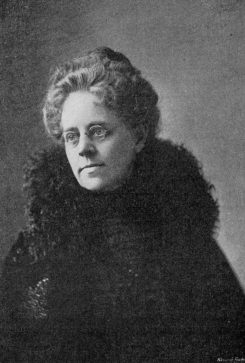
In recent years and months, composer Emma Ashford (who died today in 1930) has received some additional attention online from others who are interested in her background and career.
This article from the Vanderbilt University magazine, discusses several songs that have been written for the university. The section on Ashford's musical contributions (as well as her association with Vanderbilt) is just a few paragraphs down, beginning with her 1900 composition of the music for a song commemorating the 25th anniversary of the university.
More recently, at the end of August this year, an extensive article on Emma Ashford's life and career was published on a blog devoted to reed organs, from where I obtained today's photograph (taken about 1901). This piece contains the most information I have seen on her in one place. Ashford did write several pieces for reed organ, one of which was featured here in 2012.
The video below is a performance of Ashford's anthem Lift up your heads, O ye gates, perhaps her most popular piece which is still sung today. You can find several versions on YouTube but I chose this one by the Washington Performing Arts Society's Children of the Gospel Choir from 2009. Some of the tempos might be peppier than those that Ashford heard in her day but performance practice does change over time and this rendition certainly makes a good case for Ashford's anthem.
As you can hear, the anthem ends with the hymn All hail the power of Jesus' name, to the tune CORONATION (1793), composed by Oliver Holden (whose birthday was just this past Sunday), incorporating the oldest American hymn tune in popular use today.
P.S. - I was pleased to include Ashford's tune EVELYN in the hymn festival I wrote and led last year, matched with a text by Phebe Hanaford on Miriam from the book of Exodus. EVELYN first appeared in the Methodist Hymnal of 1905, but not in any subsequent editions, so who knows when it was sung last?
Eight Years Ago: Emma Ashford
Six Years Ago: Emma Ashford
Four Years Ago: Emma Ashford
Showing posts with label Emma Ashford. Show all posts
Thursday, September 22, 2016
Wednesday, May 6, 2015
Phebe Hanaford
Phebe Hanaford, born today in 1829, was not only the fourth woman ordained in the United States (in the Universalist Church) but was also an author, activist, poet and hymnwriter.
Born into a Quaker family, she was aware from a young age that women in that tradition were allowed to preach during services, but she tried to put those ideas aside when she married Joseph Hanaford in 1849 and agreed to worship in his Baptist church. A few years later she learned that Lucy Stone, a prominent activist for abolition and women's rights, was speaking at a local church. Knowing that her husband would not approve of her attending the lecture, she stayed outside the church but managed to listen anyway.
Following her ordination in 1868, she led churches in the Massachusetts towns of Hingham and Waltham, but when she was called to a Universalist congregation in New Haven, Connecticut, her husband refused to go with her and they separated. Ellen Miles, a Sabbath school teacher in Phebe's Waltham congregation, accompanied her to New Haven and throughout the rest of her long career, often being called the "minister's wife."
Today's hymn, probably written in the 1860s, not long before Phebe decided to pursue ordination, takes its theme from Exodus 15:20-21, the Song of Miriam, which follows the story of the deliverance of the people of Israel from Egypt. It's not quite a paraphrase of that passage, but takes it as a springboard of sorts.
Miriam’s song we’ll echo now,
Singing praises to the Lord;
Who has triumphed gloriously,
Shout the victory of our God!
Sound the timbrel! Loud and high!
Let the song of praise ascend!
Sound the timbrel, far and nigh!
God is our unchanging friend!
When the Red Sea tide o’erwhelmed
Israel’s foes in that great hour
While they sought the promised land,
Then was seen th’Almighty’s power.
Ever thus shall righteousness
Over wrong victorious be,
And the Lord shall be proclaimed
Ruler over land and sea.
Phebe Hanaford. c.1866; alt.
Tune: EVELYN (7.7.7.7.)
Emma L. Ashford, 1905
Poor health and the loss of Ellen Miles, her companion of more than forty years, prevented Phebe from remaining active in her causes in the final years of her life. She was living unhappily with her granddaughter's family in rural upstate New York, far from the cities and organizations she had loved and led. Though she had worked for years in the cause of women's suffrage, there is no evidence in local voting records that she cast a vote in 1920, the first national election following the passage of the Nineteenth Amendment. At age 91, she was unable to travel to the polls on her own. Fortunately, New York State allowed women to vote a few years earlier, and she did take advantage of that limited opportunity.
She died on June 2, 1921, one month after her 92nd birthday, and was buried in an unmarked grave next to her daughter Florence Hanaford Warner. There were some attempts over the years to have a headstone erected for her, but that did not happen until 1998, when the headstone (pictured below) was funded by the Unitarian Universalist Women's Heritage Society.
P.S. - As we were discussing Abraham Lincoln's funeral services two days ago, it should be noted that Hanaford also wrote a hymn for an ecumenical memorial service for the President at the Old South Congregational Church in Reading, Massachusetts. This is the first stanza:
Hushed today are sounds of gladness
From the mountains to the sea;
And the plaintive voice of sadness
Rises, mighty God, to thee.
Combined choirs from the Congregational, Baptist and Universalist churches sang Phebe's hymn to the tune MOUNT VERNON by Lowell Mason (finally, a historical record of a tune!). She later published it in the closing chapter of her best-selling biography of Lincoln.
***UPDATE*** This hymn is now posted on Facebook with words and music together. Go to "Conjubilant W. Song" and click on "Photos" -- it's in the Downloadable Hymns section.
Six Years Ago: Phebe Hanaford
Five Years Ago: Phebe Hanaford
Three Years Ago: Phebe Hanaford
Labels:
abolition,
Baptist,
downloads,
Emma Ashford,
Evelyn (tune),
Facebook,
LGBT,
Lowell Mason,
Mount Vernon (tune),
Phebe Hanaford,
Presidents,
Quaker,
Universalist,
Women of the Bible
Saturday, September 22, 2012
Emma L. Ashford
I have written about Emma Ashford before on this date (see links below), but unfortunately have not unearthed anything new about her since. However, in recent months a few people who are also interested in her work have visited the blog and left comments. (I now get many more readers who are searching for a particular writer or composer than those who are looking for the new material.) One of those commenters has recorded several performances of Ashford's organ compositions and posted them on YouTube.
This is known as Emma Ashford's voluntary on Abide with me (a favorite of many), though of course it's really based on the tune EVENTIDE by composer William H. Monk rather than the text. Chris S. performs it on a reed organ.
I have been having computer problems for a while now which have mostly curtailed posting but I hope to be back soon.
Four Years Ago: Emma L. Ashford
Two Years Ago: Emma L. Ashford
Wednesday, September 22, 2010
Emma L. Ashford
Eighty years ago today, composer Emma Louise Ashford died in Nashville, Tennessee. As described here two years ago, she had written about 600 works for voice, chorus, or organ. Though I have learned little more about her life, I have dug up some brief nuggets of information about some of her compositions.
She first published many of her anthems in the Choir Leader, which was a long-running monthly magazine put out by Edmund S. Lorenz for small-to-medium church choirs (his company remains in business today). A Palm Sunday anthem, Lift up your heads, is still in print, and was released on a 1960 recording by Mahalia Jackson, You'll Never Walk Alone.
In addition to the two hymn tunes that appeared in the 1905 Methodist Hymnal, I've also found a song called Christmas Bells in Triumphant Songs (1890), as well as two older gospel songs, none listed yet at the Cyber Hymnal. I also discovered a reference to her writing tunes for temperance songs, but thus far none of the temperance hymnals I've looked at has anything by Ashford.
I have already used Ashford's tune EVELYN for a few different texts, so today we have the second one from the Methodist Hymnal. This text is from the Unitarian Hymns of the Spirit (1864) which was compiled by Samuel Longfellow and Samuel Johnson, but its author remains obscure.
In every human mind we see
A temple made for Deity,
And righteous thoughts and acts declare
The Holy Spirit's presence there.
The Living God who Moses saw,
Whose pow'r revealed the ancient law,
Within the reason and the will
Makes known God's truth and goodness still.
In every age the hallowed light
Of revelation shines more bright;
Our creeds, like meteors, rise and fall;
Faith, Hope, and Love survive them all.
T. L. Harris, 19th cent.?; alt.
Tune: SUTHERLAND (L.M.)
Emma L. Ashford, 1905
Two Years Ago: More Voices Found: Emma Ashford
Tuesday, July 27, 2010
More Voices Found: Caroline Atherton Mason
The poet Caroline Atherton Mason was born today in 1823 in Marblehead, Massachusetts, a coastal town north of Boston. She and her seven sisters attended the nearby Bradford Academy, where they were collectively nicknamed "the Pleiades."
Caroline began writing at an early age, but her first successful poem, Do they miss me at home?, was published originally in the Salem Register in 1844, the same year she graduated from the Academy. Though the poem was written as the lament of a homesick schoolgirl, it was later set to music by Sidney M. Grannis and became especially popular during the Civil War as a soldier's song.
Savior! in this sacred hour
With thy grace our spirits dower;
Let thine influence from above
Fill our hearts with light and love.
Lo! thy waiting servant stands,
Asking blessings at thy hands;
Saying, "Who shall speak for thee?"
Saying, "Here am I, send me!"
Oh! sustain her, comfort, guide;
Compass her on every side;
Let thy truth inspire her tongue
Ministering thy flock among.
Clothed with thine own pow'r and might,
Make her earnest for the right;
Strong to do and brave to bear,
Ever watching into prayer,
So her ministry shall be
Owned and blessed, dear Christ, of thee;
Souls be giv'n her, and thy name
Have the glory and acclaim.
Caroline Atherton Mason, 1868; alt.
Tune: EVELYN (7.7.7.7.)
Emma L. Ashford, 1905
Her first collection of poetry, Utterance, or Private Voices to the Public Heart, was published in 1852. She also wrote short stories and articles for many journals of the day, as divergent as the St. Nicholas Magazine and the Anti-Slavery Standard. Reportedly she was also a prolific correspondent to local newspapers where her missives were signed "C.A.M.".
In 1868 she was one of six women who wrote hymns for the February 19 ordination and installation services of Universalist minister Phebe Hanaford, the fourth woman ordained in this country. Mason's hymn opened the ordination service in the morning, and was read by the Reverend James Marsden of Abingdon, MA (it's unclear whether it was also sung by the congregation; no record of any tune survives).
Savior! in this sacred hour
With thy grace our spirits dower;
Let thine influence from above
Fill our hearts with light and love.
Lo! thy waiting servant stands,
Asking blessings at thy hands;
Saying, "Who shall speak for thee?"
Saying, "Here am I, send me!"
Oh! sustain her, comfort, guide;
Compass her on every side;
Let thy truth inspire her tongue
Ministering thy flock among.
Clothed with thine own pow'r and might,
Make her earnest for the right;
Strong to do and brave to bear,
Ever watching into prayer,
So her ministry shall be
Owned and blessed, dear Christ, of thee;
Souls be giv'n her, and thy name
Have the glory and acclaim.
Caroline Atherton Mason, 1868; alt.
Tune: EVELYN (7.7.7.7.)
Emma L. Ashford, 1905
Several of Mason's other hymn texts were included in various hymnals, among them the first Harvard University Hymn Book (1895). A year after her death in 1890, her husband Charles Mason published one final collection of her work, The Lost Ring and Other Poems.
Sunday, November 22, 2009
Saint Cecilia
November 22 is the feast day of Saint Cecilia, traditionally the patron saint of music and musicians, and certainly an appropriate subject for this blog. She lived in either the second or third century (accounts differ) and was martyred along with her husband and brother-in-law, whom she had converted to Christianity. Her sainthood was conferred as early as the fifth century, when a church named for her was built in Rome. Her connection to music is also attributed to different stories; one states that she sang a hymn to God in her heart during her wedding ceremony to block out the profane worldly music of the Roman rite, while another tells of her singing boldly while she was martyred (by beheading). She is often depicted playing the organ, with an angel present.
Many pieces of music, particularly sacred choral music, have been written in her honor, including masses by Gounod and Scarlatti, extended odes by Purcell, Britten, Handel, Howells, and Parry, and many shorter works.
Older Catholic hymnals contain a handful of hymns for her feast day, and there are probably untranslated hymns from the Eastern Orthodox churches. This particular one comes from the St. Mark's Hymnal (1910), published by St. Mark's Parish in Peoria, IL. Julia C. Dox, one of the hymnal's compilers, also wrote this text.
Saint Cecilia, you who sing
Praises ever echoing,
Make our hearts your instrument
In God's service ever spent.
E'er to music give your pow'rs
Thus to aid in troubled hours;
Music, the divinest art,
Ever of our lives a part.
Inspiration still it brings,
Earthly words are given wings;
May we sing, when heav'n is won,
Praise to God, great Three in One.
Julia C. Dox, 1910; adapt.
Tune: EVELYN (7.7.7.7.)
Emma L. Ashford, 1905
Today is the last Sunday of the church year -- Advent begins next week! In many churches, today is marked as the Feast (or Solemnity) of Christ the King. But I do know of a few places where they are including one of the choral anthems to Saint Cecilia in addition to the traditional Christ the King music. I wonder what they're singing in Peoria?
One (Liturgical) Year Ago: The Feast of Christ the King
One (Calendar) Year Ago: If Jordan Above Me Shall Roll
Wednesday, March 25, 2009
Godfrey Thring
English hymn writer and hymnal editor Godfrey Thring was born on this day in 1823 in the town of Alford in Somerset. Years later, as an Anglican priest, he would return to the local church as rector for nine years.
In Popular Hymns and Their Writers, by Norman Mable, it's recorded that Thring wrote his first hymn when his mother complained that there were no good texts for a particular tune she liked -- they all required that the last line be repeated three times, which she thought ridiculous. The result of his effort was not mentioned, though presumably he was successful, judging by his further career in hymnody.
Thring published a few volumes of his own hymn texts, and also edited hymnals, most notably A Church of England Hymn-book (1880) which was considered by many hymnologists to contain the most literary collection of hymns available at that time.
Looking at a list of his works, you may discover that in many cases he was only adding a verse or two to someone else's hymn text (see here and here for examples), probably in line with his editorial work. His added verses (as well as many other textual revisions he made to various hymns) have come to be accepted as the "standard" version of those hymns (I should be so lucky).
While I considered each of the two above examples for today's hymn I decided to go with a less-familiar text that at least was entirely by Thring.
All that's good, and great, and true,
All that is and is to be,
Be it old, or be it new,
Comes, Creator, all from thee.
Mercies dawn with every day,
Newer, brighter than before,
And the sun's declining ray
Gathers others up in store.
Every blade and every tree,
All in happy concert ring,
And in wondrous harmony,
Join the cheerful birds to sing.
Far and near, o'er land and sea,
Mountain top and hidden dell,
All, in singing, sing of thee,
Songs of love unquenchable.
Fill us then with love divine,
Grant that we, though toiling here,
May, in spirit being thine,
Know and serve thee everywhere.
May we all with songs of praise,
Here on earth thy name adore,
Till with angel choir we raise
Songs of praise forevermore.
Godfrey Thring, 1874; alt.
Tune: EVELYN (7.7.7.7.)
Emma Ashford, 1905
I have used this tune by Emma Ashford before when writing about her last fall. It suits this text quite well, and as it happens, Ashford's birthday is this Friday, so this is also in celebration of that occasion.
One Year Ago: The Feast of the Annunciation
Subscribe to:
Posts (Atom)


