August 12 is a shared birthday between two prominent hymn tune composers of the Victorian age: Joseph Barnby (1838-1896) and Frederick Arthur Gore Ouseley (1825-.1889). Though I have treated them fairly evenly here on the blog, I admit to a slight preference for Ouseley's tunes, though his reputation faded earlier than Barnby's. Barnby continues to appear in modern hymnals thanks to LAUDES DOMINI, his tune for When morning gilds the skies. The brand-new hymnal of the Christian Reformed Church, Lift Up Your Hearts (2013) and the Presbyterian Church (USA)'s upcoming Glory to God (Fall 2013) both include LAUDES DOMINI.
Today's Barnby tune is much less known, but it seems to me to be a sturdy tune in Common Meter which could be sung today without embarrassment. It's matched here to a text by Isaac Watts based partially on Psalm 119.
God, I have made your Word my choice,
My lasting heritage:
There shall my noblest powers rejoice,
My warmest thoughts engage.
I'll read the histories of your love,
And keep your laws in sight,
While through your promises I rove
With ever-fresh delight.
A broad'ning land of wealth unknown,
Where springs of life arise;
Seeds of immortal bliss are sown,
And hidden glory lies.
Isaac Watts, 1719; alt.
Tune: POWER (C.M.)
Joseph Barnby, 1869
The names of Barnby's tunes were probably not all assigned by the composer. This happened because many of his tunes first appeared in The Hymnary (1872) where they were identified by numbers rather than by names, even though Barnby was the musical editor (the book is often referred to as Barnby's Hymnary). Perhaps he didn't think proper names for hymn tunes as significant as many of his contemporaries did, or perhaps he found himself with too many new tunes to name and a fast-approaching deadline. When those tunes were subsequently used in later hymnals, their names were probably invented by the editors of those books, which is why some of his tunes are known by more than one name.
P.S.: The portrait of Barnby above with his conductors' baton is by the artist John Wallace Knowles, and was retained by Barnby's descendants for nearly a century before being donated to a museum.
Five Years Ago: Joseph Barnby
Four Years Ago: Frederick A. Gore Ouseley
Three Years Ago: Joseph Barnby
One Year Ago: Frederick A. Gore Ouseley
Another Birthday Today: Katharine Lee Bates
 Composer and conductor Joseph Barnby (pictured here at work, on a Victorian postcard) was born today in 1838. His father was an organist, which led to his early training on that instrument. Young Joseph also sang in the cathedral choir at York Minster beginning at age seven.
in 1854 he went to study at the Royal College of Music, and two years later was one of nineteen applicants for the first Mendelssohn Scholarship in England. Unfortunately, he came in second to Arthur Sullivan. After graduation, he held organist and music director positions as well as teaching positions at Eton College and the Guildhall School of Music.In 1867 he began as the conductor of a group that became known as "Barnby's Choir." In 1872 that group combined with another choir started by Charles Gounod and became the Royal Albert Hall Choral Society, which still sings today. Barnby conducted the first English performances of several important works, including the Stabat Mater of Dvorak (1883) and Wagner's last opera Parsifal (1884), and earlier, the first English church performance of Bach's St. Matthew Passion at Westminster Abbey in 1871.As noted here before, Barnby wrote several anthems and other sacred choral works (his oratorio Rebekah is now downloadable at the Sibley Music Library site) and 246 hymn tunes. collected in one volume after his death in 1896 (and mostly unknown today). The 1978 Lutheran Book of Worship is perhaps the most recent hymnal to contain as many as six of his tunes (someone on that committee must have liked Barnby!); these days, if a hymnal has any of his tunes at all, this is the most likely one.When morning gilds the skies
My heart awaking cries:
May Jesus Christ be praised!
When evening shadows fall,
Then rings my curfew call,
May Jesus Christ be praised!
When mirth for music longs,
This is my song of songs:
May Jesus Christ be praised!
God's holy house of prayer
Has none that can compare
With: Jesus Christ be praised!
No lovelier antiphon
In all high heav’n is known
Than, Jesus Christ be praised!
There to the eternal Word
The eternal psalm is heard:
May Jesus Christ be praised!
All ye of humankind,
In this your concord find,
May Jesus Christ be praised!
Let all the earth around
Ring joyous with the sound,
May Jesus Christ be praised!
Sing, suns and stars of space,
Sing, ye that see God's face,
Sing, Jesus Christ be praised!
God’s whole creation o’er,
For aye and evermore
Shall Jesus Christ be praised!
Katholisches Gesangbuch, 1828;
tr. Robert Bridges, 1899; alt.
Tune: LAUDES DOMINI (6.6.6.6.6.6.)
Joseph Barnby, 1868
This quintessential "summer hymn" is sung in many different churches across denominations, though they may be singing different translations. The text, published in German in fourteen stanzas (by one account) is now thought to be older than 1828, though I'm not sure it has been specifically traced to any earlier hymnbook. Edward Caswall translated it for his collection The Masque of Mary (1858) and this version later made its way into Hymns Ancient and Modern, where Barnby's tune, written specifically for Caswall's text, appeared in the first Supplement of 1868.
Caswall's last stanza may be the most familiar to many:
Be this, while life is mine,
My canticle divine:
May Jesus Christ be praised!
Sing this th'eternal song
Through all the ages long:
May Jesus Christ be praised!Today's version, however, is a translation by Robert Bridges (later the poet laureate of England)which appeared in his Yattendon Hymnal (1899), and in several other hymnals since. Some hymnals even combine stanzas from both translations, which works of course because both are written in the same meter and thus can be sung to the same tune. Unfortunately, none of the major online hymn sites have sufficiently separated the two versions so that you can easily see Caswall's whole translation and Bridges' whole translation.Two Years Ago: Sir Joseph BarnbyOne Year Ago: Sir Frederick A. Gore Ouseley
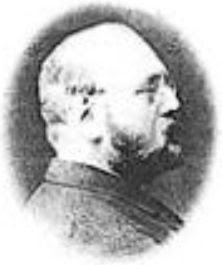 Joseph Barnby (born August 12, 1838) was another Victorian church musician and composer who started his career at an esrly age. At 7 he sang in the choir at York Minster, and at 12 he was already an organist and choirmaster. Later educated at the Royal College of Music, he went on to hold several organist and conductor positions in London. He was knighted in 1892 for his contributions to British music. His compositions include several anthems (one available at the Sibley Music Library site, settings of the evening canticles (one can be found at the Choral Public Domain Library), an oratorio (Rebekah) and a cantata (The Lord is King), as well as many secular partsongs.He edited at least five hymnals, including The Hymnary (1872) and The Home and School Hymnal (1894). Naturally, many of his own hymn tunes found their way into these hymnals, but his tunes were very popular for nearly fifty years, appearing in nearly all the hymnals published in Britain and the US during that time. After his death in 1896, a collection of Barnby's 246 hymn tunes was published (the Cyber Hymnal lists only 58).Here at the blog we have already heard his ST. ANSELM. His tune SARUM was for many years the preferred tune for For all the saints, appearing in many hymnals until SINE NOMINE by Ralph Vaughan Williams became more popular. The same thing happened to most of his tunes as the Victorians fell out of favor with hymnal editors in the mid- twentieth century. His only tune that remains in somewhat wide use is LAUDES DOMINI, for When morning gilds the skies.
This one also remains in some (maybe only Episcopal?) hymnals.Now the day is over,Night is drawing nigh,Shadows of the eveningSteal across the sky.Jesus, give the wearyCalm and sweet repose;With thy tenderest blessingMay mine eyelids close.Grant to little childrenVisions bright of thee;Guard the sailors tossingOn the deep, blue sea.Through the long night watchesMay thine angels spreadTheir bright wings above me,Watching round my bed.When the morning wakens,Then may I arisePure, and fresh, and sinlessIn thy holy eyes.Sabine Baring-Gould, 1867Tune: MERRIAL (6.5.6.5.)Joseph Barnby, 1868This is an somewhat unique tune in that the melody, usually important, is not all that interesting. This hymn really requires the participation of a choir, or at least a congregation that will sing the four-part harmony to have its full effect. Baring-Gould, author of the text, had written a tune of his own for it, called EUDOXIA, but it's Barnby's tune that prevailed.This is another of those Victorian children's hymns that have come to be used in general worship, though it's borderline twee, with the "sailors tossing on the deep, blue sea." Another verse I left out (the original second):Now the darkness gathers,Stars begin to peep,Birds, and beasts and flowersSoon will be asleep.Practically Walt Disney, with the sleeping flowers and the peeping stars.


