Showing posts with label Edward Caswall. Show all posts
Sunday, November 22, 2015
Saint Cecilia
November 22 marks the commemoration of the patron saint of music, Saint Cecilia, in some places. Her connection to music is perhaps a bit more tenuous than some of the legends which have sprung up around her would suggest, but it is that connection which is most remembered today.
Oh, let the organ swell the lay,
In honor of this festive day;
Let earth's harmonious choirs proclaim
Cecilia's ever-blessed name.
Rome gave the virgin martyr birth,
Whose holy skill has filled the earth,
And from the early dawn of youth,
She fixed herself on song and truth.
Then, from the world's bewild'ring strife,
In peace she spent her holy life,
Teaching the organ to combine
With voice, to praise the Lamb divine.
Cecilia, with a two-fold crown
Adorned in heav'n, we pray, look down,
Upon us exiled here below,
On earth your music here bestow.
Charles Constantine Pise, 1851; alt.
Tune: EASTWICK (L.M.)
T. Tertius Noble, 1900
I believe the "two-fold crown" refers to her standing as both virgin and martyr.
The Reverend Charles Pise, an American, was ordained in the Roman Catholic Church in 1825 and served parishes in Washington DC and Brooklyn. He was also the first Catholic chaplain of the US Senate who served for a term. This hymn was first published when added to an American edition of Edward Caswall's Lyra Catholica in 1851.
P.S. One of the most unusual tributes to Cecilia was recorded by the Andrews Sisters during World War II: The Shrine of St. Cecilia, which can be heard on YouTube.
Seven Years Ago: If Jordan Above Me Shall Roll
Six Years Ago: Saint Cecilia
Five Years Ago: Successive Cecilias
Seven (Liturgical) Years Ago: The Feast of Christ the King
Five (Liturgical) Years Ago: The Feast of Christ the King
Three (Liturgical) Years Ago: The Feast of Christ the King
Sunday, March 3, 2013
Healers, Prophets All
Today's hymn continues on the theme on "non-Lent" Lenten hymns. There is a contemporary movement afoot in some places to emphasize the life of Jesus as an example to us during this season, rather than a focus on fasting and penitence and the unworthiness of sinners. However, most well'known Lenten hymns are in that second column.
This text is an adaptation, even perhaps might be called a renovation of this older text often used during Lent and Holy Week. I with an editorial collaborator took it apart and reassembled it in a different way, but it still feels like a Lenten hymn in some ways, and the tune remains familiar to many, though much of the original text is no longer present.
Glory be to Jesus,
Who, in Galilee,
Spoke of love and justice,
Truth to make us free.
Grace and hope eternal
In Christ's life we find;
Blest be his compassion,
Infinitely kind.
Blest through endless ages,
Is that voice, so clear,
Challenging oppression,
Prejudice and fear.
Let us pledge together,
Answering Christ's call;
Let us be like Jesus,
Healers, prophets all.
Let us lift our voice,
Joined with saints above,
Louder still and louder
Praising Jesus' love.
Italian, 1815;
tr. Edward Caswall, 1857
adapt. J.M. & C.W.S., 1990
Tune: WEM IN LEIDENSTAGEN (6.5.6.5.)
Friedrich Filitz, 1847
Thursday, December 27, 2012
Saint John the Evangelist
Today is the feast day of Saint John the Evangelist, one of the twelve disciples (perhaps the "beloved disciple") and author of three Epistles and one Gospel. Throughout much of Christian history he was also believed to be the author of the Book of Revelation during his exile to the Greek island of Patmos.. Though this is now believed by some scholars to be unlikely, it is the subject of today's hymn by the seventeenth-century French priest Nicolas le Tourneaux.
An exile for the faith,
Of his incarnate Lord,
With eagle gaze beyond the stars
The loved disciple soared.
There the new City, bathed
In clear celestial light,
The home of bliss his sprit saw,
The land that hath no night.
There heard through highest heav'n
The Alleluia sound,
The great Amen that ever rolls
Th'eternal throne around.
O grant us, Christ, with John
Into these courts to gaze,
To see the rainbow 'round thy throne
And hear those songs of praise.
Nicolas le Tourneaux, 1686
tr. Edward Caswall, 1849; alt.
Tune: ADVENT (S.M.)
John Goss, 1872 Today is also the birthday of composer John Goss (December 27, 1800 - May 10, 1880), an eminent English church musician of the Victorian age who trained several other composers of the following generations.
Four Years Ago: Saint John the Evangelist
Four Years Ago: Sir John Goss
Three Years Ago: Saint John the Evangelist
Sunday, July 22, 2012
Saint Mary Magdalene
I have written before about Mary Magdalene on the occasion of her feast day today (as usual, you can check the links below), and about the scholarly confusion that has ensued over the years over just which "Mary" we're reading about at various points in the Gospels.
Not everyone agrees that the woman in Luke 7:36-38 is Mary Magdalene, though she often has been depicted as that woman in art and literature, as well as in today's hymn. However, I decided to use this hymn text because it does go on to recount her witness to Jesus' crucifixion (when most of the disciples were in hiding). And then I couldn't resist an addition of my own: a stanza honoring her role as "apostle to the apostles" on Easter morning. This is an ancient concept which seems to have been (mostly) forgotten for a few centuries but is more often recognized in modern hymnody about Mary Magdalene.
The original Latin text was written by Cardinal Bellamine, probably in the fourteenth century, and used as an office hymn for this day ever since. It begins:
Pater superni luminis,
Cum Magdalenam respicis,
Flammas amoris excitas,
Geluque solvis pectoris.
The English translation, constructed in the same meter by Edward Caswall (whose birthday I missed last week) may have first appeared in Lyra Catholica (1851), a prominent book of ancient Latin texts translated into English.
Creator blest! one glance of thine,
Whose eyes the Universe control,
Fills Magdalene with holy love,
And melts the ice within her soul.
Her precious ointment forth she brings,
Upon Christ's sacred feet to pour;
She washes them with humble tears;
And with her hair she wipes them o'er.
Impassioned to the Cross she clings:
Nor fears beside the tomb to stay;
Nought for its ruffian guard she cares,
For love has cast all fear away.
The morning breaks: He calls her name,
The pow'rs of death could not prevail;
She hastes to tell the fearful twelve,
First to proclaim the glorious tale.
O Christ, thou very Love itself!
Blest hope of earth, through thee forgiv'n!
So touch our spirits from above,
That we may rise to thee in heav'n.
Riccardo Bellarmine, ca. 14th cent.;
tr: Edward Caswall, 1851; alt. (st. 4 C.W.S.)
Tune: PIXHAM (L.M.)
Horatio W. Parker, 1901
If you don't think that the ancient office hymns should be disturbed, feel free to leave out the fourth stanza, but it seems to me that the Cardinal could have included the idea. However, for many years the primary educational value of Mary Magdalene was considered to be the story of the reformation of a "fallen woman."
P.S. - The statue above is South German in origin, by an unknown fifteenth-century artist, and currently in the collection of The Cloisters, a renowned museum in New York City. It caught my eye because one of the stained glass windows in my church (depicting the Presentation) is also from the fifteenth century and was supposedly loaned to and on display at The Cloisters for several years in the 1930s and/or 40s.
Four Years Ago: Saint Mary Magdalene
Three Years Ago: Emily E. S. Elliott
Two Years Ago: Saint Mary Magdalene
Wednesday, February 22, 2012
Ash Wednesday
All those who seek a comfort sure
In trouble and distress,
Whatever sorrows stir the mind,Or guilt the soul oppress,
Jesus, who gave himself for you
Upon the cross to die,
Opens to you his sacred heart;
O, to that heart draw nigh.
We hear how kindly he invites;
We hear his words so blest;
“All those that labor come to me,
And I will give you rest.”
O Jesus, Joy of saints on high,
And Hope of pilgrims here,
Attracted by those loving words
To you we lift our prayer.
That grace may ever flow;
A new and loving heart on all
Who cry to you bestow.
Text: Latin, 18th cent; tr. Edward Caswall, 1849; alt.
Tune: BANGOR (C.M.)
William Tans'ur, 1734
At church tonight we had a choir of 57. I'm not sure there were that many people out in the pews. But another Lent is upon us.

Four (Liturgical) Years Ago: Christ, who throughout these forty days
Three (Calendar) Years Ago: Sarah Flower Adams
Three (Liturgical) Years Ago: Awhile in spirit, Christ, to thee
Two (Liturgical) Years Ago: O Christ, whose tender mercy hears
Sunday, October 10, 2010
Thrice Holy Fount, Thrice Holy Fire

One of the oldest hymns of the Holy Spirit, Veni Creator Spiritus, comes down to us from the ninth century. It's a prayer that begins:
Veni, Creator Spiritus,
mentes tuorum visita,
imple superna gratia
quae tu creasti pectora.
The Latin text is now generally attributed to the German monk Rhabanus Maurus, a scholar and author, and later the bishop of Mainz, though in earlier times it was sometimes credited to the Emperor Charlemagne. Rhabanus wrote a fair amount of poetry, though one source claimed that he was "a skillful versifier, but a mediocre poet." Still, this text has survived to the present day, often sung at ordinations, confirmations, and of course at Pentecost.
Martin Luther translated it into German in 1524 as Komm, Gott Schopfer, heiliger Geist. It was first translated into English in 1549, when it was added to the Anglican Book of Common Prayer, where it began:
Come Holy Ghost, eternal God,
Proceeding from above,
Both with the Father and the Son,
The God of peace and love.
Since then there have been more than sixty English translations. Among the best-known are:
Come, Holy Ghost, our souls inspire, (1627) by John Cosin
Creator Spirit by whose aid, (1693) by John Dryden
Come, Holy Ghost, Creator blest, (1877) by Edward Caswall (and others)
Today's hymn is a later adaptation of the Dryden text, in four-line rather than six-line stanzas.
Creator Spirit, by whose aid
The world’s foundations first were laid,
Come, visit every pious mind;
Come, pour thy joys on humankind;
Plenteous of grace, descend from high,
Rich in thy sev'nfold energy,
From sin, and sorrow set us free;
And make us temples worthy thee.
Heal and refine our earthly parts;
But, oh, inflame and fire our hearts!
O'er all may we victorious be
That stands between ourselves and thee.
Thrice holy Fount, thrice holy Fire,
Our hearts with heav’nly love inspire;
Make us eternal truths receive,
And practice all that we believe.
Rhabanus Maurus, 9th cent.;
tr. John Dryden, 1693; adapt.
Tune: BALM (L.M.)
William B. Bradbury, 19th cent.
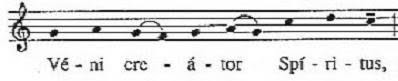
Of course, for most of its existence, Veni Creator Spiritus was sung to plainsong chant (even up to the present), and some of the English translations have also used that melody, partially pictured here.

But plainsong was not always in fashion in many places over the last thousand years, so other tunes have been used too. This particular tune I discovered this week, in preparation for the birthday of William B. Bradbury (which was October 6, and I never finished writing it). I like it because it would seem to have great potential in the hands of a skillful musician; it builds in intensity and reaches its peak in the cascading notes of the last line. It seems made for a text like this one, which is a prayer of supplication.
Two Years Ago: Samuel Johnson
Friday, August 20, 2010
Bernard of Clairvaux
The French monk who became known as Bernard of Clairvaux was born into a noble family in 1091, near Dijon, and died on August 20, 1153 (hence his commemoration today).As a young man he was a soldier, but left the military with 30 others, including his brothers, and joined a monastery at Citeaux. A few years later he was asked to go and found another monastery, which he named Clairvaux. During the course of his life he was involved with the founding of 163 communities across Europe.
His surviving writings became part of the theology of the Catholic Church. He was especially devoted to the Virgin Mary, and helped formulate much of the doctrine around her. He was canonized in 1174 by Pope Alexander III, only about twenty years after his death.
Bernard was much admired during the Reformation as well; both Martin Luther and John Calvin thought he embodied the best of the Catholic faith. Today, some of the poetry of Bernard is sung in many churches, several hymns excerpted from longer poems, a few of which we have seen here on the blog. Today's hymn is part of a longer one, Jesu, Rex admirabilis, translated by Edward Caswall in 1849.
O Jesus, Light of all below,
Great Fount of life and fire,
Surpassing all the joys we know,
And all we can desire!
Thy wondrous mercies are untold,
Through each returning day;
Thy love exceeds a thousandfold,
Whatever we can say.
May every heart confess thy Name;
And ever thee adore;
And seeking thee, itself inflame,
To seek thee more and more.
Thus may our tongues forever bless;
Thee may we love alone;
And ever in our lives express
The image of thine own.
Bernard of Clairvaux, 12th cent.
tr. Edward Caswall, 1849
Tune: ST. LEONARD (C.M.)
Henry T. Smart, 1867
P.S. The painting above is a portion of The Vision of St. Bernard by Fra Bartolomeo (1504), currently in the Uffizi Gallery in Florence.
Two Years Ago: Bernard of Clairvaux
Thursday, August 12, 2010
Sir Joseph Barnby
Composer and conductor Joseph Barnby (pictured here at work, on a Victorian postcard) was born today in 1838. His father was an organist, which led to his early training on that instrument. Young Joseph also sang in the cathedral choir at York Minster beginning at age seven.in 1854 he went to study at the Royal College of Music, and two years later was one of nineteen applicants for the first Mendelssohn Scholarship in England. Unfortunately, he came in second to Arthur Sullivan. After graduation, he held organist and music director positions as well as teaching positions at Eton College and the Guildhall School of Music.
In 1867 he began as the conductor of a group that became known as "Barnby's Choir." In 1872 that group combined with another choir started by Charles Gounod and became the Royal Albert Hall Choral Society, which still sings today. Barnby conducted the first English performances of several important works, including the Stabat Mater of Dvorak (1883) and Wagner's last opera Parsifal (1884), and earlier, the first English church performance of Bach's St. Matthew Passion at Westminster Abbey in 1871.
As noted here before, Barnby wrote several anthems and other sacred choral works (his oratorio Rebekah is now downloadable at the Sibley Music Library site) and 246 hymn tunes. collected in one volume after his death in 1896 (and mostly unknown today). The 1978 Lutheran Book of Worship is perhaps the most recent hymnal to contain as many as six of his tunes (someone on that committee must have liked Barnby!); these days, if a hymnal has any of his tunes at all, this is the most likely one.
When morning gilds the skies
My heart awaking cries:
May Jesus Christ be praised!
When evening shadows fall,
Then rings my curfew call,
May Jesus Christ be praised!
When mirth for music longs,
This is my song of songs:
May Jesus Christ be praised!
God's holy house of prayer
Has none that can compare
With: Jesus Christ be praised!
No lovelier antiphon
In all high heav’n is known
Than, Jesus Christ be praised!
There to the eternal Word
The eternal psalm is heard:
May Jesus Christ be praised!
All ye of humankind,
In this your concord find,
May Jesus Christ be praised!
Let all the earth around
Ring joyous with the sound,
May Jesus Christ be praised!
Sing, suns and stars of space,
Sing, ye that see God's face,
Sing, Jesus Christ be praised!
God’s whole creation o’er,
For aye and evermore
Shall Jesus Christ be praised!
Katholisches Gesangbuch, 1828;
tr. Robert Bridges, 1899; alt.
Tune: LAUDES DOMINI (6.6.6.6.6.6.)
Joseph Barnby, 1868
This quintessential "summer hymn" is sung in many different churches across denominations, though they may be singing different translations. The text, published in German in fourteen stanzas (by one account) is now thought to be older than 1828, though I'm not sure it has been specifically traced to any earlier hymnbook. Edward Caswall translated it for his collection The Masque of Mary (1858) and this version later made its way into Hymns Ancient and Modern, where Barnby's tune, written specifically for Caswall's text, appeared in the first Supplement of 1868.
Caswall's last stanza may be the most familiar to many:
Be this, while life is mine,
My canticle divine:
May Jesus Christ be praised!
Sing this th'eternal song
Through all the ages long:
May Jesus Christ be praised!
Today's version, however, is a translation by Robert Bridges (later the poet laureate of England)which appeared in his Yattendon Hymnal (1899), and in several other hymnals since. Some hymnals even combine stanzas from both translations, which works of course because both are written in the same meter and thus can be sung to the same tune. Unfortunately, none of the major online hymn sites have sufficiently separated the two versions so that you can easily see Caswall's whole translation and Bridges' whole translation.
Two Years Ago: Sir Joseph Barnby
One Year Ago: Sir Frederick A. Gore Ouseley
Sunday, May 23, 2010
The Feast of Pentecost
The Feast of Pentecost is the third great day in the church calendar, after Christmas and Easter, celebrating the arrival of the Holy Spirit sent by Jesus ten days after his ascension. The story is told in the second chapter of Acts, of the sound of a great wind, the tongues of flame descending on the gathered disciples, and the miracle of understanding that was granted so that everyone suddenly knew the many languages of those around them.The reason that people from so many different lands were in Jerusalem on that day is that it was already a Jewish holiday, the Festival of Weeks, or Shavu'ot, which occurs fifty days after the Passover. Similarly, Pentecost is generally considered to be fifty days after Easter, if you count Easter Sunday itself. If you don't, then it's forty-nine days, or "seven times seven," as in this Latin hymn (Jam Christus astra ascenderat) by Ambrose of Milan, Bishop of Rome during the fourth century.
Above the starry spheres,
To where he was before,
Christ had gone up, a promised gift
Upon the earth to pour.
At length had fully come,
On mystic circle borne
Of sev'n times sev'n revolving days,
The Pentecostal morn.
When, as the apostles knelt
At the third hour in prayer,
A sudden rushing sound proclaimed
The Holy Spirit there.
Forthwith a tongue of fire
Is seen on every brow,
Each heart receives the Spirit’s light,
The Word’s enkindling glow.
This gracious gift on all
Is mightily outpoured,
Who straight in diverse tongues declare
The wonders of the Lord.
While strangers of all climes
Flock round from far and near,
And their own tongue, wherever born,
All with amazement hear.
But some are faithless still --
Deny the hand divine;
And, mocking, jeer the saints of Christ
As full of new-made wine.
Till Peter, in their midst,
By Joel’s ancient word,
Rebukes their unbelief, and wins
The souls of all who heard.
So may that pow'r as then,
Descend to us today
That rushing wind, that fire of God,
Enflame our souls, we pray;
Creator and the Christ
And Spirit we adore,
O may the Spirit’s gifts be poured
On us forevermore.
Ambrose of Milan, 4th cent.
tr. Edward Caswall, 1849; alt.
Tune: FAIRFIELD (S.M.D.)
Peter LaTrobe, 19th cent.
The Pentecost painting above is by Josef Ignaz Mildorfer, an eighteenth century artist from Germany. Some artistic depictions of the scene are rather staid, showing the disciples calmly sitting around a table, but it seems to me that things would have been rather more chaotic, as this painting suggests.
Two Years Ago: The Feast of Pentecost
One Year Ago: The Feast of Pentecost
Thursday, March 25, 2010
The Feast of the Annunciation
The Feast of the Annunciation is celebrated today in many churches, commemorating the appearance of the angel Gabriel to Mary to give her the surprising news of her impending pregnancy (as told in Luke 1:26-38). It's nine months to Christmas! Some churches have moved that particular lesson into the season of Advent, while some will mark it on both occasions. The hymn chosen here is not well known today, though it was one of the office hymns of the church as far back as the sixth century. The Latin text by Venantius Fortunatus was originally sung to plainchant but was also set to music by various composers, such as William Byrd. It begins:
Quem terra, pontus, aethera
colunt, adorant, praedicant,
trinam regentem machinam
claustrum Mariae baiulat.
colunt, adorant, praedicant,
trinam regentem machinam
claustrum Mariae baiulat.
This comes to us in English from Edward Caswall, published in his Hymns and Poems Original and Translated (1873).
Our God, whom earth and air and sea
With one adoring voice resound;
Who rules them all in majesty;
In Mary's heart a cloister found.
Lo! in a humble virgin's womb,
O'ershadowed by Almighty power;
God whom the stars and sun and moon,
Each serve in their appointed hour.
O Mary blest, to whom was giv'n
Within thy compass to contain
The Architect of earth and heav'n,
Whose hands the universe contain;
To thee was sent an angel down;
In thee the Spirit was enshrined;
From thee came forth the Mighty One,
The long-desired of humankind.
O Jesus, born of Mary bright,
Unending praise we sing to thee,
To the Creator infinite,
And Holy Spirit: wondrous Three.
Venantius Fortunatus, 6th cent.
tr. Edward Caswall, 1873; alt.
Tune: SHARON (L.M.)
Frederick A. Gore Ouseley, 1875
John Mason Neale translated this Latin text in his Hymnal Noted (1854) as The God whom earth and sea and sky, and his version (somewhat altered) is still in the Episcopal Hymnal 1982 but I liked Caswall's version better. Neale already gets plenty of exposure.
P.S. The window above with Mary and Gabriel is from the Lady chapel of my own church, older than the ones seen here before.
Two Years Ago: The Feast of the Annunciation
One Year Ago: Godfrey Thring
Wednesday, January 6, 2010
The Feast of the Epiphany
The Feast of the Epiphany, now observed twelve days after Christmas, is in fact the older of the two observances. As early as the fourth century, this day was marked to celebrate the Incarnation, including the Nativity, the visit of the three magi, the baptism of Christ in the Jordan, and even the anniversary of Jesus's first miracle at Cana. Now, of course, we've broken those all up into different occasions, with Christmas overshadowing them all.The season of Epiphany retained the other observances of the Incarnation, those examples of Christ showing his divine nature to the world around him, leaving the date of January 6 for the story of the sages from the East (but signifying the nations of the world) following a brilliant star which guided them to the wondrous birth in Bethlehem.
This particular hymn also dates from the fourth century, though it was not a part of the Catholic Epiphany liturgy until 1570, following the Council of Trent. Marcus Aurelius Clemens Prudentius only became a Christian poet late in life, after careers as a lawyer and judge. This text (O sola magnarum urbium) begins at line 77 of a much longer work, Quicumque Christum quaeritis. It has been translated into English several times; this one is based on a version by Edward Caswall, altered by the editors of Hymns Ancient and Modern in 1861 (where it was first matched to this tune).
Earth has many a noble city;
Bethlehem, thou dost all excel;
Out of thee the Christ from heaven
Came to rule o'er Israel.
Fairer than the sun at morning
Was the star that told his birth,
To the world its God announcing
Seen in fleshly form on earth.
Eastern sages at his cradle
Make oblations rich and rare;
See them give, in deep devotion,
Gold and frankincense and myrrh.
Sacred gifts of mystic meaning:
Incense doth their God disclose,
Gold the promised reign proclaimeth,
Myrrh his sepulcher foreshows.
Jesus, whom the nations worshipped
At thy glad Epiphany,
Unto Thee, with the Creator
And the Spirit, glory be.
Aurelius Prudentius, 4th cent.
tr. Edward Caswall, 1849; alt.
Tune: STUTTGART (8.7.8.7.)
Psalmodia Sacra; 1715
adapt. Henry J. Gauntlett, 1861
One Year Ago: We Too May Seek That Cradle
Wednesday, July 15, 2009
Edward Caswall
Sometimes it seems like all the Anglican hymnwriters followed the Oxford Movement in the 1840s, left the Church of England and became Roman Catholics. It wasn't quite that many, but a number of prominent ones did. Today we mark the birthday of yet another of these, Edward Caswall.Caswall was born in 1815 in Hampshire, the son and grandson of Anglican chergymen. Educated at Oxford, where he would have become familiar with the writings and ideas of John Henry Newman, he was ordained a deacon after graduation and went on to become the perpetual curate at Stratford-sub-Castle, near Salisbury.
However, in 1846 he converted to Roman Catholicism, and following the death of his wife a few years later, he became a priest at the Roman Oratory of St. Philip Neri, where Newman was the leader. He wrote several hymn texts of his own, some of which remain in use (primarily in Catholic hymnals) but it is his translations from Latin texts that are more widely known (some of which we have already seen here).
Jesus, the very thought of thee
With sweetness fills the breast;
But sweeter far thy face to see,
And in thy presence rest.
Nor voice can sing, nor heart can frame,
Nor can the memory find
A sweeter sound than thy blest Name,
Savior of humankind!
O hope of every contrite heart,
O joy of all the meek,
To those who fall, how kind thou art!
How good to those who seek!
But what to those who find? Ah, this
Nor tongue nor pen can show;
The love of Jesus, what it is,
All of Christ's loved ones know.
O Jesus, thou the beauty art
Of angel worlds above;
Thy Name is music to the heart,
Inflaming it with love.
Jesus, our only joy be thou,
As thou our prize will be;
Jesus, be thou our glory now,
And through eternity.
Bernard of Clairvaux, 12th c.;
tr. Edward Caswall, 1849; alt.
Tune: CLAIRVAUX (C.M.)
Herman A. Polack, 1910
There are several more verses, but most hymnals only use four or five. Bernard of Clairvaux we have encountered before. The ubiquitous tune ST. AGNES, by John Bacchus Dykes, is most often used with this text, but see how you like CLAIRVAUX, an American tune written specifically for these words.
Wednesday, January 28, 2009
Saint Thomas Aquinas
Thomas Aquinas, commemorated on this day, was born in 1224 or 1225, and at the age of five was sent by his parents to live in a Benedictine monastery, where they hoped he would follow in the footsteps of his uncle, the monastery's abbot. This didn't work out for his family, as he eventually became a Dominican friar instead. They had him abducted and imprisoned for two years, trying to convince him to renounce the Dominican order, but without success.In adulthood, Aquinas became a prominent theologian and philosopher, his reputation continuing into the present day. Fifty years after his death on March 7, 1274, he was proclaimed a saint by Pope John XXII. Subsequent popes have declared that the theology of Aquinas is considered definitive for the Roman Catholic Church.
In addition to his many theological works, he wrote many Latin hymns that have been translated by different poets over the years. Some of the most well known have become part of the Catholic liturgy, such as this one, the Latin O salutaris Hostia.
O saving Victim, open wide
The gate of heaven to us below;
Our foes press on from every side;
Thine aid supply; thy strength bestow.
All praise and thanks to thee ascend
Forevermore, blest One in Three;
O grant us life that shall not end
In our true native land with thee.
Thomas Aquinas, 13th c.;
tr. Edward Caswall,1849, and others
Tune: HEREFORD (L.M.)
Samuel Sebastian Wesley, 1872
This short hymn is the final section of a longer text, Verbum supernum prodiens, and is sung during the rite of Benediction of the Blessed Sacrament, celebrated in the Roman Catholic church, the Western Rite Orthodox Church, and in some Anglo-Catholic Episcopal/Anglican churches.
Another Aquinas hymn, the Tantum ergo, is also sung during Benediction of the Blessed Sacrament. At my own church, Benediction is celebrated a few times a year during Evensong services. The congregation sings O salutaris Hostia (as the hymn above), followed by a choral setting of the Tantum ergo. I sometimes wonder about reversing them; having a choral setting of the O Salutaris (of which there are many) and a metrical hymn version of the Tantum ergo, but we never do it that way. There may well be some arcane liturgical rule about why not.
At YouTube you can hear one of the Tantum ergo settings we have sung, by Gabriel Faure, performed by a choir of men and boys (we do a standard four-part arrangement, with tenor solo instead of boy soprano).
Saturday, February 2, 2008
The Feast of the Presentation
O Zion, open wide thy gates,
As we with thanks draw near;
A Source and Savior both in one,
The Truth Himself is here.
Aware of hidden Deity
The joyful Mary brings
Her newborn babe, with two young doves,
Her humble offerings.
The aged Simeon sees at last
This promise long-desired,
And Anna welcomes Israel's hope,
With holy rapture fired.
"This is the light prepared to shine
Upon the lands of earth;
This, Israel's glory evermore,
Salvation's blessed birth!"
But silent knelt the mother blest
Of the yet-silent Word,
And pond'ring all things in her heart,
With speechless praise adored.
Jean de Santeuil, 1680
tr. Edward Caswall, 1849; alt.
Tune: THIS ENDRIS NYGHT (C.M.)
There are other hymns for this day (though not a great many), but of course I'd choose the one that includes both Simeon AND Anna, from the passages in the Gospel of Luke.
Subscribe to:
Posts (Atom)