Showing posts with label Martin Luther. Show all posts
Thursday, November 10, 2016
Martin Luther
From the great reformer Martin Luther (November 10, 1483 - February 18, 1546), a hymn asking for the intervention of the Holy Spirit to bring us clarity and strength that we may persevere in the right:
Come, Holy Spirit, God and Lord!
Let all your graces be outpoured
On each believer’s mind and heart;
Your fervent love to us impart;
And by the brightness of your light,
In holy faith all folk unite
Of every land and every tongue;
This to your praise, O God, be sung.
From every error keep us free;
Let none but Christ our Teacher be,
That we in living faith abide,
In Christ with all our might confide.
O holy Fire, our Comfort true,
Grant us the will your work to do
And in your service to abide,
Let trials turn us not aside.
And by your power prepare each heart,
Unto our weakness strength impart,
That bravely here we may contend,
Through life and death to you ascend.
Martin Luther, 1524;
tr. Catherine Winkworth, 1855, and others
Tune: DAS NEUGEBORNE KINDELEIN (L.M.)
Melchior Vulpius, 1609;
harm. Johann Sebastian Bach, 1724
Eight Years Ago: Martin Luther
Seven Years Ago: Martin Luther
Sunday, March 27, 2016
The Sun That Warms and Lights Us
Christ Jesus lay in death’s strong bands,
For our offenses given;
But now at God’s right hand he stands,
And brings us life from heaven.
Wherefore let us joyful be,
And sing to God right thankfully
Loud songs of Alleluia! Alleluia!
It was a strange and dreadful strife
When life and death contended;
The victory remained with life;
The reign of death was ended.
Stripped of power, no more it reigns,
An empty form alone remains
Death’s sting is lost forever! Alleluia!
So let us keep the festival
Where to our God invites us;
Christ is himself the joy of all,
The sun that warms and lights us.
By his grace he doth impart
Eternal sunshine to the heart;
The night of death is ended! Alleluia!
Then let us feast this Easter day
On the true Bread of heaven;
The Word of grace hath purged away
The old, forgotten leaven.
Christ alone our souls will feed,
Who is our meat and drink indeed;
Faith lives upon no other! Alleluia!
Martin Luther, 1524; tr. Richard Massie, 1854; alt.
Tune: CHRIST LAG IN TODESBANDEN (8.7.8.7.7.8.7. with Alleluia)
Martin Luther, 1524; harm. J. S. Bach, 1724
Seven (Liturgical) Years Ago: Christ is risen! Alleluia!
Seven (Calendar) Years Ago: George Matheson
Six (Liturgical) Years Ago: The strife is o'er, the battle done
Six (Calendar) Years Ago: George Job Elvey
Five (Calendar) Years Ago: George Matheson
Four (Liturgical) Years Ago: Jesus Christ is risen today
Three (Liturgical) Years Ago: Lift your voice rejoicing, Mary
Another Birthday Today: Emma Ashford
Tuesday, December 29, 2015
But Mary's Arms Contain Thee Now (Day Five)
All praise to thee, O Jesus Christ,
Clothed in a garb of flesh and blood;
Choosing a manger for thy throne,
While worlds on worlds are thine alone.
Once did the skies before thee bow;
But Mary’s arms contain thee now,
While angels, who in thee rejoice,
Now listen for thine infant voice.
A little child, thou art our guest,
That weary ones in thee may rest;
Humble and lowly is thy birth;
That we may rise to heav'n from earth.
Thou comest in the lonely night
To make us children of the light;
To make us, in the realms divine,
Like thine own angels round thee shine.
All this for us thy love hath done;
By this to thee our love is won;
For this we tune our cheerful lays,
And sing our thanks in ceaseless praise.
Martin Luther, 1535; tr. anonymous, 1858; alt.
Tune: MAINZER (L.M.)
Joseph Mainzer, 1845
This translation of Gelobet seist du, Jesu Christ by Martin Luther first appeared anonymously in the Sabbath Hymn Book (1858), published in Massachusetts by Lowell Mason's firm. Though found in 88 (mostly American) hymnals at the Hymnary.org site, only two of those appear to be Lutheran collections. Lutheran editors seem to have preferred another translation, All praise to Jesus' hallowed name, by Richard Massie, from his collection titled Martin Luther's Spiritual Songs (1854).
I like this one better, even as a former Lutheran.
P.S. The art above is from a larger painting, William-Adolphe Bouguereau's Song of the Angels (1881)
Six Years Ago: Go, tell it on the mountain
Wednesday, February 2, 2011
The Feast of the Presentation
We come round again to our fourth Feast of the Presentation here at the blog. The story is told in Luke 2:22-40, how Jesus was brought to the temple forty days after his birth, there to be recognized by Anna and Simeon as the fulfillment of ancient prophecy.
The Song of Simeon, which begins in verse 29, also known as the Nunc dimittis, has been a part of Christian liturgy for hundreds of years. It is often sung in various musical settings, but today's version was set as a hymn by Martin Luther, and adapted from a translation by Catherine Winkworth.
In peace and joy I now depart,
According to thy will;
For full of comfort is my heart,
So calm and still.
For thou in mercy unto all
Hast set this Savior forth;
To Christ's dominion thou dost call
The whole wide earth.
Christ is the Hope, the saving Light,
That earthly nations need,
And those who know thee now aright
Will teach and lead.
Martin Luther, 16th cent.
tr. Catherine Winkworth, 1869; adapt.
Tune: WREFORD (8.6.8.4.)
Edmund S. Carter, 1874
In peace and joy I now depart,
According to thy will;
For full of comfort is my heart,
So calm and still.
For thou in mercy unto all
Hast set this Savior forth;
To Christ's dominion thou dost call
The whole wide earth.
Christ is the Hope, the saving Light,
That earthly nations need,
And those who know thee now aright
Will teach and lead.
Martin Luther, 16th cent.
tr. Catherine Winkworth, 1869; adapt.
Tune: WREFORD (8.6.8.4.)
Edmund S. Carter, 1874
The weather in many parts of the country today has probably cancelled many midweek observances of the day (including ours here in CT) but here you have four hymns for the occasion to consider without going outside in the cold.
Three Years Ago: O Zion, open wide thy gates
Two Years Ago: Hail to the Lord who comes
One Year Ago: O Jerusalem beloved
Sunday, January 16, 2011
As Christ, the Morning Star
The Epiphany season continues in many churches, with lessons about Christ revealing his glory to the world. The image of Jesus as the Morning Star comes from Revelation 22:16, and we know it from another popular hymn often sung during this season. This text is even earlier, and still appears in Lutheran hymnals.
The Savior sent from heaven,
Foretold by ancient seers,
By our Creator given,
In human form appears.
No sphere his light confining,
No star so brightly shining,
As Christ, our Morning Star.
O time of God appointed,
O bright and holy morn!
The Sovereign One anointed,
The Christ, the virgin-born,
Grim death to vanquish for us,
To open heav'n before us,
And bring us life again.
Awaken now our spirit
To know and love you more,
In faith to stand unshaken,
In spirit to adore,
That we, through this world moving,
Each glimpse of heaven proving,
May reap in fullness there.
Creator, here before you,
With God the Holy Ghost,
And Jesus, we adore you,
O pride of angel-host.
Before you mortals lowly
Cry "Holy, Holy, Holy,"
Eternal Trinity!
Elizabeth Cruciger, 1524
tr. Arthur Tozer Russell, 1851; alt.
Tune: MEIN FREUD (7.6.7.6.7.7.6.)
Erfurt Enchiridion, 1524
Elizabeth Cruciger was the first Lutheran woman to write hymns. Born around 1500, she married Caspar Cruciger, a student of Martin Luther whom Luther encouraged and helped in various ways. Elizabeth also became a friend of Luther's wife Katherine. This text appeared in the Enchiridion, published in Erfurt in 1524, one of the first Protestant hymnals, and Luther later included it in some of his own hymn collections. It was first translated into English by Arthur Tozer Russell in his Psalms and Hymns (1851), an Anglican hymnbook.
The tune was selected by Cruciger hersself, but it was based on an older German folk tune often matched with the secular text Mein Freud mocht such wohl mehren. Like many other chorale melodies set down in the Enchiridion, it was used by Johann Sebastian Bach in some of his cantatas and organ works.
Two Years Ago: Wisdom eternal, brooding o'er creation
The Savior sent from heaven,
Foretold by ancient seers,
By our Creator given,
In human form appears.
No sphere his light confining,
No star so brightly shining,
As Christ, our Morning Star.
O time of God appointed,
O bright and holy morn!
The Sovereign One anointed,
The Christ, the virgin-born,
Grim death to vanquish for us,
To open heav'n before us,
And bring us life again.
Awaken now our spirit
To know and love you more,
In faith to stand unshaken,
In spirit to adore,
That we, through this world moving,
Each glimpse of heaven proving,
May reap in fullness there.
Creator, here before you,
With God the Holy Ghost,
And Jesus, we adore you,
O pride of angel-host.
Before you mortals lowly
Cry "Holy, Holy, Holy,"
Eternal Trinity!
Elizabeth Cruciger, 1524
tr. Arthur Tozer Russell, 1851; alt.
Tune: MEIN FREUD (7.6.7.6.7.7.6.)
Erfurt Enchiridion, 1524
Elizabeth Cruciger was the first Lutheran woman to write hymns. Born around 1500, she married Caspar Cruciger, a student of Martin Luther whom Luther encouraged and helped in various ways. Elizabeth also became a friend of Luther's wife Katherine. This text appeared in the Enchiridion, published in Erfurt in 1524, one of the first Protestant hymnals, and Luther later included it in some of his own hymn collections. It was first translated into English by Arthur Tozer Russell in his Psalms and Hymns (1851), an Anglican hymnbook.
The tune was selected by Cruciger hersself, but it was based on an older German folk tune often matched with the secular text Mein Freud mocht such wohl mehren. Like many other chorale melodies set down in the Enchiridion, it was used by Johann Sebastian Bach in some of his cantatas and organ works.
Two Years Ago: Wisdom eternal, brooding o'er creation
Sunday, October 10, 2010
Thrice Holy Fount, Thrice Holy Fire

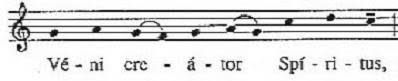
One of the oldest hymns of the Holy Spirit, Veni Creator Spiritus, comes down to us from the ninth century. It's a prayer that begins:
Veni, Creator Spiritus,
mentes tuorum visita,
imple superna gratia
quae tu creasti pectora.
The Latin text is now generally attributed to the German monk Rhabanus Maurus, a scholar and author, and later the bishop of Mainz, though in earlier times it was sometimes credited to the Emperor Charlemagne. Rhabanus wrote a fair amount of poetry, though one source claimed that he was "a skillful versifier, but a mediocre poet." Still, this text has survived to the present day, often sung at ordinations, confirmations, and of course at Pentecost.
Martin Luther translated it into German in 1524 as Komm, Gott Schopfer, heiliger Geist. It was first translated into English in 1549, when it was added to the Anglican Book of Common Prayer, where it began:
Come Holy Ghost, eternal God,
Proceeding from above,
Both with the Father and the Son,
The God of peace and love.
Since then there have been more than sixty English translations. Among the best-known are:
Come, Holy Ghost, our souls inspire, (1627) by John Cosin
Creator Spirit by whose aid, (1693) by John Dryden
Come, Holy Ghost, Creator blest, (1877) by Edward Caswall (and others)
Today's hymn is a later adaptation of the Dryden text, in four-line rather than six-line stanzas.
Creator Spirit, by whose aid
The world’s foundations first were laid,
Come, visit every pious mind;
Come, pour thy joys on humankind;
Plenteous of grace, descend from high,
Rich in thy sev'nfold energy,
From sin, and sorrow set us free;
And make us temples worthy thee.
Heal and refine our earthly parts;
But, oh, inflame and fire our hearts!
O'er all may we victorious be
That stands between ourselves and thee.
Thrice holy Fount, thrice holy Fire,
Our hearts with heav’nly love inspire;
Make us eternal truths receive,
And practice all that we believe.
Rhabanus Maurus, 9th cent.;
tr. John Dryden, 1693; adapt.
Tune: BALM (L.M.)
William B. Bradbury, 19th cent.
Of course, for most of its existence, Veni Creator Spiritus was sung to plainsong chant (even up to the present), and some of the English translations have also used that melody, partially pictured here.

But plainsong was not always in fashion in many places over the last thousand years, so other tunes have been used too. This particular tune I discovered this week, in preparation for the birthday of William B. Bradbury (which was October 6, and I never finished writing it). I like it because it would seem to have great potential in the hands of a skillful musician; it builds in intensity and reaches its peak in the cascading notes of the last line. It seems made for a text like this one, which is a prayer of supplication.
Two Years Ago: Samuel Johnson
Tuesday, June 1, 2010
Henry Francis Lyte
Henry Francis Lyte was born today in 1793, near the Scottish village of Kelso. His father deserted the family when Lyte was a boy, and his mother died shortly after. Young Henry was at the time attending Portora Royal School in Ireland, and the headmaster there adopted him unofficially.
Following Portora he studied at Trinity College in Dublin and was ordained in the Church of England in 1815. After serving at a few other country parishes he settled in Lower Brixham in 1823, where he was employed at All Saints Church until poor health forced his retirement in 1844.
Lyte is primarily remembered for his two most popular hymns, Abide with me and Praise, my soul, the King of heaven, though he wrote several others. That latter hymn first appeared in a collection by Lyte called Spirit of the Psalms (1834) which contained 65 psalm paraphrases, many of which were subsequently used in various hymnals. In the introduction to the book, he wrote: Poetry and music are never better employed than when they unite in the celebration of the praises of God. The first edition of the book was published anonymously, but it proved very successful, and Lyte eventually took credit for it. His paraphrases were compared favorably to those of Isaac Watts written a hundred years earlier, though they are not much known today.
This is Lyte's version of Psalm 46. One reason it is not generally sung today is that there is a much more familiar hymn based on that psalm, if one is called for.
God is our Refuge, tried and proved
Amid a stormy world;
We will not fear though earth be moved
And hills to ocean hurled.
The waves may roar, the mountains shake,
Our comfort shall not cease;
For God the world will not forsake,
And God will give us peace.
A gentle stream of hope and love
To us shall ever flow;
It issues from God's throne above,
And cheers the saints below.
When earth and hell against us came,
God spoke, and quelled their powers;
Eternal God is still the same,
The God of grace is ours.
Henry Francis Lyte, 1830; alt.
Tune: SINAI (C.M.)
Joseph Barnby, 19th cent.
Two Years Ago: Henry Francis Lyte
Tuesday, November 10, 2009
Martin Luther

German reformer Martin Luther (November 10, 1483 - February 18, 1546) was born in the town of Eisleben. In college, at the University of Erfurt, he studied many subjects, even law briefly, but eventually entered the Augustinian friary in Erfurt and became a monk.
His conflicts with the Catholic Church are better documented elsewhere, but it's useful to remember that theological disputes in his time were not polite exchanges across dueling dissertations or magazine articles. When he refused to recant his Ninety-Five Theses, which had been declared heretical by church authorities in Germany and in Rome, the Holy Roman Emperor Charles V presided at a trial in 1521 (the Diet of Wurms) which pronounced him an outlaw, subject to arrest. Luther's writings were banned and it was now a crime for anyone to give him food or shelter. Fortunately he still had influential friends; Frederick III of Saxony had him taken to Wartburg Castle, where he remained in protective custody for a year. It was during this time that he translated the New Testament from Latin to German. He remained committed to bringing religious practice into the language of his people, both through his translation of Scripture (eventually completed after his Wartburg stay and updated frequently until his death) and his hymns in German, meant to be sung by the congregation.
This hymn of Luther's may not be particularly well known, even to Lutherans, but it caught my eye because I had been looking at All Saints' Day hymns last week. In 1523, two Augustinian monks, were arrested and tried for heresy in Brussels and were burned at the stake. Luther was incensed by the actions of the Inquisition and inspired by the martyrdom of the monks. He must have thought that the same fate could have come upon him.
Flung to the heedless winds,
Or on the waters cast,
The martyrs’ ashes, watched,
Shall gathered be at last.
And from that scattered dust,
Around us and abroad,
Shall spring a plenteous seed,
Of witnesses for God.
Their loving God received,
Their latest living breath,
And vain is any boast
Of victory in their death.
Still, still, though dead, they speak,
And, trumpet-tongued, proclaim,
To many a wakening land,
The one availing Name.
Martin Luther, 1523
tr, John A, Messenger, 1843: alt.
Tune: MARIA JUNG UND ZART (6.6.6.6.)
Geistliche Kirchengesäng, 1623
One Year Ago: Martin Luther
Sunday, May 10, 2009
Frances E. Cox
Frances Elizabeth Cox was born at Oxford on this day in 1812. Almost nothing is known about her life, but her translations of German hymns have survived and continue to be sung today.Congregational hymn singing in Germany was part of their worship long before the practice took hold in England. Yet German hymns were nearly unknown in England until the middle of the nineteenth century, except for some that had been translated by John Wesley. Catherine Winkworth would come to be the most prolific translator, but others such as Frances Cox made their contribution.
In 1841, Cox published Sacred Hymns from the German, containing 49 translated hymns. Her second volume, 23 years later, Hymns from the German, contained many of those 49 with an additional 29. Julian's Dictionary of Hymnology says that there were a few other translations published in magazines that appeared in neither collection.
It seems that everyone who ever translated a German hymn took a crack at Martin Luther's Ein feste burg. Cox's translation begins:
A Fortress firm and steadfast Rock
Is God in time of danger
A Shield and Sword in every shock
From foe well-known or stranger.
Two of Cox's translations we have already seen here: one for Easter and one of my favorite hymns, for All Saints' Day. This one is, I suspect, more widely known in various denominations.
Sing praise to God who reigns above,
The God of all creation,
The God of power, the God of love,
The God of our salvation;
With healing balm my soul is filled,
And every faithless murmur stilled:
To God all praise and glory.
What such almighty power hath made,
God's gracious mercy keepeth;
By morning glow or evening shade
God's watchful eye ne'er sleepeth.
Within the realm of God's delight,
Lo! all is just and all is right:
To God all praise and glory.
For God is never far away,
But through all grief distressing,
An ever present help and stay,
Our peace and joy and blessing.
As with a mother's tender hand,
God gently leads the pilgrim band:
To God all praise and glory.
Then all my toilsome way along
I sing aloud God's praises,
That all may hear the grateful song
My voice unwearied raises:
Be joyful in the Lord, my heart!
Both soul and body bear your part!
To God all praise and glory.
O ye who name Christ's holy name
Give God all praise and glory;
Let all who know God's power proclaim
Aloud the wondrous story!
Cast each false idol from its throne,
And worship God, and God alone!
To God all praise and glory.
Johann J. Schutz, 1675
tr. Frances E. Cox, 1864; alt.
Tune: MIT FREUDEN ZART (8.7.8.7.8.8.7.)
Bohemian Brethren Kirchegesang, 1566
This hymn by the Lutheran Johann Schutz was originally in eight verses, though most hymnals print only four or five. One that is rarely seen:
I cried to God in my distress --
In mercy, hear my calling!
My Maker saw my helplessness
And kept my feet from falling;
For this, Lord, thanks and praise to thee
Praise God, I say, praise God with me!
To God all praise and glory.
The tune, MIT FREUDEN ZART, may have been traced back to a medieval French secular song, Une pastourelle gentille, though the more martial setting we know today seems a little heavy for a French shepherd girl.
Thursday, March 12, 2009
Paul Gerhardt
Paul Gerhardt (March 12, 1607 - June 7, 1676) was the first significant Lutheran hymnwriter after Martin Luther. Born in Germany near Wittenburg, he studied theology at the university there for several years during the Thirty Years War. He began writing verse a few years after leaving his studies. His first eight hymns were published by Johann Cruger in his hymnal Praxis Pietatis Melica (1647). In 1651 Gerhardt was ordained in the Lutheran church and served several congregations. In Berlin, religious tensions were so high that pastors were forbidden by law to refer to doctrinal differences in their sermons. Gerhardt refused to comply and was dismissed from his job there.
In succeeding editions of Cruger's hymnal, more and more of Gerhardt's hymns were published. His hymns were known for their personal testimony and connection to Lutheran theology, as opposed to Luther's more doctrinal texts. Eventually he wrote more than 130 and many of them are still known today (not only in Lutheran churches). He also translated Latin hymns into German, the most well known being O sacred head, sore wounded.
Give to the winds your fears,
Hope and be undismayed.
God hears your sighs and counts your tears,
God shall lift up your head.
Through waves and clouds and storms,
God gently clears the way;
Wait for God's time; at last shall come
The perfect, promised day.
Still heavy is your heart?
Still sinks your spirit down?
Cast off the weight, let fear depart
And every care begone.
God everywhere has sway
And all things serve the right;
God's every act pure blessing is,
God's path life-giving light.
Far, far above all thought,
God's counsel shall appear,
When fully God the work has wrought,
That caused your needless fear.
Leave to God's sovereign will
To choose and to command;
With wonder filled, you then shall own
How wise, how strong God's hand.
Paul Gerhardt, 1656;
tr. John Wesley, 1737; alt.
Tune: DIADEMATA (S.M.D.)
George J. Elvey, 1868
P.S. For more on John Wesley (and his brother Charles), go back to March 3 for a "new" entry that I started on that day but didn't finish due to illness. Spent a few days in bed last week with bronchitis but I did want to get back to the Wesleys again at some point. (and there's a very important hymn!)
One Year Ago: Gregory the Great
Friday, January 2, 2009
Elizabeth Rundle Charles
Elizabeth Rundle Charles (January 2, 1828 - March 28, 1896) was a popular author in Victorian England. Nicholas Smith, in Songs From the Hearts of Women (1903) writes that her books "covered a wide field, including fiction, travels, history, biography, general religious literature, translations from the Latin, Greek, Swedish, and German languages, poetry, and hymnology." Though she was an Anglican by birth, her interests and her education pursued broader Christian themes. One of her greatest successes was a novel (published anonymously) about Martin Luther and the Reformation, The Chronicles of the Schönberg-Cotta Family (1863); many of her other books were published as "by the author of" that novel, such as the one pictured above, Christian Life in England in the Olden Time (1866).
She translated hymns from several languages (and therefore several denominations), many of them appearing in The Voice of Christian Life in Song (1859). She writes in the introduction of that book:
"It is trusted that the treasures of sacred song, faintly reflected in these translations, may serve to illustrate that unity of faith which binds one age to another through the Communion of Saints."
Her translated hymns seem to have survived into modern times better than her original ones (e.g., three to none in the Episcopal Hymnal 1982), but I find her original texts very intriguing, such as this one.
Around a table, not a tomb,
Christ willed our gathering place to be;
When, going to prepare our home,
Our Savior said,"Remember me."
We kneel around no sculptured stone,
To mark the place where Jesus lay;
Empty the tomb, the angels gone,
The stone forever rolled away.
No, sculptured stones are for the dead!
The three sad days of death are o'er;
Thou art the Life, our living Head,
Our living Light forevermore!
Thus round thy table, not thy tomb,
We keep the sacred feast with thee;
Until within our promised home
Our endless gathering place shall be.
Elizabeth Rundle Charles, 1862; alt.
Tune: HERONGATE (L.M.)
English traditional melody;
arr. Ralph Vaughan Williams, 1906
Probably one reason I like Charles is that she also wrote verse and prose about the women of the Bible. I've talked before about how so many of those women went unnamed, perhaps due to the unconscious sexism of the time the scriptures were written. In Songs Old and New (1887), she advances a different theory in this excerpt from her poem The Unnamed Women:
He would not have the sullied name
Once fondly spoken in a home,
A mark for strangers' righteous blame,
Branded through every age to come.
And thus we only speak of them
As those on whom His mercies meet --
"She whom the Lord would not condemn,"
And "She who bathed with tears His feet"
I don't actually agree with her (the motive is still somewhat sexist, though chivalrous instead of unthinking) but the theory is interesting nonetheless.
Monday, November 10, 2008
Martin Luther
Today is the birthday of Martin Luther, German theologian and reformer who rebelled against the abuses of the medieval Catholic Church and (the legend goes) began the Protestant Reformation by nailing his Ninety-Five Theses to a church door in Wittenburg.You can read many more learned articles on Luther and his historic and theological importance than I could provide, so I'll confine myself to his hymns.
Luther had some musical training in his youth and played both the lute and the flute. He composed many of the tunes sung with his hymn texts, which numbered about three dozen and were published intermittently during his lifetime. Since each of his hymns have been translated into other languages numerous times, it sometimes seems that there are many more.
This is undoubtedly his most famous hymn (taken partially from Psalm 46) sung across nearly all Christian denominations -- even Catholic hymnals include it now -- and 1t also has its own separate Wikipedia entry.
A mighty fortress is our God,
A bulwark never failing;
Our helper 'mid the raging flood
Of mortal ills prevailing:
For still our ancient foe
Doth seek to work us woe;
With craft and power great,
And, armed with cruel hate,
On earth is not an equal.
Did we in our own strength confide,
Our striving would be losing;
Were not the right one on our side,
The One of God’s own choosing:
Dost ask who that may be?
Christ Jesus, verily;
Anointed One by name,
From age to age the same,
And Christ shall win the battle.
And though this world, with devils filled,
Should threaten to undo us,
We will not fear, for God hath willed
The truth to triumph through us:
The powers of evil grim,
We tremble not for them;
Their rage we can endure,
For lo, their doom is sure,
One little word shall fell them.
That word above all earthly powers,
No thanks to them, abideth;
The Spirit and the gifts are ours
Through God who with us sideth:
Let goods and kindred go,
This mortal life also;
The body they may kill:
God’s truth abideth still,
This truth shall last forever.
Martin Luther, 1529; tr. Frederick F. Hedge, 1853; alt.
Tune: EIN FESTE BURG (8.7.8.7.6.6.6.6.7.)
Martin Luther, 1529
This is the version most familiar to American singers. There are reportedly more than seventy different translations from Luther's German text into English, though most of them are not regularly sung. A popular translation used in the UK is by Thomas Carlyle:
A safe stronghold our God is still
Industrious translator Catherine Winkworth contributed
A sure stronghold our God is he
Henry J. Buckoll took a crack at it:
A tower of strength our God doth stand
and Richard Robinson Whittingham gave us
A mountain fastness is our God
Elizabeth Wordsworth (daughter of hymnwriter Christopher Wordsworth) translated it as
God is a stronghold and a tower
and Godfrey Thring, writer of many hymn texts, came up with
A fortress sure is God our King
These seven were all nineteenth century translations, developed to meet a growing demand for hymns -- editors probably wanted unique translations for their new hymnals before the Hedge and Carlyle versions became the standards. Supposedly there are ten times as many more out there! And that's not counting the many translations into other languages (click on the flags).
Sunday, October 5, 2008
Joined With All the Glad and Good

O thou whose gracious presence shone,
A light to bless all humankind,
To thee we fondly turn again
As to a friend that we have known.
Thy grace and truth, thy life that shed
Undying radiance through all time,
Thy tender love, thy faith steadfast,
Remembering these, we break the bread.
And lo! again we seem to hear
Thy blessing on the loaf and cup,
The presence that was given then
Again to loving hearts brought near.
Our humble lives, thus touching thine,
Are joined with all the glad and good,
In truer, nobler unity
That lifts the world to realms divine.
Marion Franklin Ham, 1912; alt.
Tune: BROMLEY (L.M.)
Jeremiah Clarke, 1700
Marion Franklin Ham (1867 - 1956) was a Unitarian minister who served churches from Texas to Massachusetts. He shares a February 18 birthday with a more prominent hymnwriter, Martin Luther.
It may seem unusual for a communion hymn to come from a Unitarian origin, but most Unitarian and Universalist hymnals of the past did contain a section of such hymns. Even today the rite is still practiced in some UU churches, though it's controversial in many others.
Subscribe to:
Comments (Atom)