When I survey the wondrous cross
On which the Prince of Glory died,
My richest gain I count but loss,
And pour contempt on all my pride.
See from his head, his hands, his feet,
Sorrow and love flow mingled down!
Did e’er such love and sorrow meet,
Or thorns compose so rich a crown?
Were the whole realm of nature mine,
That were an off'ring far too small;
Love so amazing, so divine,
Demands my soul, my life, my all.
Isaac Watts, 1707
Tune: ROCKINGHAM (L.M.)
Edward Miller, 1790(#2 in The Best Church Hymns of 1899 and still fairly high on most lists today)Two Years Ago: Good FridayOne Year Ago: Good Friday
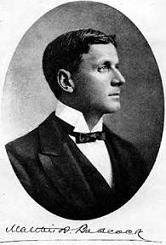 Maltbie Davenport Babcock (August 3, 1858 - May 18, 1901) was a popular Presbyterian minister. Born in Syracuse, NY, he graduated from Syracuse University and Auburn Theological Seminary. Following his graduation in 1882, he became the pastor of the First Presbyterian Church of Lockport, NY (where they still remember him on their website). From 1887 to 1900 he was senior minister at Brown Memorial Presbyterian Church in Baltimore. During this period he became renowned for his preaching and his commitment to social issues.
He was called to lead the prestigious Brick Presbyterian Church in New York City in 1900, where he succeeded Henry Van Dyke. Unfortunately, his tenure there was short; he became ill during a Mediterranean cruise and died in Naples.
Following his death, his wife Katherine published a collection of his poems with excerpts from his sermons, articles, and letters called Thoughts for Everyday Living (1902). Some of the poems were then set to music in various hymnals, including this one.
As e'er the sun sinks to its rest,
Its golden glories thrilling me,
And voiceless longings stir my breast,
Then teach me, God, to worship thee.
And when the stars — the daylight fled —
In serried, shining ranks I see,
Filling the splendid vault o’erhead,
Then teach me, God, to worship thee.
Or if in solemn forest shades
The calm of nature steals o’er me,
And silence all my soul pervades,
Then teach me, God, to worship thee.
Not in the sacred shrines alone,
Which chime their summons unto me,
Would I look upward to thy throne,
But everywhere would worship thee.
Maltbie D. Babcock, 1901; alt.
Tune: ROCKINGHAM (L.M.)
arr. Edward Miller, 1790Like many of his poems, this one shows Babcock's love of nature; his wife recalled the long walks he would take along Lake Ontario when they lived in Lockport. His most famous hymn, This is my Father's world, excerpted from a longer poem, also sings the praises of God in nature.One Year Ago: Where cross the crowded ways of life
 Philip Doddridge, the Nonconformist preacher and professor who trained at least two hundred men in ministry at his own academy, was born today in 1702. He admired the hymns of Isaac Watts, whom he later met and befriended. Later in life, having written many hymns of his own, Doddridge wrote that he was but one of the many lamps "kindled at Watts' torch."
I think the most interesting thing about Doddridge is that he wrote his hymns to be sung immediately following his sermons; he apparently wrote them at the same time, using the same scripture verses as the theme. How many modern ministers would find it a useful discipline to write both a sermon and a hymn illustrating that sermon each week?My God, thy table now is spread,
Thy cup with love doth overflow;
Be all thy children thither led,
And let them thy sweet mercies know.
O, let thy table honored be,
And furnished well with joyful guests;
And may each soul salvation see
That here its sacred pledges tastes.
Drawn by thy quick'ning grace, O Lord,
In countless numbers let them come;
And gather from their Savior's board
The Bread that lives beyond the tomb.
Nor let thy spreading Gospel rest
Till through the world thy truth has run;
Till with this Bread all those be blest
Who see the light, or feel the sun.
Philip Doddridge, 1755; alt.
Tune: ROCKINGHAM (L.M.)
arr. Edward Muller, 1790 This hymn has undergone many changes over the years; though it still reads a bit old-fashioned to us, it has in fact been "modernized" from Doddridge's original, which began:My God, and is thy table spread?And does thy cup with love o'erflow?Somewhere along the way an editor decided to make the opening lines declarative rather than questioning (though Doddridge was certainly not questioning - he knew the answer was "yes").The tune ROCKINGHAM, familiar and used in many hymnals, appeared in Edward Muller's Psalms of David (1790). He adapted the tune from an earlier one called TUNBRIDGE, which appeared in another psalter tune book about ten years earlier. The relationship between the tunes was apparently revealed in 1909 in The Musical Times, which reproduced the page from Miller's copy of the earlier book containing TUNBRIDGE, with his notation "would make a good long m.[eter tune]."P.S. The illustration above is the frontispiece of a book by Doddridge, described as "the Author, supported by Faith and Piety, accompanied by Benevolence."One Year Ago: Philip Doddridge