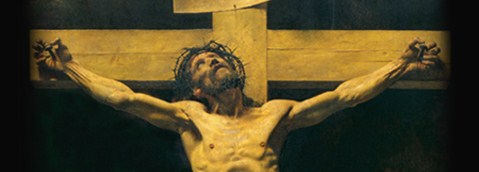
Showing posts with label Holy Week. Show all posts

Saturday, April 20, 2019

Gleams of Eternity Appear


As another Holy Week comes to a close...

Sunset to sunrise changes now,
For God has made the world anew;
On the Redeemer's thorn-crowned brow,
The wonders of that world we view.

E'en though the sun withholds its light
Lo! a more heav'nly lamp shines here,
And from the cross, on Calvary's height,
Gleams of eternity appear.

Here in o'erwhelming final strife
The Lord of Life has victory,
And sin is slain, and death brings life,
And earth inherits heaven's key.

Clement of Alexandria, 3rd cent.;
para. Howard Chandler Robbins, 20th. cent.; alt.
Tune: KEDRON (L.M.)
attrib. Elkanah Kelsay Dare, 19th cent.

Saint Clement of Alexandria (c.150-c.215) was originally Titus Flavius Clemens, a Greek theologian and a convert to Christianity who became the intellectual leader of the Christian community in Alexandria. His sainthood was revoked by the Roman Catholic Church in the sixteenth century, but he remains revered in Anglicanism, as well as the Coptic and Ethiopian branches of Christianity.

Howard Chandler Robbins (1876-1952) was ordained to the Episcopal priesthood in 1904 and served parishes in New York and New Jersey before serving as dean of the Cathedral of St. John the Divine in Manhattan from 1917-1929. Following that position, he became a professor at the (Episcopal) General Theological Seminary. He was a member and was eventually made a Fellow of the Hymn Society of America, as well as a member of the Society of Mayflower Descendants. He served on the committee that produced the Episcopal Hymnal 1916, and several of his hymns (including today's paraphrase) appear in the subsequent Hymnal 1940. My own particular favorite of his hymns is Put forth, O God, thy Spirit's might, for which he also composed the tune CHELSEA SQUARE, one of the finest tunes of the twentieth-century, in my opinion.

One of the earliest published American composers, Elkanah Kelsay Dare (1782-1826), was also a Presbyterian minister who was pastor of the Union Presbyterian Church in Colerain Township (now Kirkwood), Pennsylvania (his middle name is sometimes given as Kelsey). His ten hymn tunes appeared in the Repository of Sacred Music, Part Second (1813) edited by John Wyeth.  (The most well-known tune that also appeared in that volume is NETTLETON, which everyone here has undoubtedly sung.)


P.S. - While putting this entry together, it occurred to me that the tune ST. CLEMENT is also a Long Meter tune, so I tried to match this text with that Anglican tune (suggestive of the original author) but sadly the word stresses don't line up correctly. And anyway, it appears that KEDRON is the only tune used for this text in the thirteen hymnals where it appears, as documented at Hymnary.org, so, OK.


Eleven (Liturgical) Years Ago: O sorrow deep

Ten (Liturgical) Years Ago: All the sacrifice is ended

NIne
(Liturgical) Years Ago: When Jesus was convicted


Three (Liturgical) Years Ago: Resting from his work today

Friday, April 14, 2017

Good Friday


In the cross of Christ I glory,
Speechless stand through endless time;
As the grandeur of the story
Fills my heart with joy sublime.

By the cross of Christ my feeling
Overflows in boundless praise
For the love that is so healing,
For the bliss of coming days.

Near the cross of Christ I never
Lose my faith, or conscience still,
But with greater zeal than ever
I go forth to do thy will.,

All my hope, my pain, my pleasure
Through the cross are glorified,
Be of all my only measure,
Near to thee I would abide.

Simon N. Patten, 1916
Tune: RATHBUN  (8.7.8.7.)
Ithamar Conkey, 1849

This re-writing of the familiar text In the cross of Christ I glory is from Advent Songs (1916), by Simon Nelson Patten (1852-1922), who was an economist by trade but a hymnwriter by avocation. Subtitled A Revision of Old Hymns to Meet Modern Needs, Patten's collection provides new texts, many of them rewrites or at least suggestive of previous texts, as in this case, the original by John Bowring.

From Patten's introduction to Advent Songs, this passage may apply more directly to this particular revision, where he talks about the need for new texts to replace the old:

In the epoch of suffering, the vision was of another world with its protection, peace, and rest. Today we see the future clearly. We need a Christ more than ever, but (...) to build and not to relieve. Charity is displaced by cooperation, the physician by the architect, the hospital by the park.

Perhaps needless to say, the contemporaneous reviews of Advent Songs that I've seen were not altogether favorable, but Patten had touched on something that would flower into a broader movement in the coming years, and a century later his ideas might still be somewhat relevant to the hymnwriters of today.

The tune RATHBUN, by Ithamar Conkey (1815-1867), generally matched with Bowring's In the cross... was not used by Patten but I have restored it here.  The tune was named for Mrs. Beriah S. Rathbun, a faithful soprano in the choir of the Central Baptist Church of Norwich, CT, where Conkey was the organist for some years.


Eight (Liturgical) Years Ago: There is a green hill far away

Seven (Liturgical) Years Ago: Ah, holy Jesus, how hast thou offended?

Six (Liturgical) Years Ago: When I survey the wondrous cross

Five (Liturgical) Years Ago: Were you there when they crucified my Lord?


Four (Liturgical) Years Ago: On a hill far away

One (Liturgical) Year Ago: Beneath the shadow of the cross


Thursday, April 13, 2017

Maundy Thursday


When th'apostles with their Friend,
One last supper would attend,
Then his parting word he said,
Blessed the cup and broke the bread,
"This, where'er you do or see,
Evermore remember me."

Years have passed, in every clime,
Changing with the changing time,
Still the sacred table spread,
Flowing cup and broken bread,
With that parting word agree:
"Drink and eat, remember me."

When, in this thanksgiving feast,
We would give to God our best,
Then, O Friend of humankind,
Make us true and firm of mind;
Pure of heart, in spirit free,
Thus may we remember thee.

Arthur Penrhyn Stanley, 1878; adapt.
Tune: ARFON (7.7.7.7.7.7.)
Welsh (or French?) melody, 19th cent.?
arr. Hugh Davies, c.1906


NIne (Liturgical) Years Ago: 'Tis midnight, and on Olive's brow

Eight (Liturgical) Years Ago: "Remember me," the Savior said

Seven (Liturgical) Years Ago: Thou, who at thy first Eucharist did pray

Six (Liturgical) Years Ago: Within an upper room they met (now on Facebook)

Five (Liturgical) Years Ago: Love consecrates the humblest act

One (Liturgical) Year Ago: According to thy gracious word

Sunday, April 9, 2017

Palm Sunday


To commemorate Jesus' entry into Jerusalem, today we continue a series of social justice hymns with this text by Congregational minister James Gordon Gilkey (1889-1964) that links the story from the Gospels to our lives in the present.

Outside the Holy City
Unnumbered footsteps throng,
And crowded mart and streets of trade
Fling back a swelling song.
The voices echo nearer,
In flaming hope they sing:

Throw down your branches at his feet!
To Christ your praises bring!


Once more outside our cities
God's liberation waits,
Once more the people throng to bring
A welcome at the gates.
Within, our hearts are burdened
Our feet may go astray;
O Christ of God, come near and walk
Our city streets today!


The branches that we offer
Are no unmeaning sign;
Take thou the hands we lift on high
And make them wholly thine.
No songs of shallow welcome
Are these we raise to thee;
O give us faith to face the cross
And set thy city free!


A distant music mingles
With all our songs today,
Hosannas from a city fair
Where sin has passed away.
There rides the Christ triumphant
And glorious songs ring clear;
O God, give us the strength to build
With Christ that city here!


James G. Gilkey, 1915; alt.
Tune: ALFORD (7.6.8.6.D.)
John Bacchus Dykes, 1875


Nine (Liturgical) Years Ago: Green Palms and Blossoms Gay

Eight (Liturgical) Years Ago: Hosanna, loud hosanna

Seven (Liturgical) Years Ago: Ride on, ride on in majesty

Six (Liturgical) Years Ago: Come, faithful people, come away

Five (Liturgical) Years Ago: See what unbounded zeal and love

One (Liturgical) Year Ago: O Christ, who through this holy week

Seven (Calendar) Years Ago: Jane Laurie Borthwick

One (Calendar) Year Ago: Jane Laurie Borthwick

Saturday, March 26, 2016

Holy Saturday


Resting from his work today
In the tomb the Savior lay;
Still he slept, from head to feet
Shrouded in the winding sheet,
Lying in the rock alone,
Hidden by the sealèd stone.

Late at even there was seen
Watching, Mary Magdalene;
Early, ere the break of day,
Sorrowful she took her way
To the holy garden glade,
Where her buried Friend was laid.

So with thee, till life shall end,
I would solemn vigil spend:
Let me hew thee, Christ, a shrine
In this rocky heart of mine,
Where in pure embalmèd cell,
None but thou may ever dwell.

Myrrh and spices will I bring,
True affection’s offering;
Close the doors from sight and sound
Of the busy world around;
And in patient watch remain
Until Christ appear again.

Thomas Whytehead, 1842; alt.
Tune: REDHEAD (7.7.7.7.7.7.)
Richard Redhead, 1853


Eight (Liturgical) Years Ago: O sorrow deep

Seven (Liturgical) Years Ago: All the sacrifice is ended

Six (Liturgical) Years Ago: When Jesus was convicted

Friday, March 25, 2016

Good Friday


Beneath the shadow of the cross,
As earthly hopes remove,
A new commandment Jesus gives -- 
The blessed word of love.

O bond of union, strong and deep!
O bond of perfect peace!
Not e'en the lifted cross can harm
If we but hold to this.

Then, Jesus, be thy Spirit ours,
And swift our feet shall move
To deeds that match your sacrifice
And the sweet tasks of love.

Samuel Longfellow, 1848; alt.
Tune: CLAIRVAUX (C.M.)
Herman Adolph Polack, 1910


Three (Liturgical) Years Ago: On a hill far away

Four (Liturgical) Years Ago: Were you there when they crucified my Lord?

Five (Liturgical) Years Ago: When I survey the wondrous cross

Six (Liturgical) Years Ago: Ah, holy Jesus, how hast thou offended?

Six (Calendar) Years Ago: The Feast of the Annunciation

Seven (Liturgical) Years Ago: There is a green hill far away

Seven (Calendar) Years Ago: Godfrey Thring

Eight (Calendar) Years Ago: The Feast of the Annunciation


Thursday, March 24, 2016

Maundy Thursday

According to thy gracious word,
In meek humility,
This will I do, my dying Lord,
I will remember thee.
Thy body, broken for my sake,
My bread from heav'n shall be;
The testamental cup I take,
And thus remember thee.
Gethsemane can I forget?
Or there thy conflict see,
Thine agony, and bloody sweat,
And not remember thee?
When to the cross I turn mine eyes,
And rest on Calvary,
O Lamb of God, my sacrifice,
I must remember thee;
Remember thee, and all thy pains
And all thy love to me;
Yea, while a breath, a pulse remains,
Will I remember thee.
   James Montgomery, 1825
   Tune: CAITHNESS (C.M.)
   Scottish Psalter, 1625


Four (Liturgical) Years Ago: Love consecrates the humblest act

Four (Calendar) Years Ago: Fanny Crosby

Five (Liturgical) Years Ago: Within an upper room they met

Five (Calendar) Years Ago: Fanny Crosby

Six (Liturgical) Years Ago: Thou, who at thy first Eucharist did pray

Six (Calendar) Years Ago: Fanny Crosby

Seven (Liturgical) Years Ago: "Remember me," the Savior said

Seven (Calendar) Years Ago: Fanny Crosby

Eight (Liturgical) Years Ago: 'Tis midnight, and on Olive's brow

Sunday, March 20, 2016

Palm or Passion?


Most churches will celebrate Palm Sunday today in some fashion. In some traditions, the celebration, perhaps beginning with All glory, laud, and honor in a procession, extends through the whole service, the Gospel reading tells of Jesus' triumphant entry into Jerusalem, and the final hymn is still something joyful like Hosanna, loud hosanna.

In other places, the reading of the Passion story occurs at some point during the service, changing the emphasis from celebration to suffering. The end of the service will be more somber, including something like O sacred head.  One argument for this seems to be that people today are less likely to come to church on Maundy Thursday and Good Friday, so they should hear the story on a Sunday morning (and some churches don't even have services on both or either of those days, let alone on Holy Saturday). There is some resistance to the idea of leaving the palms aside for the Passion, though there also may well be those in the all-celebration mode who would like a little more of the upcoming suffering acknowledged. 

Today's hymn, perhaps more appropriate for the second sort of Palm/Passion Sunday, not only looks forward to the sadness of the coming week, but also to the final triumph of Easter. It's by John Mason Neale, first published in his Hymns for Children (1842) and one of his original texts (which are far outnumbered by his translations from older sources). 

O Christ, who through this holy week
Didst suffer for us all,
The sick to heal, the lost to seek,
To raise up them that fall;

We cannot tell the bitter woe
Thy love was pleased to bear;
O Lamb of God, we only know
That all our hopes are there.

Thy feet the path of suff'ring trod,
Thy hands the victory won;
What shall we render to our God
For all God's mercies done.

O grant us, Christ, at Easter day
With thee to rise anew;
Then at the last, to soar away,
And heav'nly life pursue.

To God, the blessed Three in One
All praise and glory be!
Crown, Lord, thy people who have won
Through thee, the victory.

John Mason Neale, 1842; alt.
Tune: ST. MAGNUS (C.M.)
Jeremiah Clarke, 1707; harm. William H. Monk, 1868


P.S. - Best hashtag seen for the day: #Special Fronds


Eight (Liturgical) Years Ago: Green Palms and Blossoms Gay

Seven (Liturgical) Years Ago: Hosanna, loud hosanna

Six (Liturgical) Years Ago: Ride on, ride on in majesty

Five (Liturgical) Years Ago: Come, faithful people, come away

Four (Liturgical) Years Ago: See what unbounded zeal and love

Five (Calendar) Years Ago: May Whittle Moody

Friday, March 29, 2013

Good Friday


On a hill far away stood an old rugged cross,
The emblem of suffering and shame;
And I love that old cross where the dearest and best
For the grace of redemption was slain.

Refrain
So I’ll cherish the old rugged cross,
Till my trophies at last I lay down;
I will cling to the old rugged cross,
And exchange it some day for a crown.

O that old rugged cross, so despised by the world,
Has a wondrous attraction for me;
For the dear Lamb of God left his glory above
To bear it up to Calvary.
Refrain

In that old rugged cross, stained with blood so divine,
A wondrous beauty I see,
For ’twas on that old cross Jesus suffered and died,
To pardon and sanctify me.
Refrain

To the old rugged cross I will ever be true;
Its shame and reproach gladly bear;
Christ will call me some day to my home far away,
Where his glory forever I’ll share.
Refrain

George Bennard, 1912; alt.
Tune: THE OLD RUGGED CROSS (Irregular with refrain)


Four Years Ago: There is a green hill far away

Three Years Ago: Ah, holy Jesus

Two Years Ago: When I survey the wondrous cross

One Year Ago: Were you there when they crucified my Lord?


Friday, April 6, 2012

Good Friday


Were you there when they crucified my Lord?
Oh! Sometimes it causes me to tremble, tremble, tremble.
Were you there when they crucified my Lord?

Were you there when they nailed him to the tree?
Oh! Sometimes it causes me to tremble, tremble, tremble.
Were you there when they nailed him to the tree?

Were you there when they pierced him in the side?
Oh! Sometimes it causes me to tremble, tremble, tremble.
Were you there when they pierced him in the side?

Were you there when they laid him in the tomb?
Oh! Sometimes it causes me to tremble, tremble, tremble.
Were you there when they laid him in the tomb?

African American spiritual, 19th cent.
Tune:
WERE YOU THERE (irregular)
harm. C. Winfred Douglas, 1940


Three Years Ago: There is a green hill far away

Two Years Ago: Ah, holy Jesus

One Year Ago: When I survey the wondrous cross

Thursday, April 5, 2012

Maundy Thursday


Love consecrates the humblest act
And haloes mercy’s deeds;
It sheds a benediction sweet
And hallows human needs.

When in the shadow of the cross
Christ knelt and washed the feet
Of the disciples, thus he gave
A sign of love complete.

Love serves and willing stoops to serve;
What Christ in love so true
Has freely done for one and all,
Let us now gladly do!

Silas B. McManus, 1902; alt.
Tune:
WINDSOR (C.M.)
Christopher Tye, 1533;
arr. William Daman, 1591


Four Years Ago: 'Tis midnight, and on Olive's brow

Three Years Ago: "Remember me, " the Savior said

Two Years Ago: Thou, who at thy first Eucharist did pray

One Year Ago: Within an upper room they met

Friday, April 22, 2011

Good Friday


When I survey the wondrous cross
On which the Prince of Glory died,
My richest gain I count but loss,
And pour contempt on all my pride.

See from his head, his hands, his feet,
Sorrow and love flow mingled down!
Did e’er such love and sorrow meet,
Or thorns compose so rich a crown?

Were the whole realm of nature mine,
That were an off'ring far too small;
Love so amazing, so divine,
Demands my soul, my life, my all.

Isaac Watts, 1707
Tune:
ROCKINGHAM (L.M.)
Edward Miller, 1790


(#2 in The Best Church Hymns of 1899 and still fairly high on most lists today)


Two Years Ago: Good Friday

One Year Ago: Good Friday

Thursday, April 21, 2011

Maundy Thursday


Today we remember the final night that Jesus spent with his friends before his death and the events of their evening together as they gathered for a meal. That Last Supper has been depicted in art and poetry in many different ways (such as the painting above by Tintoretto).

Today's hymn is inspired by just one verse in the Gospel story of the day.
Matthew 26:26-30 recounts the disciples' gathering, and ends with "And when they had sung a hymn, they went out to the Mount of Olives." This text by Frances Ridley Havergal, part of a longer poem, imagines that the hymn they sang together, the last time they would sing before Jesus died, must have been something very unique.

Within an upper room they met,
A small, yet faithful band,
On whom a deep, yet chast'ning grief
Had laid its soft'ning hand.
Disciples seated 'round have heard
Their friend and Savior tell
That he with them no longer now
As heretofore may dwell.

The hour is come, but ere they meet
Its terrors, yet once more
Their voices blend with his who sang
As none e'er sung before.
Why do they linger on that note?
Why thus the sound prolong?
Ah! 'Twas the last, 'tis ended now,
That strangely solemn song.

And forth they go, the song is past;
But like the roseleaf, still,
Whose fragrance does not die away,
Its soft, low echoes thrill.
Through many a soul, and there awake
New strains of glowing praise
To Christ who, on that fateful eve,
That last sweet hymn did raise.

Frances Ridley Havergal, 1855; alt.
Tune:
PENMAENMAWR (C.M.D.)
Sarah G. Stock, 1887


It's unlikely that this hymn would find its way into a service nowadays, dealing as it does with such a small part of the Passion story, but it's the part we celebrate here, of singing hymns together.

Sarah Geraldina Stock wrote both hymn tunes and texts, as well as several popular books for children on religious subjects. PENMAENMAWR (named for the town in Wales where she lived) seems like a tune that's just as unusual as this text, so they made a good pairing.


Three Years Ago: Maundy Thursday

Two Years Ago: Maundy Thursday

One Year Ago: Maundy Thursday

Sunday, April 17, 2011

Hosanna in the Highest

Come, faithful people, come away,
Your homage unto Jesus pay;
It is the feast of palms today;
Hosanna in the highest!

Go, Savior, thus to triumph borne,
Thy crown shall be the wreath of thorn,
Thy royal garb the robe of scorn:
Hosanna in the highest!

They thronged before, behind, around,
They cast palm branches on the ground,
And still rose up the joyful sound:
Hosanna in the highest!

Thus, Savior, to thy passion go,
Arrayed in royalty of woe,
Assumed for people here below:
Hosanna in the highest!

Gerard Moultrie, 1867; alt.
Tune: GREENWELL (8.8.8.7.)
William J. Kirkpatrick, 1885


Saturday, April 3, 2010

Holy Saturday


When Jesus was convicted
That tree of torture rose
To threaten all who loved him,
To reassure his foes.

Disciples feared the outcome
And left their friend alone,
Deserted by his followers,
Entombed behind a stone.

Three days they stayed in silence,
Denial, and despair;
The cross's shadow o'er them
Prevented even prayer.

Christ's rising in the morning
Went unobserved by all;
No witness to the glory,
But Mary heard his call.

She told the joyful story
To those who hid in fear;
Some said it could not happen,
And some refused to hear.

Then Jesus stood among them,
Their grieving hearts were thrilled;
Though many there had doubted,
His promise was fulfilled.

Though we, in bleakest hours,
May fear, and doubt our way,
This resurrection promise
Upholds us every day.

C.W.S., 2010
Tune:
CHRISTUS, DER IST MEIN LEBEN (7.6.7.6.)
Melchior Vulpius, 1609
Text © 2010

Today is often a somber day in the church calendar, suspended between the Good Friday story of crucifixion and the joy we know that comes tomorrow on Easter. This time between is part of the story too, but the Gospels say almost nothing about it. We read that only one of the disciples remained with Jesus during his execution (only Luke says that the others “stood at a distance, watching”) and later, that they had hidden in fear for their own lives. Next week, Thomas gets held up as the bad example who didn't believe in the resurrection without seeing Jesus for himself, but in fact, none of them believed Mary Magdalene when she told them what she had seen. The time between Jesus' death and the joy and relief at his return must have been both grim and dispiriting for his friends.

There are hymns that deal with this in-between time (see below) but it seems to me that they are considered a bit old-fashioned in some circles. The liturgy of the Great Vigil of Easter has been gaining in popularity for this Saturday, and there is usually no place for these hymns there. That service goes back to the creation story, proceeding through the Old Testament stories of God's covenants, leading to the renewal of baptismal vows and jumping directly to the proclamation of Easter.

Being a bit old-fashioned myself, I think this time is still an important part of the story. Something struck me during the performance of the Passion story on Palm Sunday and the second stanza above came almost immediately.

The tune name CHRISTUS, DER IST MEIN LEBEN (Christ, you are my life) is certainly suited to these words as well as the tune itself, but I didn't write the text with it in mind. The German composer Melchior Vulpius is better known for a tune that will be sung in many churches tomorrow: GELOBT SEI GOTT. I've mentioned before my research into hymn tunes by women composers and there is one that would also work here called BESIDE THE CROSS, which first appeared in Hymns for the Children of the Church (1907) and probably nowhere else, credited only to a “Mrs. Strickland.” No sound file for us to hear, unfortunately.

The in-between time is nearly over. We know what happens next in the story -- come back tomorrow for the return of the word that hasn't been spoken for the last six weeks.


One Year Ago: Holy Saturday

Two Years Ago: Easter Eve

Friday, April 2, 2010

Good Friday


Ah, holy Jesus, how hast thou offended,
That we to judge thee hath in hate pretended?
By foes derided, by thine own rejected,
O most afflicted.

Who was the guilty? Who brought this upon thee?
Alas, my treason, Jesus, hath undone thee.
’Twas I, Lord Jesus, I it was denied thee!
I crucified thee.

For me, kind Jesus, was thy incarnation,
Thy mortal sorrow, and thy life’s oblation;
Thy death of anguish and thy bitter passion,
For my salvation.

Therefore, kind Jesus, since I cannot pay thee,
I do adore thee, and will ever pray thee,
Think on thy pity and thy love unswerving,
Not my deserving.

Johann Heerman, 1630
tr. Robert Bridges, 1899; alt.
Tune: HERZLIEBSTER JESU (11.11.11.5.)
Johann Cruger, 1640


P.S. The painting above is detail from The Ascent to Calvary by Jacopo Tintoretto (1566)


One Year Ago: Good Friday


Saturday, April 11, 2009

Holy Saturday


The last day of Lent is finally here and we know the celebration of Easter is at hand. Holy Saturday, or Easter Eve, is a day of preparation, but it only lasts until dusk. After sundown, in the Anglican, Catholic, and increasingly, Lutheran traditions, the liturgy of the Great Vigil of Easter is celebrated. The prescribed lessons for this service recount the great stories from the Old Testament of God's promises, including the Creation, Noah and the ark, and the parting of the Red Sea.

Traditionally, the service may include baptisms and reception of new members, proceeds to the proclamation of the resurrection and ends with the celebration of the first Easter Eucharist. The day begins somberly, recalling the events of Good Friday, but ends in joy.

All the sacrifice is ended,
Breathed his body’s latest breath,
And his human soul hath wended
Where the weary rest beneath;
Christ's own body comprehended
All the human law of death!

Yet not there his soul remaineth
Nor his body in the tomb:
Lo! what sudden glory gaineth
Quick dominion o’er the gloom!
Yea, o’er death and hell he reigneth
Bursting back the gates of doom!

Manifold the attestation
Comrades tell the marvel o’er,
And the soldiers from their station,
And the angels at the door,
And his own Word’s revelation,
“Lo! I live for evermore.”

Hail, thou morn of resurrection,
Primal holy Easter Day!
Now the hours of deep dejection
’Neath the night-clouds’ bleak array,
Foes’ reviling, friends’ defection,
In thy glory pass away!

Savior! in our night of weeping
Tell us of the joyful morn,
Guard our souls, their vigil keeping
In the hours of hate and scorn
Raise us falling, wake us sleeping,
Till our Easter day be born.

Samuel J. Stone, 1866
Tune:
ORIEL (8.7.8.7.8.7.)
Caspar Ett, 1840


This appears to be an in-between hymn, starting in the tomb and ending in Easter glory. Author Samuel Stone is known for a much more familar hymn.

Revisiting an earlier hymn presented here, I've come to recognize that O'er the shoreless waste of waters was probably intended for the Easter Vigil. Bishop How's original last verse for this baptism hymn connected the resurrection with the promises of the Old Testament. (I think my revision still works for the rest of the year.)

P.S. The painting above, The Angel is Opening Christ's Tomb, is by 17th century Dutch artist Benjamin Gerritsz Cuyp.

One (Liturgical) Year Ago: Easter Eve
One (Calendar) Year Ago: Christopher Smart

Friday, April 10, 2009

Good Friday

There is a green hill far away,
Outside a city wall,
Where Jesus Christ was crucified,
Who died to save us all.

We may not know, we cannot tell,
What pains you had to bear;
But we believe it was for us
You hung and suffered there.

You died that we might be forgiv’n,
You died to make us good,
That we might go at last to heav’n,
Saved by your precious blood.

There was no other good enough
To pay the price of sin;
You only could unlock the gate
Of heaven and let us in.

O dearly, dearly you have loved,
And we must love you, too,
And trust in your redeeming blood,
And try your works to do.

Cecil Frances Alexander, 1847; alt.
Tune:
HORSLEY (C.M.)
William Horsley, 1844


Friday, April 3, 2009

Calm Before the Storm


If you're at all involved in church music, you probably know what I'm talking about -- Holy Week is coming!

Nearly every Christian church probably adds at least one service to the upcoming week, and some seem to add as many as possible. Palm Sunday is followed by Maundy Thursday, Good Friday, Holy Saturday (or the Great Vigil of Easter) and then Easter Sunday itself. It's a busy time, but it can also be a meaningful and mysterious one. Church musicians (and, ok, the clergy too) spend a lot of time in preparation before they even get to the added time commitment and pressure of the next several days.

In my own church, we will have two Palm Sunday services (up from one), services on Thursday, Friday, Saturday, and three on Sunday (including sung compline at 9:00 pm). Could be worse; for a few years we did compline on Monday, Tuesday, and Wednesday too. The music always encompasses a wide emotional spectrum, and a broad musical range as well.

In preparation for the rigors of Holy Week (which we sometimes complain about but wouldn't miss for anything) here is a little hymn for serenity.

’Mid all the traffic of the ways,
Turmoils without, within,
Make in my heart a quiet place,
And come and dwell therein.

A little shrine of quietness,
All sacred to thyself,
Where thou shalt all my soul possess,
And I may find myself.

A little shelter from life’s stress,
Where I may pray alone,
And bare my soul in peacefulness,
And know as I am known.

A little place of mystic grace,
Of self and sin swept bare,
Where I may look into thy face,
And talk with thee in prayer.

John Oxenham, 1917; alt.
Tune: ST. AGNES (C.M.)
John Bacchus Dykes, 1866

John Oxenham was the pen-name of English writer William Dunkerley. He was a journalist who also published several novels and collections of poetry, and some of his poems have become good hymns.