Thursday, October 16, 2014

Frederick Lucian Hosmer

Frederick Lucian Hosmer (October 16, 1840 - June 7, 1929), Unitarian minister, hymnwriter and hymnal editor,  was born in Framingham, Massachusetts.  He graduated from Harvard Divinity School in 1869, a generation later than Samuel Longfellow, in whose hymnodic footsteps Hosmer would travel.

Today's hymn was written by Hosmer for the January 1891 dedication of the Unity Church of Decorah, Iowa (a Unitarian congregation, building pictured below).  In the nineteenth and early twentieth century there were several different texts written by various poets to be sung to the familiar tune of the Battle Hymn of the Republic (or John Brown's Body) such as the one we have already seen by Charlotte Perkins Gilman.

From age to age they gather, all the brave of heart and strong;
In the strife of truth with error, of the right against the wrong;
I can see their gleaming banner, I can hear their triumph song;
The truth is marching on.
Glory, glory, hallelujah! Glory, glory, hallelujah!
Glory, glory, hallelujah! The truth is marching on!


The earth is circling onward out of shadow into light;
The stars keep watch above our way, however long the night;
For every martyr’s stripe there glows a bar of morning bright;
And love is marching on!
Glory, glory, hallelujah! Glory, glory, hallelujah!
Glory, glory, hallelujah! And love is marching on!


Lead on, O cross of urgent faith, with thee is victory;
Shine forth, O stars and reddening dawn, the full day yet shall be;
God's dominion quickly cometh, and with joy our eyes shall see,
Our God is marching on!
Glory, glory, hallelujah! Glory, glory, hallelujah!
Glory, glory, hallelujah! Our God is marching on!


Frederick Lucian Hosmer, 1891: alt.  
Tune: BATTLE HYMN OF THE REPUBLIC (Irregular with refrain)
William Steffe (coll.), c.1856

The theme of the coming reign of God appears in other texts by Hosmer, includimg somewe have already seen here (links below).


Six Years Ago: Frederick Lucian Hosmer

Five Years Ago: Frederick Lucian Hosmer  

Four Years Ago: Frederick lucian Hosmer


Monday, September 29, 2014

Saint Michael and All Angels


Today's feast-day for Saint Michael and All Angels is not celebrated as widely as it once was, but sometimes churches (such as my own) will observe it on the nearest Sunday (which we did yesterday).

I realized that the hymn I posted last week was really perfect for today, but fortunately there are dozens to choose from, as this partial list indicates.

High on a hill of dazzling light
As first creation’s glory shone,
Vast troops of angels stretched for flight,
Stand waiting round God’s heavenly throne.


Go, says the Lord, "my Gabriel, go --
Salute the Virgin's fruitful womb; 
Make haste, you seraphs down below,
Sing and proclaim the Savior come."


Here a bright squadron leaves the skies,
And thick around Elisha stands;
Again a heav’nly soldier flies,
And breaks the chains from Peter’s hands.


Your wingèd troops, O God of hosts!
Wait on your wandering church below:
When we are sailing to your coasts;
Let angels be our convoy, too.


Are they not all your servants, Lord?
At your command they go and come;
With cheerful haste obey your word,
And guard your children to their home.


Isaac Watts, 1709; alt.
Tune: SALISBURY (L.M.)
Thomas Ravenscroft, 1621

This text reminds us of only a few of the scriptural stories of angels: Gabriel's visit to Mary (Luke 1: 26-38). the heavenly host that appeared to Bethlehem's shepherds (Luke 2:8-14), the angels with flaming chariots that protected the prophet Elisha (2 Kings 6:17), and the liberation of Peter from prison (Acts 12:4-11).

Isaac Watts wrote other hymn texts specifically about Saint Michael's war in heaven, from Revelation 12:7-12, so it may have been a particular interest of his, but not all of them are still likely to be sung in many places.  Texts like From heav'n the sinning angels fell and Down headlong from their native skies are perhaps better left in the past. 


Two Years Ago: O Captain of God's host

Four Years Ago: They are evermore around us

Five Years Ago: Stars of the morning, so gloriously bright

Six Years Ago:  Around the throne of God

Sunday, September 21, 2014

Leading Into Life


God will send the angels to the earth anew,
Bringing joyful tidings, songs the whole world through;
They who first, at Christmas, thronged the heavenly way,
Then, beside the tomb-door, sat on Easter Day.


Refrain
Angels sing his triumph, as you sang his birth,
"Jesus Christ is risen!. Peace, goodwill on earth."


In the lonesome desert, where the Lord was tried,
There the faithful angels gathered at his side;
And when in the garden, grief and pain and care
Bowed him down with anguish, they were with him there.

Refrain

Yet the Christ they honor is the same Christ still,
Who, in joy and sorrow, did his Father's will;
And the tomb deserted shines just like the sky,
Since he passed out from it into victory.

Refrain

God has still these angels, helping, with the Word,
All God’s faithful children, like their faithful Lord;
Soothing them in sorrow, shielding them in strife,
Opening wide the tomb-doors, leading into life.

Refrain

Phillips Brooks, 1877; alt.
Tune: ARMAGEDDON (6.5.6.5.D. with refrain)
Luise Reichardt, 19th cent.; adapt. John Goss, 1871 

Sunday, June 8, 2014

The Feast of Pentecost


Happy Birthday to the Church!  One more Pentecost - a day that I have not yet missed here for the last six years (so there are plenty of hymns to explore again below) You have to look closely at the picture above to see the tongues of fire on the heads of Mary and the apostles.

Spirit of grace and health and pow'r,
Fountain of life and light below,
On us your healing influence show'r
O'er all the nations let it flow.

Inflame our hearts with perfect love;
In us the work of faith instill;
So not heavn's host shall swifter move
Than we on earth to do your will.

In faith we wait and long and pray

To see that time by prophets told,
When nations, new-born into day,
Shall be ingathered to your fold.

We cannot doubt your gracious will,
O Spirit, merciful and just;
And you will speedily fulfill
The word in which your people trust.

Charles Wesley, 1742; alt.
Tune: HEBRON (L.M.)

Lowell Mason, 1830

This text, which I found in the Mission Hymnal (1929) of the Unitarian Laymen's League, is at least partly taken from Charles Wesley's Son of thy Sire's eternal love,  The text as amended seems to have appeared first in a later edition of A Book of Hymns for Public and Private Devotion, which was originally compiled in 1844 by our old friends Samuel Longfellow and Samuel Johnson, so it's likely that they adapted it from Wesley's original words. 


Six Years Ago: Joy! because the circling year

Five Years Ago:  O prophet souls of all the years

Four Years Ago: Above the starry spheres

Three Years Ago: Hail thee, festival day

Two Years Ago: Hail festal day! through every age

One Year Ago: O God, the Holy Ghost


Sunday, May 4, 2014

Not (yet?) a Liturgical Observance

I hardly know what to write about the article at this link, so just go read it.

(I think my favorite of the hymns listed is the fourth of the suggested recessional hymns.)

Ir's unlikely that your church celebrated May Fourth in this way, but apparently there were a few...

Tuesday, April 29, 2014

Peter Hallock

Word is spreading that composer and church musician Peter Hallock died on Sunday at the age of 89.  Hallock was for 40 years (1951-1991) the music director at St. Mark's Cathedral in Seattle.  One of his most lasting contributions to St. Mark's (and to the wider Episcopal church) was his development and promotion of the weekly service of Compline on Sunday nights, which he began in the 1950s and continued to direct until 2003.  During the second half of the twentieth century, when evening worship was disappearing in many places, St. Mark's Compline service grew and grew and continues today, inspiring many other churches to offer this kind of service.

Hallock's choral music and his psalm settings are widely sung in different denominations. If you have 30 minutes to spare, you can listen to the St. Mark's Compline service from January 12 of this year, which includes his setting of Psalm 89 and his anthem The Baptism of Jesus (1980), which I've chosen because my own choir sings this anthem every year at our Advent Lessons and Carols service.  The text is from a medieval carol, in both Latin and English.

Jesus autem hodie regressus est a Jordane. (But today Jesus emerges from the Jordan.) 
When Jesus Christ baptized was, the Holy Ghost descended with grace;
the Father’s voice was heard in the place:
Hic est filius meus, ipsum intende. (This is my Son, listen to him.) 
There were Three Persons and one Lord, the Son baptized with one accord,
the Father said this blessed word:
Hic est filius meus, ipsum intende. (This is my Son, listen to him.) 
Now, Jesus, as thou art both God and man, and were baptized in from Jordan,
At our last end, we pray thee, say then:
Hic est filius meus, ipsum intende. (This is my Son, listen to him.)

I heartily recommend taking the time to listen -- it could be a pleasant way to end the day. (we also sing Compline every week at my church, though our service is somewhat simpler than Seattle's.). 
 We remember Peter Hallock today and give thanks for his ministry in music, which will surely continue through his many works.

Sunday, April 27, 2014

A World Renewed to Life


The season of Easter links resurrection with new life and rebirth,  and sometimes with the season of spring as well.  It's been a long winter in many places in the US and we're ready for all these things, so I like that we have several more weeks of the Easter season.

A trip to a local library book sale yesterday yielded two interesting hymnals, one of them being Hymns of the Kingdom of God (1910), edited by Henry Sloane Coffin and Ambrose White Vernon.  This was a nondenominational hymnal, described in the Preface as "a small collection of large hymns" (small in its own time, perhaps, but it includes 488 hymns, which we probably wouldn't call small today).  Coincidentally, the Preface is dated Easter 1910, and so I looked for something new and different (to me) for the season.  The thing I like about today's text is that it's not just about the Easter story, it's about going out and telling the good news of the resurrection.

Proclaim to all, both far and near
That Christ is ris'n again;
That he is with us now and here,
And ever shall remain.

And what we say, let all this morn,
Go tell it to their friends,
That soon in every place shall dawn
Christ's reign, which never ends.

The earthly paths that Jesus trod
To heav'n at last shall come,
And all who hearken to the Word
Shall reach God's promised home.

He lives! His presence has not ceased,
Though foes and fears be rife;
And thus we hail in Easter’s feast
A world renewed to life!

Friedrich von Hardenberg, 1799;
tr. Catherine Winkworth, 1858; alt.
Tune: MAGNIFY (C.M.)

Calvin W. Laufer, 20th cent.

OK, the word "rife" is probably not the most user-friendly of terms, and I'm not sure modern hymnwriters should use it, but I do like the rest of that stanza.

I've had a copy of this hymnal downloaded from the internet for some time, but there's really no more convenient substitute for holding the book in your hand and leafing through it.

In the spirit of Eastertide I hope to bring some new life of my own to the blog here.  Hope someone out there is still listening.

Thursday, February 20, 2014

Emma Mundella

Emma Mundella, a somewhat obscure British composer, died on this day in 1896, but her birth date in 1858 seems to be unknown.  She is described in Otto Ebel's Women Composers (1913) as "a highly gifted lady" who had written part-songs, piano pieces, and "some church music."  She also wrote an oratorio, Victory of Song, for female voices and strings which was published by Novello.

Among her music instructors were Arthur Sullivan and John Stainer, and she attended the Royal College of Music, becoming one of the first students to receive the Associate of the R.C.M. degree.

I mention her here because she was the editor of The Day School Hymn Book (1896)., which was also published by Novello.  She writes in the foreword that it was her aim to

...provide a Hymn Book for school use which should combine throughout an elevated tone of thought and feeling, both in the words and the music, with sufficient sympathy of ideas to make it acceptable to the young people for whom is is especially intended

Of course, dozens, if not hundreds, of other hymnbooks for the use of young persons had already claimed and would continue to express similar intentions.  At any rate, this book included hymns in German, Latin, and French in addition to many standard Church of England hymns.

In the foreword she also thanks her former teacher John Stainer for "his invaluable help and the unfailing interest he has shown throughout the preparation of this book." Stainer had provided her with a previously-unpublished tune by John Bacchus Dykes as well as composing six new tunes for the book.  

Twelve of Mundella's own tunes appear in the book (remember, the best way for women to get their tunes or texts into a hymnbook was to edit it themselves).  Several of these tunes are in unusual meters that would make them unlikely to be used today, but there are a few possibilities. Unfortunately, none of her tunes are available to hear online.  The Cyber Hymnal does not list Mundella at all, and Hymnary.org only acknowledges her as the editor of a hymnbook, without listing any of her tunes.  Maybe someday.

Sunday, February 16, 2014

A Hush of Expectation


In some traditions we are still in the liturgical season of Epiphany, which will run until the Sunday before Lent -- March 2 this year (when we hear the story of the Transfiguration of Jesus).  It's a long season in 2014; often we have already passed Ash Wednesday by this time.

There are still hymns that can be used for the season without singing about the three kings and the star over Bethlehem, even though some worship planners are out of ideas.  Light is a recurring Epiphany theme, as well as the spreading of the awareness of Jesus.  Today the light comes from the dawn of the coming day of God, which seems appropriate for Epiphany, and also for other times of the year as well.

I encountered this text in an interesting collection I recently found, Social Hymns of Brotherhood and Aspiration (1914), though I suspect it was not first published there.

There’s a light upon the mountains,
As we greet the coming morn;
When our eyes shall see the beauty
And the splendors of the dawn;
Weary was our heart with waiting,
And the night-watch seemed so long,
But the jubilee is breaking
And we hail it with a song.

There’s a hush of expectation
And a quiet in the air
And the breath of God is moving
In the fervent breath of prayer;
Then we hear a distant music
And it comes with fuller swell;
’Tis the triumph-song of Jesus,
Promised One, Immanuel!

Christ is breaking down the barriers,
He is casting up the way;
He is calling for his angels
To build up the gates of day:
But his angels here are human,
Not the shining hosts above;
For the drumbeats of this legion
Are the heartbeats of our love.


Henry Burton, 1910; alt.
Tune: TON-Y-BOTEL (8.7.8.7.D.)
Thomas J. Williams, 1890

Wednesday, February 5, 2014

Thomas Turton

Bishop Thomas Turton (February 5, 1780 - January 7, 1864) was born in the town of Hatfield, in South Yorkshire, the son of Thomas and Ann Turton.

He graduated from St. Catherine's College (part of the University of Cambridge) in 1805, and treturned there to teach, eventually serving as Professor of Mathematics (1822-1826) and of Divinity (1827-1842). In 1834 he published a pamphlet opposing the admission of non-Anglicans for univerity degrees.  During his teaching career, he also served in various clerical capacities following his ordination in the Church of England in 1813, which led to his inclusion in The Extraordinary Black Book (1832) by John Wade, a catalog of corruption and abuse in church and state. After leaving St. Catherine's, he became Dean of Westminster Abbey for three years, and in 1845 he was made Bishop of Ely.

He was also a composer of some church music, and two hymn tunes (including today's) were included in Hymns Ancient and Modern.

O thou, in all thy might so far,
In all thy love so near,
Betond the range of sun and star,
And yet beside us here.

What heart can comprehend thy Name,
Or searching, find thee out,
Who art within, a quick'ning Flame,
A Presence 'round about.

Yet though we know thee but in part,
We ask not, God, for more,
Enough for us to know thou art,
To love thee, and adore.

Frederick Lucian Hosmer, 1876; alt.
Tune: ST. ETHELDREDA (C.M.)
Thomas Turton, 1860

This tune was named for Saint Etheldreda, the patron saint of the Diocese of Ely, while Turton's other tune in Hymns Ancient and Modern was called ELY.

Turton was in poor health during much of his term as Bishop and died in 1864, leaving much of his estate to charity.  He was buried next to his friend Dr. Thomas Musgrave, Archbishop of York.

This text, by Frederick Lucian Hosmer, written while he was pastor of the Unitarian congregation in Quincy, Illinois, is described in Hymn Lore (1932) by Calvin Laufer as suggestive of Psalm 139.


Five Years Ago: Joy is like the rain

Four Years Ago: Roger Williams

Sunday, February 2, 2014

The Feast of the Presentation


 Joy! joy! the Mother comes,
And in her arms she brings
The Light of all the world,
The Ruler of all things,
And in her heart the while
All silently she sings.


Saint Joseph follows near,
In rapture lost, and love,
While angels 'round about
In glowing circles move,
And o'er the Mother broods
The everlasting Dove.


There in the temple court,
Old Simeon's heart beats high,
And Anna feeds her soul
With food of prophecy;
And see! the shadows pass,
The world's true Light draws nigh.


Frederick William Faber, 1854; alt.
Tune: BACA (6.6.6.6.6.6.)
William Henry Havergal,
19th cent.


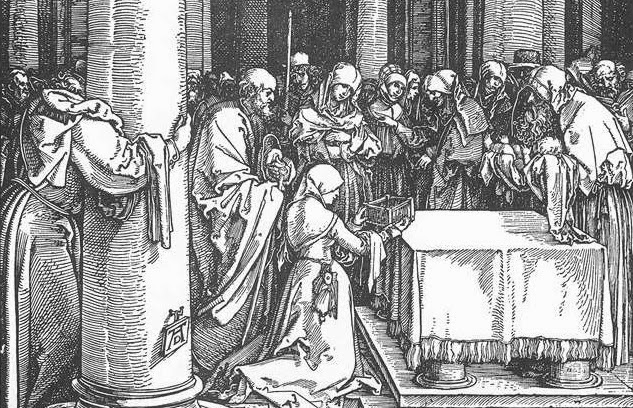
P.S - The illustration above is from The Presentation of Christ in the Temple by Albrecht Durer.


One Year Ago: In the temple now behold him

Three Years Ago: In peace and joy I now depart

Four Years Ago: O Jerusalem beloved

Five Years Ago: Hail to the Lord who comes

Six Years Ago: O Zion, open wide thy gates

Sunday, January 12, 2014

The Baptism of Christ


The Sunday after the Feast of the Epiphany sometimes commemorates the baptism of Jesus in the Jordan River by his cousin John, as told in Matthew 3: 13-16.  Infant or adult baptisms are often performed today in churches which mark this day, but even if there are no such celebrations the people of the congregation may renew their baptismal vows together.

O God, our strength in weakness,
We pray to you for grace,
Patience to trust your promise,
And speed to run the race;
When your baptismal waters
Were poured upon our brow,
We then were made your children
And pledged our earliest vow.

So we on earth are blessèd
For we shall see the Lord,
Forever and forever,
By seraphim adored;
And we shall drink the pleasure
Such as no tongue can tell
From heav'ns clear crystal river,
And life’s eternal well.

Then sing to our Creator,
Who formed us with great love;
And sing to God the Savior
Who leads to realms above;
Sing we with saints and angels
Before the heavenly throne,
To God the Holy Spirit,
Sing to the Three in One.

Christopher Wordsworth, 1881; alt.
Tune: STOKE (7.6.7.6.D.)
Mrs. G. E. Cole, 1889

Christopher Wordsworth wrote this text toward the end of his life, long after his major collection The Holy Year (1862).  He was Bishop of Lincoln from 1868 until his death in 1885, and apparently wrote this hymn for the handbook of the Lincoln Girls' Friendly Society.   Many of his other hymns have already appeared here (click on the tag below).

I am unable to find anything more about Mrs. G. E. Cole, whose tune first appeared in the 1889 supplement of Hymns Ancient and Modern (not even her name!).  It's likely that the initials belong to her husband.


Five Years Ago: 'I come,' the great Redeemer cries

Monday, January 6, 2014

The Feast of the Epiphany


Twelve days after Christmas we come again to the Feast of the Epiphany, marked by the familiar story of three royal visitors to the infant Jesus (Matthew 2:1-12).  

Many churches probably celebrated this occasion yesterday but there will be some service today in various places.

Lo! the pilgrim magi
Leave their royal halls,
And with eager footsteps
Speed to Bethlehem's walls;
As they onward journey,
Faith, which firmly rests,
Built on hope unswerving,
Triumphs in their breasts.


Refrain: 
Praise to the Creator,
Fount of Life alone;
who unto the nations,
made Christ's glory known.


O what joy and gladness
Filled each heart, from far
When, to guide their footsteps,
Shone that radiant star;
O'er that home so holy,
Pouring down its ray,
Where the cradled infant
With his mother lay.

Refrain

Costly pomp and splendor
Earthly kings array;
Christ, a mightier Monarch,
Hath a nobler sway;
Straw may be his pallet,
Mean his garb may be,
Yet with power transcendent
He all hearts can free.

Refrain

At his crib they worship,
Kneeling on the floor,
And their God there present,
In that babe adore;
To our God and Savior
We, as seekers true,
Give our hearts o'erflowing,
Give our tribute due.

Refrain

Charles Coffin, 1736;
tr, John David Chambers, 1857; alt.
Tune: ARMAGEDDON (6.5.6.5.D. with refrain)

Luise Richardt, 19th cent.;
adapt. John Goss, 1871 

The Roman Catholic Charles Coffin wrote his hymns in Latin, most for the Paris Breviary (1736).  We saw a much more familiar Epiphany hymn by Coffin a few years ago.

Luise Reichardt (1779-1826), born in Berlin, was the daughter of two composers, Juliane Reichardt and Johann Friedrich Reichardt.  One of her grandfathers had been concert master in the court of Frederick the Great.  Her earliest published songs appeared in 1800 in a collection of her father's work.  This particular melody was adapted into a hymn tune by John Goss, and has been used most often with the text Who is on the Lord's side.


Five Years Ago: Saw you never, in the twilight

Four Years Ago:  Earth has many a noble city

Three Years Ago: What star is this, with beams so bright

Two Years Ago: As with gladness those of old

One Year Ago:  O thou, who by a star didst guide

Sunday, December 15, 2013

Prophet to the Multitudes

John the Baptist always gets a week or two to himself during Advent worship, and several Advent hymns are about John and his proclamations about the coming Savior.

Today's gospel lesson in many churches was Matthew 11:2-11.  John was in jail again for his unpopular preaching, but was questioning whether Jesus (his cousin!) was truly the Promised One that John had been talking about.  Jesus responds with reminders of his works thus far, and praises John for his prophetic voice.

Today's hymn traces the whole of John's life, all the way to his death at the hands of King Herod. 

Herald, in the wilderness,
Breaking up the road,
Sinking mountains, raising plains,
For the path of God;

Prophet, to the multitudes
Calling to repent,
In the way of righteousness
Unto Israel sent;

Messenger, God’s chosen one
Foremost to proclaim,
Proffered titles passing by,
Pointing to the Lamb.

Captive, for the word of truth
Boldly witnessing;
Then in Herod’s dungeon cave,
Faint and languishing;

Martyr, sacrificed to sin
At that feast of shame;
As his life foreshowed the Word,
In his death the same—

Holy Jesus, when he heard,
Went apart to pray:
Thus may we our lesson take
From this saint today.

Henry Alford, 1866; alt.
Tune: BRUCE (7.5.7.5.)
The Hymnal, 1907


Five (Liturgical) Years Ago: On Jordan's bank the Baptist's cry

Four (Liturgical) Years Ago: The great forerunner of the morn

One (Liturgical) Year Ago: O Wisdom, spreading mightily

Sunday, December 1, 2013

Knowing You Are On Your Way

Another year in the church's calendar begins today, with the first Sunday in Advent.  These four Sundays before Christmas serve as a time of waiting and expectation as the commemoration of the birth of Christ approaches.  We have seen many Advent hymns over the last five years here at the blog, and they aren't used up yet.

Emily May Grimes (May 10, 1864 - July 9, 1927) was born in England but went to South Africa as a missionary in 1893.  In 1903, she married Dr. T. W. W. Crawford, another missionary in the Anglican church who was stationed in Africa.  Many of her hymns (such as today's) were written before her marriage and were attributed to 'E. May Grimes.'

Her texts seems to have appeared in more and more hymnals as the twentieth century progressed, unlike many of her contemporaries, though this is probably largely due to her most well-known hymn, Speak, Lord, in the stillness.

In the Advent light, O Savior,
We are living day by day;
Waiting, working, watching ever,
Knowing you are on your way.

In the Advent light rejoicing!
Songs of praise along the road
Seem to make the journey shorter,
Mounting upward to our God!

So from glory unto glory,
Gladdened by the Advent ray;
All the path is growing brighter,
Shining unto perfect day.

Christ is coming! Christ is coming!
Pass the heavenly watchword on!
Go we forth to meet the Savior
Hail! the heavn'ly promised one!

E. May Grimes, 1902; alt.
Tune: RESTORATION (8.7.8.7.)
The Southern Harmony, 1835


Five (Liturgical) Years Ago: Lo! Christ comes with clouds descending

Four (Liturgical) Years Ago: Jesus came, adored by angels

Three (Liturgical) Years Ago: Lift up your heads, ye mighty gates

Two (Liturgical) Years Ago: The King shall come when morning dawns

One (Liturgical) Years Ago: Once he came in blessing

Another Anniversary Today: World AIDS Day

Saturday, October 19, 2013

Claudia Frances Hernaman

Claudia Frances Hernaman was born in the village of Addlestone, Surrey on this day in 1838, the daughter of W. H. Ibotson, a Church of England minister.  Like many clerical daughters, she grew up to marry another minister, the Reverend J. W. D. Hernaman, in 1858. Not much else seems to be known of her life except the more than 150 hymns she wrote or translated from Latin, mostly for children.  These were published in several books written by her.

We have already seen her most familiar hymn, first published in her collection The Child's Book of Praise (1873), which still appears today in many modern hymnals.  Today's hymn, appropriate for this season of Hernaman's birthday, is matched with a sprightly tune that children would probably like to sing.

Come, children, lift your voices, 
And sing with us today,
As to the Lord of harvest
Our grateful vows we pray,
We thank thee, God, for sending
The gentle showers of rain,
The summer suns which ripened
The fields of golden grain.

Come join our glad procession
As onward still we move,
Rejoicing in the tokens
Of our Creator's love;
All good is God's creation,
All beautiful and fair,
Birds, insects, beasts and fishes
Our harvest gladness share.

May we by holy living
Thy praises echo forth,
And tell thy boundless mercy
To all the list'ning earth;
May we grow up as branches
Of Christ, the one true Vine,
Bear fruit to life eternal,
And be forever thine.

Claudia Frances Hernaman, 1878; alt.
Tune: BRITISH GRENADIERS (7.6.7.6.D.)
Traditional English melody, 17th cent.

The well-known and traditional tune BRITISH GRENADIERS was used since the eighteenth century as a march for several different divisions of the British and Canadian military, though it has since been heard in many different contexts.  I actually remember it from a long-ago television commercial for Chef Boy-ar-dee's Beefaroni.


Five Years Ago: Emily Swan Perkins

Four Years Ago: Emily Swan Perkins

Four Years Ago: John White Chadwick