Showing posts with label William H. Havergal. Show all posts

Sunday, February 5, 2017

Not Despair, But Wise Intent


Unfortunately, the challenges of our present day are not unique.  People of faith often have had to stand up for what they believe, in both large ways and small.

Why discouraged? Why despair,
Yielding to the present woe?
We are not what once we were;
Let us build on that we know.

Even now the future life
Shape we with our conscious hands;
And amidst the woe and strife,
Full our dream incarnate stands.

Lightest thought and humblest deed,
Aspiration's faintest breath,
These are but the unseen seed,
Springing up in spite of death.

Not despair, but wise intent,
Takes the hardship from our task;
High resolve and onward bent --
These the pressing moment ask.

Malcolm Quin, 19th cent; alt.
Tune: PATMOS (7.7.7.7.)
William Henry Havergal, 1869


Malcolm Quin (1854-1927? - no useful link available) was at one time the minister of a Church of Humanity congregation in Newcastle-upon-Tyne. The Church of Humanity was based on the philosophy of Positivism, developed by Auguste Comte in the nineteenth century. It was described by one critic as "Catholicism minus Christianity," and Quin was definitely interested in this aspect, developing liturgies for his church, designing vestments, and writing hymns. He wrote about Catholicism and corresponded with George Tyrell, a Jesuit priest who was excommunicated for his modernist ideas.


Eight Years Ago: Joy is like the rain

Seven Years Ago: Roger Williams

Three Years Ago: Thomas Turton

Wednesday, December 14, 2016

Frances Ridley Havergal

Today is the 180th birthday of hymnwriter and composer Frances Ridley Havergal (1836-1879).  She was the daughter of William Henry Havergal, a menber of the clergy of the Church of England, who also wrote and composed hymns. Her middle name was given in honor of Bishop Nicholas Ridley (c.1500-1555), an English Protestant martyr who was executed for heresy after the Roman Catholic Mary Tudor became queen (Ridley had supported the brief accession of Lady Jane Grey).

Young Frances was quite a prodigy; her father nicknamed her 'Little Quicksilver.' She began to read at age three, and to memorize the Bible at age four. She learned at least seven languages, including Greek and Hebrew so that she could further her Biblical studies.  At seven, she began to write poetry. She also memorized much piano music of the great composers of her day, sang, and composed music of her own.

As an adult, she was very involved with mission work and other social causes, including temperance and the YWCA.  She founded the Flannel Petticoat Society, which provided clothing to poor children.

Many of her early hymns were first published in pamphlet form, and the first collection of her writings was not published until 1869, only ten years before her death at 46. Over the next few years she became well known for her hymn texts and other religious poetry and prose. One of her famous correspondents was the American Fanny Crosby, and the two sometimes exchanged poems. The Seeing Heart (1872) is a long poem to Crosby by Havergal, from which the phrase "Her heart can see" was taken for the title of a modern biography of Crosby. The poem ends with the following stanza:

Singing for Jesus! Telling his love
All the way to our home above,
Where the severing sea, with its restless tide
Never shall hinder and never divide.
Sister, what shall our meeting soon be
When our hearts shall sing and our eyes shall see?


Most of Havergal's hymn texts and poetry express her deep relationship with Jesus, rarely dealing with the wider variety of themes that many Victorian hymnwriters explored.  Though I have only marked her birthday twice, several more of her texts have appeared here (click her tag below) and a few of her tunes as well. This text was published in Loyal Responses (1878) though it may have been released earlier in a pamphlet.

Christ is with us! He has said it,
In his truth and tender grace;
Sealed the promise, softly spoken,
With how many a mighty token,
Of his love and faithfulness.

Christ is with us! in our living,
Shielding us from fear of ill;
All our burdens kindly bearing,
For our loved ones gently caring,
Guarding, keeping, blessing still.

Christ is with us! with us always,
All the nights and all the days;
Never failing, never frowning,
With his loving-kindness crowning,
Tuning all our lives to praise.

Christ is with us! Our own Savior,
Leading, loving to the end;
Bright'ning joy and light'ning sorrow,
All today, yet more tomorrow,
Lamb of God, our Guide and Friend.

Frances Ridley Havergal, 1878; alt.
Tune: WINDERMERE (Maker) (8.7.8.8.7.)
Frederick C. Maker, 19th cent.

The meter of this text is a bit unusual and there are not many tunes that fit it - WINDERMERE, by Frederick Maker (composer of ST. CHRISTOPHER) is a compromise.  The score may help you match the text with the words.

Havergal died of peritonitis on June 3, 1879. She had been staying for several months with her sister Maria, who wrote an account of the poet's decline which was published as The Last Week (1879). Family members were with her in her last days, and they sang together several times. Just before she died she sang her own tune, HERMAS, one last time, to the following words by Mary J. Walker:

Jesus, I will trust thee, 
Trust thee with my soul;
Guilty, lost, and helpless,
Thou canst make me whole.
There is none in heaven
Or on earth like thee:
Thou hast died for sinners—
Therefore, Lord for me.


Eight Years Ago: Frances Ridley Havergal

Seven Years Ago: Frances Ridley Havergal

Friday, October 28, 2016

Saint Simon and Saint Jude

For thy dear saints, O Lord,
Who strove in thee to live,
Who followed thee, obeyed, adored,
Our grateful hymn receive.

For thy dear saints, O Lord,
Who strove in thee to die,
Who counted thee their great reward,
Accept our thankful cry.

They all in life and death,
With thee their Lord in view,
Learned from thy Holy Spirit’s breath
To suffer and to do.

Thine earthly members fit
To join thy saints above,
In one communion ever knit,
One unity of love.

Jesus, thy name we bless,
And humbly pray that we
May follow them in holiness,
Who lived and died for thee.

Richard Mant, 1837; alt.
Tune: NARENZA (S.M.)
Catholicum Hymnologium, 1584;
arr. William Henry Havergal, 1847


Eight Years Ago: Thou who sentest thine apostles

Seven Years Ago: Let the church of God rejoice

Six Years Ago: When thou, O Christ, didst send the Twelve

Four Years Ago: Blessed feasts of blessed martyrs

One Year Ago: By all your saints still striving


Monday, January 18, 2016

William Henry Havergal

William Henry Havergal, born today in 1793, may have been one of the people most responsible for the immense surge in hymn singing in England in the middle of the nineteenth century.  He and Henry J. Gauntlett worked to adapt and arrange older melodies, such as psalm tunes and chorales from Germany into the four-part harmonies that we still sing today (much like Lowell Mason was doing in the United States).  He composed a number of original hymn tunes and also wrote hymn texts.

Havergal was ordained in the Church of England in 1816, serving several churches, the longest in Astley, a village in Worcestershire, where he is buried.  

Today's hymn has both a text by Havergal as well as one of his arrangements, adapted from a sixteenth-century German melody.

To praise our Shepherd's care,
His wisdom, love, and might,
Your loudest, loftiest songs prepare,
And bid the world unite.

Supremely good and great,
He tends his earthly fold;
And stoops, though throned in highest state,
The weary to uphold.

He hears their softest plaint, 
Follows them when they roam;
And if one single lamb should faint,
His bosom bears it home.

Kind Shepherd of the sheep,
A faithful flock are we,
And snares and foes are nigh, but keep
The lambs who look to thee.

William Henry Havergal, 19th cent.; alt.
Tune: NARENZA (S.M.)
Catholicum Hymnologium, 1584;
arr. William Henry Havergal, 1847

One of his daughters, Frances Ridley Havergal, followed in his line of work as a writer of hymns and composer of tunes.  Havergal is now mostly remembered for his tunes rather than his texts, while the texts of Frances are most familiar and her tunes are all but unknown.  Following Havergal's death in 1870, Frances edited a collection of his tunes and arrangements which was published in 1871.


Another Commemoration Today: Martin Luther King, Jr.

Seven Years Ago: William Henry Havergal

Four Years Ago: The Confession of Saint Peter

One Year Ago: The Confession of Saint Peter


Wednesday, October 7, 2015

Henry Alford


The Reverend Henry Alford was born today in London in 1810.  Ordained in the Church of England in 1833, he eventually was named Dean of Canterbury Cathedral in 1857.  He is still known today for his four-volume translation and commetary on the New Testament.

For our purposes here he is best known as the author of Come, ye thankful people, come, but he wrote many other texts and even some tunes, and also edited hymnals, including Psalms and Hymns (1844) and The Year of Praise (1867) which was especially for use at Canterbury. Actually, as a boy of 11, he compiled his first hymnal, which he titled A Collection of Hymns for Sundry Occasions (unpublished, alas!). 

Today's hymn by Alford is a response to the parable of the Prodigal Son, from Luke 15:11-32, updated a bit for contemporary worship.

Hark! through the courts of heav'n
Voices of angels sound;
Those that were dead now live again;
Those that were lost are found.

God of unfailing grace,
Send down thy Spirit now;
Raise the dejected soul to hope,
And make the lofty bow.

In countries far from home
On earthly husks we feed;
Back to our shelt'ring home, O God,
Our wand'ring footsteps lead.

Then at each soul's return
The heav'nly harps shall sound,
Those that were dead now live again;
Those that were lost are found.

Henry Alford, 1844; alt.
Tune: SWABIA (S.M.)
Johann Speiss, 1745;
arr. William Henry Havergal, 1847

You might suspect that I like quite a few of Alford's hymns, as several have already been seen on the blog (click on his tag below).  My particular favorites include We walk by faith and not by sight and Ten thousand times ten thousand.


P.S. - The art above is detail from The Return of the Prodigal Son (1670) by Bartolome Esteban Murillo.


Seven Years Ago: Henry Alford

Six Years Ago: Henry Alford

Five Years Ago: Charles Crozat Converse

Three Years Ago: Henry Alford


Sunday, January 18, 2015

The Confession of Saint Peter


On some church calendars, January 18 is marked to commemorate the Confession of Saint Peter, as told in Matthew 16:13-20.  Saint Peter is often depicted with large keys,  probably deriving from this same passage where Jesus says he will give Peter "the keys to the kingdom of heaven."

By all your saints still striving,
For all your saints at rest,
Your holy Name, O Jesus,
Forevermore be blessed!
For those passed on before us,
We sing our praise anew
And, walking in their footsteps, 

Would live our lives for you.

Praise for your great apostle,
The eager and the bold,
Thrice failing, yet repentant,
Thrice charged to keep your fold;
God, make your pastors faithful,
To guard their flocks from ill,
And grant them dauntless courage,
With humble, earnest will.

We pray for saints we know not,

For saints still yet to be,
For grace to bear true witness
And serve you faithfully,
Till all the ransomed number
Who stand before the throne
Ascribe all power and glory
And praise to God alone.

Horatio Bolton Nelson, 1864; alt.
Tune: ZOAN (7.6.7.6.D.)

William Henry Havergal, 1859

This tune by William Henry Havergal (1793-1870) is no longer well known but it has appeared in many hymnals, and was chosen today because January 18 is also Havergal's birthday.  He was a prominent name in the mid-nineteenth century for his work in hymnody; he wrote several hymn texts, but more importantly, he wrote tunes and worked to reestablish many older psalm tunes, arranging and harmonizing them according to the musical tastes of his time so that they would be widely used again as they had been in previous centuries. One of his daughters, hymnwriter and composer Frances Ridley Havergal is probably more widely known today.


Two Years Ago: The Confession of Saint Peter 

Six Years Ago: William Henry Havergal

Tuesday, November 4, 2014

James Montgomery

Hymnwriter James Montgomery was born today in 1771, in Scotland. His parents were missionaries in the Moravian church, who left young James with friends while they traveled to evangelize the West Indies, and unfortunately both died there. 

He wrote poetry from a young age (even being expelled from school once because of it), and as an adult became a newspaper editor. He wrote several long secular poems, some on political subjects. However, Montgomery correctly believed that his hymns (about 400 in total) would be most remembered out of all his work. Nearly any hymnal index you check today will still contain his hymns, several of which have already been covered here (click on his name tag below).


Sing we the song of those who stand
Around th’eternal throne,
Of every kindred, clime, and land,
A multitude unknown.

Toil, trial, suffering, still await
On earth the pilgrim throng,
Yet learn we, in our earthly state,
The Church Triumphant’s song.

“Worthy the Lamb!” we join to sing,
“Who died for souls to save;
Henceforth, O death! where is thy sting?
Thy victory, O grave?”

Then, Alleluia! power and praise
To God in Christ be given;
May all who now this anthem raise
Renew the strain in heav’n!

James Montgomery, 1824; alt.
Tune: EVAN (C.M.)
William Henry Havergal, 1846

Following his death in 1854, a monument was erected at his gravesite in Sheffield in 1861. The inscription reads in part: Wherever poetry is read, or Christian hymns sung, in the English language, 'he being dead, yet speaketh' by the genius, piety and taste embodied in his writings.

We're still singing -- both Montgomery's hymns and those of the "multitude unknown."


Six Years Ago: James Montgomery

Four Years Ago: James Montgomery

Another Birthday Today: Augustus Montague Toplady


Sunday, February 2, 2014

The Feast of the Presentation


 Joy! joy! the Mother comes,
And in her arms she brings
The Light of all the world,
The Ruler of all things,
And in her heart the while
All silently she sings.


Saint Joseph follows near,
In rapture lost, and love,
While angels 'round about
In glowing circles move,
And o'er the Mother broods
The everlasting Dove.


There in the temple court,
Old Simeon's heart beats high,
And Anna feeds her soul
With food of prophecy;
And see! the shadows pass,
The world's true Light draws nigh.


Frederick William Faber, 1854; alt.
Tune: BACA (6.6.6.6.6.6.)
William Henry Havergal,
19th cent.


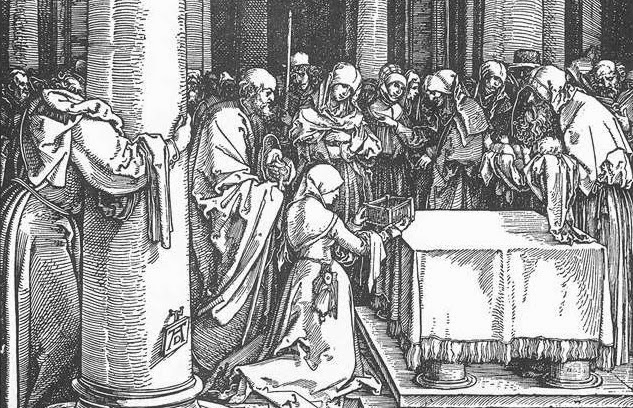
P.S - The illustration above is from The Presentation of Christ in the Temple by Albrecht Durer.


One Year Ago: In the temple now behold him

Three Years Ago: In peace and joy I now depart

Four Years Ago: O Jerusalem beloved

Five Years Ago: Hail to the Lord who comes

Six Years Ago: O Zion, open wide thy gates

Sunday, March 27, 2011

George Matheson

Scottish minister George Matheson was born today in Glasgow in 1842. He entered the university there at fifteen, and during his time there his already-poor eyesight deteriorated to the point of blindness. Undeterred, he continued his studies with the help of his sisters and was awarded several academic honors. His first degree was in philosophy, followed by one in divinity, after which he was licensed to preach in the Church of Scotland.

Over the next several years he became a renowned preacher, adding to his fame when the first of his several books was published in 1874. He continued to write books and articles on theology and comparative religions even after his retirement in 1899, until his death from a stroke in 1906.


He published only one book of poetry, Sacred Songs (1890), though he did not include his most well-known hymn until the third edition in 1904. He considered O Love that wilt not let me go to be a special case as it was written with an ease that he never experienced again. Most of the poems in Sacred Songs are not suited to be hymns, but a few of them have also appeared in hymnals, such as this one.


Jesus, Fountain of my days,

Wellspring of my heart's delight.

Brightness of my morning rays,

Solace of my hours of night,

Loving thee I shall arise

To the hope of cloudless skies.


As thy presence on the deep

Calmed the pulses of the sea,

And the waters sank to sleep

In the rest of seeing thee,

So my restless, troubled will

Heard the mandate, "Peace, be still!"


Now thy will and mine are one,

Heart in heart and hand in hand;

All the clouds and all the sun,

All the ships have reached the land;

And thy love has said to me,

"No more night!" and "No more sea!"


George Matheson, 1890; alt.

Tune:
RATISBON (7.7.7.7.7.7.)
Leipzig Choralbuch, 1816;

harm. William Henry Havergal, 1861


P.S. - In many churches today, the Gospel lesson was the story of the woman at the well (
John 4:4-41), which brings to mind this hymn from a few years ago.

Two Years Ago:
George Matheson

One Year Ago:
George Job Elvey

Another Birthday Today:
Emma Ashford

Monday, January 31, 2011

Bernard Barton

Bernard Barton (January 31, 1784 - February 19, 1849) was known in England as the Quaker Poet, years before John Greenleaf Whittier gained that attribution in this country.

Born in Carlisle, in northwest England, into a Quaker family, he eventually settled on a career in banking. His first book of poetry, Metrical Effusions, was published in 1812. Several succeeding volumes over the next sixteen years would help him establish friendships with other famous poets of the day such as Robert Southey and Charles Lamb. It was Lamb who gave him some advice when Barton was considering leaving his position at Alexanders' Bank in Suffolk to support himself through his writing. "Keep to yous bank, and the bank will keep you." So Barton would remain at that same Suffolk bank until his death. After 1828 his books of poetry became less frequent until 1845, when his Household Verses appeared to great acclaim and success.

Many of Barton's poems that later appeared in hymnals are from his Devotional Verses (1826). Today's hymn was probably his most well-known, which Hymnary.org finds in more than 200 hymnals, but only two published since 1978. Still, it's probably remembered by many.

Lamp of our feet, whereby we trace
Our path when wont to stray;
Stream from the fount of heav’nly grace,
Brook by the traveler’s way.

Bread of our souls whereon we feed,
True manna from on high;
Our guide and chart wherein we read
Of realms beyond the sky.

Pillar of fire, through watches dark,
Or radiant cloud by day;
When waves would break our tossing bark,
Our anchor and our stay.

Yet to unfold thy hidden worth,
Thy myst'ries to reveal,
That Spirit which first gave thee forth,
Thy volume must unseal.

God, grant us all aright to learn
The wisdom it imparts,
And to its gracious teaching turn
With simple, childlike hearts.

Bernard Barton, 1826
Tune:
EVAN (C.M.)
William Henry Havergal, 1846

I think that, in some places today, hymns about the Scriptures themselves are sometimes seen as "singing to the Bible" and are less likely to be found in hymnals. But here I think you could make a broader case; that Barton was talking about the concept of the Word of God and not, strictly speaking, about words on a page.

Thursday, June 17, 2010

Charles Gounod

The French composer Charles Gounod (June 17, 1818 - October 18, 1893) was born today in Paris. His mother was his first piano teacher but eventually he enrolled in the Paris Conservatoire and later studied the sacred choral music of Palestrina and others in Italy. It was reportedly Fanny Mendelssohn (sister to Felix and a composer herself) who introduced Gounod to the piano music of J.S. Bach. For two years he considered entering the priesthood but returned to composing, and though he wrote music in many forms, sacred music was always a part of the mix.

Gounod's first major work to gain success was a Messe solenelle (solemn mass) which was first sung on Saint Cecilia's Day in 1855 (and is now known as the St. Cecilia Mass). He was also writing symphonies around this time, and had produced his first opera, Sapho (1851), which was a failure. He eventually wrote twelve operas, the most successful of which was Faust (1859), which was for many years the most-performed opera in the world. It was the first work performed at New York's Metropolitan Opera House in 1883, and most people today think of Gounod as solely an opera composer.

For a time during and after the Franco-Prussian War, Gounod went to live in London, where he concentrated more specifically on sacred music. He formed a choral group (still singing today as the Royal Choral Society) which performed new pieces of his beginning with the cantata Gallia (1871). Even after his return to France in 1876 he continued to write large-scale choral works such as La rédemption (1882) for the major British choral festivals.

Many of his sacred vocal and choral pieces were smaller, such as his Ave Maria, adapted from a keyboard piece of Bach (which I well remember singing at my sister's wedding 20 years ago). His years in England coincided with the huge growth in hymnals published (following the popularity of Hymns Ancient and Modern in 1861), so it is not surprising that he wrote a few hymn tunes as well while he was there, such as this one which still appears in some hymnals today.

Christ, whose glory fills the skies,
Christ, the true, the only Light,
Sun of Righteousness, arise,
Triumph o’er the shades of night;
Dayspring from on high, be near;
Day-star, in my heart appear.

Cold and cheerless is the morn
Unaccompanied by thee;
Joyless is the day’s return
Till thy mercy’s beams I see;
Till they inward light impart,
Glad my eyes, and warm my heart.

Visit then this soul of mine,
Pierce the gloom of sin and grief;
Fill me, Radiancy divine,
Scatter all my unbelief;
More and more thyself display,
Shining to the perfect day.

Charles Wesley, 1740; alt.
Tune:
LUX PRIMA (7.7.7.7.7.7.)
Charles Gounod, 1872

I would be in trouble in some quarters if I did not mention the other tune to which this hymn is frequently matched, a German tune later harmonized by William Henry Havergal called RATISBON. I don't really have a preference between the two, but some people do.

Some of Gounod's other hymn tunes are adapted from his choral works, and I would not be surprised if, hidden away in some nineteenth-century hymnals, there are also some tunes taken from melodies in his operas.

Though Gounod is no longer as acclaimed in this century as he once was, he is far from unknown. His descendants, however, are not quite satisfied with his current reputation and have built their own website to spread the word about the glories of Charles Gounod.


Two Years Ago: Helen Maria Williams


Wednesday, January 27, 2010

John Julian

John Julian was probably the most eminent hymnographer of the nineteenth century (a time when there were dozens if not hundreds of books published in the subject).

Born on this day in 1839, in
Cornwall, he was ordained in the Church of England in 1866. He wrote three shorter books, Concerning Hymns (1874), The History of the Use of Hymns in Public Worship (1894), and Carols Ancient and Modern (1900), but his primary accomplishment was the enormous Dictionary of Hymnology (1892). This book contained more than 40,000 entries on hymn texts and hymn writers. In Julian's 1913 obituary in the Musical Times, it was described as:

...stand(ing) alone as a guide to the study of English Hymnody, which it has helped to raise to its present dignity as a branch of aesthetical and historical learning.

The Dictionary was revised and updated at least twice, and was reprinted by three publishers, most recently in 1985. Today, of course, it can be
downloaded from the internet. Nearly every serious book on hymnody published since probably includes it in the bibliography.

Like most people interested in hymnody, Julian also
wrote some hymn texts himself, including this one.

Gracious Spirit, Life divine
Breathe on us thy life benign;
Life, to join ourselves to thee
Life, our life in thee to see.

Bounteous Spirit, Light divine
Cause on us thy light to shine;
Light, our path in life to see,
Light, to lead our feet to thee.

Gentle Spirit, Love divine
With thy love all love entwine;
Love, in trial peace to give
Love, for all through life to live.

John D. Julian, 19th c.
Tune:
PATMOS (7.7.7.7.)
William Henry Havergal, 1869


Monday, December 14, 2009

Frances Ridley Havergal

Frances Ridley Havergal (December 14, 1836 - June 3, 1879) was born in the small village of Astley, Worcestershire. She followed in the footsteps of her father, William Henry Havergal, also a writer and composer of hymns, and though she remained in his shadow during his lifetime (where her stepmother wanted Frances to remain), today she is more well known and her hymns are more widely sung.

As she once described her own hymnwriting process: Writing is like praying for me; for I never seem to write even a verse by myself [...] Very often I have a most distinct and happy consciousness of direct answers.

Havergal recorded the completion of this hymn in November, 1870, though it was not published until 1874 in her collection titled Under the Surface. Its theme comes from 1 Peter 1:8 -- Whom having not seen, ye love; in whom, though now ye see him not, yet believing, ye rejoice with joy unspeakable and full of glory.

O Savior, precious Savior,
Whom yet unseen we love!
O Name of might and favor,
All other names above!
We worship thee, we bless thee,
To thee, O Christ, we sing;
We praise thee, and confess thee
Our Life, our Hope, our Spring.

O Bringer of salvation,
Who wondrously hast wrought,
Thyself the revelation
Of love beyond our thought;
We worship thee, we bless thee,
To thee, O Christ, we sing;
We praise thee, and confess thee
Our Life, our Hope, our Spring.

In thee all fullness dwelleth,
All grace and power divine;
The glory that excelleth,
O Child of God, is thine;
We worship thee, we bless thee,
To thee, O Christ, we sing:
We praise thee, and confess thee
Our Life, our Hope, our Spring.

O grant the consummation
Of this our song above,
In endless adoration,
And everlasting love!
Then shall we praise and bless thee
Where perfect praises ring,
And evermore confess thee
Our Life, our Hope, our Spring.

Frances Ridley Havergal, 1870; alt.
Tune:
WATERMOUTH (7.6.7.6.D.)
Arthur Henry Mann, 1881

In his study of women hymnwriters, Songs From the Hearts of Women (1903), writer Nicholas Smith writes of Havergal: From her consecrated girlhood to the hour of her departure, her prayer was that her life might be one anthem unto her Redeemer.


One Year Ago: Frances Ridley Havergal


Friday, July 24, 2009

John Newton

John Newton, the writer of the most recorded hymn of all time, was born in London on this day in 1725. It may even be that Amazing grace is the most recorded vocal selection ever. There are multiple books about Newton and his famous hymn (I'd recommend the one by Steve Turner).

The story of Newton's conversion from participant in the slave trade to Anglican priest is probably known to most of you (though Turner's book makes it clear that it was no simple, clean-cut process). So I don't have a lot to add about Newton's life, or about his top-ten hymn. But he wrote a large number of other hymns during the years when he was the curate of the Anglican church in Olney. Every time I look thorough Olney Hymns (1779), the hymnal he compiled with his friend
William Cowper, I find an interesting text I haven't seen before.

As I've said before, I like hymns that recount stories from scripture, and I think Newton
liked them too. This one starts with the story of Elijah and the widow's cruse of oil, from I Kings 17:8-16.

By one poor widow’s oil and meal
Elijah was sustained;
Though small the stock it lasted well,
For God the store maintained.

It seemed as if from day to day,
They were to eat and die;
But still, though in a secret way,
God sent a fresh supply.

No barn or storehouse we possess
On which we can depend;
Yet have no cause to fear distress,
For Jesus is our Friend.

Then let not doubts your mind assail,
Remember, God has said,
“The cruse and barrel shall not fail;
My people shall be fed.”

And thus though faint it often seems,
Christ keeps our grace alive;
Supplied by rich, refreshing streams,
Our faltering hopes revive.

John Newton, 1779; alt,
Tune: EVAN (C.M.)
William Henry Havergal, 1846


It must have been shortly after the publication of Olney Hymns that Newton left that parish in 1779 to become rector of St. Mary Woolnoth in London, where he remained until his death in 1807. He and his wife were buried at that London church, but in 1893 were reinterred in Olney.

One Year Ago: John Newton


Sunday, January 18, 2009

William Henry Havergal

William Henry Havergal (January 18, 1793 - April 19, 1870) was a composer, hymnwriter and hymnologist. Ordained in 1817, he served as rector in three different parishes until his health forced him to retire in 1867. In fact, his health was never very good; a carriage accident in 1829 disabled him and he turned to composing music as a form of relaxation, then a few years later he lost most of his sight.

He made a study of hymn tunes and in 1844 published a reprint of the Thomas Ravenscroft Whole Booke of Psalmes, which had been originally published in 1618. He followed this with Old Church Psalmody (1847), another collection of older tunes, many with his new arrangements. Later, he brought out A Hundred Psalm and Hymn Tunes (1859) which were all new compositions. A History of the Old Hundredth Psalm Tune appeared in 1854. He also wrote hymn texts in addition to other sacred compositions, and many of his sermons were published.

To praise our Shepherd's care,
That wisdom, love, and might,
Our loudest, loftiest songs prepare
And bid the world unite!

Supremely good and great,
Christ tends the earthly fold;
And stoops, though throned in highest state

The weary to uphold.

Kind Shepherd of the sheep,
A wandering flock are we,
And snares and foes are nigh; but keep
The lambs who look to thee.

And if through death's sad vale
Our feet should early tread,
Oh, may we reach thy fold, and hail
The love which has us led.

William Henry Havergal, 19th c.; alt.
Tune: SWABIA (S.M.)
Johann Speiss, 1745;
arr. William Henry Havergal, 1847

Most of his texts and tunes are little known today. SWABIA is still found in some modern hymnals, though I don't know that it's anyone's favorite tune (someone will no doubt show up now to tell me that it is); also surviving is EVAN, an original Havergal tune. William Henry is probably better known today as the father of another hymnwriter and composer, Frances Ridley Havergal.

The painting below, by an unknown artist, depicts St. Nicholas' church in Worcester, where Havergal was rector for eighteen years and was probably painted around the time he was there. However, the church was closed in 1990 and is now a pub/restaurant, part of the "Slug & Lettuce" chain (if you should ever find yourself in Worcester).

Sunday, December 14, 2008

Frances Ridley Havergal

Today we mark the birthday of Frances Ridley Havergal (1836 - 1879), surely one of the most famous women hymnwriters. She was born into a musical family; her father, William Henry Havergal, was an evangelical minister who also wrote hymns and composed hymn tunes. Frances learned to play the piano at an early age, and wrote her first poems at seven. She became fluent in at least six languages, and memorized much of the Bible.

Havergal was in poor health for much of her life, though she did manage to travel to Germany in 1852 for a year of study, where she also wrote her first hymn. She became more and more dedicated to her religion, and after 1873 it was said that she only sang and played sacred music. She was also involved in several philanthopic causes.

Her hymns appeared in a few small volumes and periodicals during her lifetime. Her most famous hymn, still sung today, is the consecration hymn Take my life and let it be, which is sung in many denominations. Much less known are the several tunes she composed, though this one still appears today in some hymnals. Her text, though not an Advent one, seems appropriate as the end of the year comes closer.

Standing at the portal
Of the opening year,
Words of comfort meet us,
Hushing every fear;
Spoken thru the silence
By our Maker’s voice,
Tender, strong and faithful,
Making us rejoice.

Refrain
Onward, then, and fear not,
Live the words we pray,
For God's Word shall never,
Never pass away.

“I, your God, am with thee,
Be thou not afraid;
I will help and strengthen
Be thou not dismayed.
Yea, I will uphold thee
With my own right hand;
Thou art called and chosen
In my sight to stand.”
Refrain

For the year before us,
O what rich supplies!
For our care and comfort
Living streams shall rise;
For the sad and doubting
Shall God's grace abound;
For the faint and weary
Perfect strength be found.
Refrain

God will never fail us,
God will not forsake;
The eternal covenant
God will never break.
Resting on the promise,
What have we to fear?
God is all sufficient
For the coming year.
Refrain

Frances Ridley Havergal, 1873; alt.
Tune: HERMAS (6.5.6.5.D. with refrain)
Frances Ridley Havergal, 1871

HERMAS was not written especially for this text, but for an earlier one by Havergal. It has been used for several other hymns over the years.

About a year before her death at age 43, Frances and her sister Maria moved to a part of south Wales called The Mumbles. After Frances's passing, Maria published Memorials of Frances Ridley Havergal, as well as a collected edition of her hymns and many of her letters. Today, an organization called the Havergal Trust, based in Missouri, is working to keep her works alive and available.