Showing posts with label Hyfrydol (tune). Show all posts

Tuesday, March 1, 2011

Saint David


March 1 is the feast day of the patronal saint of Wales, Saint David (or Dewi Sant in Welsh). He was a sixth-century monk and later Archbishop of Wales, said to have converted thousands from the pagan Celtic tribes to Christianity. St. David's Cathedral in Pembrokeshire was built after he was made a saint in the twelfth century, on the site of one of his monasteries. He is usually depicted in art with a dove on his shoulder or hovering near him, and he is also closely associated with water, as fresh springs are said to have erupted in the Welsh countryside to mark many of the milestones of his life.

There are hymns specifically written for Saint David, many probably untranslated into English. You can see one at this page (of uncertain provenance) with several other legends about his life and works. However, I thought I would take this day of Welsh celebration to gather together several of the Welsh hymn tunes already used here over the last three years. The tunes of Wales were said to be rousing melodies, some from older folk melodies, simple for a congregation to learn and remember, and were not from a high church tradition. This is probably still true today - you will probably know many of these even if you did not see them the first time around on the blog. I like them all.


These are most, if not all, of the Welsh tunes I've used, and I'm sure there are more to come (the familiar AR HYD Y NOS has not yet appeared, for example).

St. David's Day is also an occasion for large gatherings of Welsh choirs, particularly in the male choir tradition, and many of these hymn tunes were probably sung somewhere today. If you want to hear more of these tunes, searching for any of the tune names above at YouTube will probably bring up a rendition or two (or more) sung exuberantly by a Welsh male choir.


P.S. - Our commenter Leland is looking for some information on a particular Welsh hymn (the text, not the tune) at his blog, if anyone here happens to know more about it.

Saturday, December 18, 2010

Charles Wesley

Today is the birthday of Charles Wesley (December 18, 1707 - March 29, 1788), who helped his brother John in founding the movement that eventually became the United Methodist Church. Though John wrote much of the underlying theology, it was undoubtedly the hymns of Charles that spoke most directly to the people of that church over the last three three centuries. Most Methodist hymnals have been compiled around his texts, and though the current United Methodist Hymnal (1989) is down to only 41 by him, that's a good number for any one person to have in a modern denominational collection. Of course, Wesley is well-represented in the hymnals of many other churches as well.

Like Luther, Charles Wesley is one of those people who have been written about much more extensively than I could adequately cover here. Since I missed an Advent hymn for last Sunday, I thought I would present Wesley's most well-known Advent text on his birthday today (incidentally, the very first Advent hymn presented here more than two years ago was also by him).

This one, which probably still appears in the hymnals of most churches today, was first published in Wesley's Hymns for the Nativity of Our Lord (1745). There it was arranged in only two stanzas; though he is often cited for his long texts, such as the nineteen original stanzas of O for a thousand tongues to sing, he was also able to be brief at times.

Come, thou long-expected Jesus
Born to set thy people free;
From our fears and sins release us,
Let us find our rest in thee.

Israel’s Strength and Consolation,
Hope of all the earth thou art;
Dear Desire of every nation,
Joy of every longing heart.

Born thy people to deliver,
Born a child and yet a King,
Born to reign in us forever,
Now thy great dominion bring.

By thine own eternal Spirit
Rule in all our hearts alone;
By thine all-sufficient merit,
Raise us to thy glorious throne.

Charles Wesley, 1745; alt.
Tune: STUTTGART (8.7.8.7.)
Christian F. Witt, 1715
adapt. Henry J, Gauntlett, 19th cent.

If you prefer this in two stanzas rather than four, you probably sing it to the ubiquitous HYFRYDOL, which of course is 8.7.8.7.D. (for double). In the UK they frequently use the John Stainer tune CROSS OF JESUS (again in four stanzas) and several other tunes have been sung over the years with these words.

Charles Wesley wrote between 5500 and 6000 hymn texts, and as usual you can see and hear many of them (though still a small fraction) at the Cyber Hymnal site, and of course you can click on his name below for the ones I've written about here. I wondered, however, whether I could find them all online somewhere, so I started at the site of the Charles Wesley Society. Before long I was directed to the Duke Divinity School site, where they do indeed have searchable PDF files of both his published verse and that which remained in manuscript at the time of his death.


Sunday, May 2, 2010

We Are Builders of That City


One of the lectionary readings appointed for today in many churches is from Revelation 21: 1-6, John's vision of the Holy City. The theme of the City of God, where sorrow and suffering will no longer exist and where peace and justice will prevail recurs throughout scripture, from Old Testament prophecy all the way to the last book of the New Testament. One of the basic tenets of the more modern concept of social justice is that we should do what we can to bring about those conditions on earth today.

The writer of today's hymn, Felix Adler, was raised in the Jewish faith, the son of a rabbi. As an adult he taught at Cornell and Columbia Universities. In 1876 he founded the New York Society of Ethical Culture, which started a worldwide movement. The concepts of Ethical Culture drew from many traditions and attracted people from a wide spectrum of beliefs, including Christianity, Judaism, and even atheism (naturally, this diversity led to various disagreements in several local chapters).

Hymns were sung at the meetings of the Ethical Culture societies and they compiled their own hymnals, such as Ethical Hymns (1899), from London, which included texts by Ethical Culture members as well as by names more familiar to us, such as Sarah Flower Adams and John Bowring. Adler wrote this hymn in 1878, and it was first published for Christian worship in the 1904 Pilgrim Hymnal.

Hail the glorious golden city,
Pictured by the seers of old!
Everlasting light shines o’er it,
Wondrous things of it are told:
Wise and righteous men and women
Dwell within its gleaming wall;
Wrong is banished from its borders,
Justice reigns supreme o'er all.

We are builders of that city,
All our joys and all our groans
Help to raise its shining ramparts;
All our lives are building stones:
Whether humble or exalted,
All are called to task divine;
All must aid alike to carry
Forward one sublime design.

And the work that we have builded,
Oft with bleeding hands and tears,
Oft in error, oft in anguish,
Will not perish with our years:
It will live, and shine transfigured,
In the final reign of Right;
It will pass into the splendors
Of the City of the Light.

Felix Adler, 1878; alt.
Tune:
HYFRYDOL (8.7.8.7.D.)
Rowland Hugh Prichard, c. 1830

Adler's concept of the "golden city" was probably not quite the same as ours, but Christian hymns do sometimes adapt others' ideas into a new interpretation. His original text was in twelve four-line stanzas (beginning Have you heard the Golden City /Mentioned in the legends old?), though most hymnals only use three eight-line stanzas (half of the original). The 1904 Pilgrim Hymnal text began Sing we of the golden city / Pictured in the legends old. This version, which went on to appear in several more hymnals (Congregational, Unitarian, and others) contains alterations made by J. Hutton Hynd, another Ethical Culture leader. This text of Adler's is the most widely known outside Ethical Culture circles, though I've also found several others by him in the Union Hymnal (1932), which was published by the Central Conference of American Rabbis.

We have seen another hymn on this same theme (though more clearly derived from the passage in the book of Revelation) nearly two years ago, O holy city, seen of John, which we sang this morning at my church. It's a favorite of a friend of mine whose birthday is today, though his church seems to be on a different lectionary cycle so he may not have sung it today.


Tuesday, March 3, 2009

John and Charles Wesley


The calendars of some denominations mark today in honor of John and Charles Wesley, eighteenth-century Anglican ministers who were instrumental in spreading the Methodist faith throughout the United Kingdom.

John Wesley is regarded as one of the founders of the Methodist Church, though he himself insisted that he always remained a member of the Church of England. Much more has been written about his theology and his history than can be easily covered here. He worked closely with his younger brother Charles in spreading his beliefs, and both men saw hymns as opportunities for teaching. John translated many hymns from other languages, while Charles wrote original texts (though edited by John). The brothers issued eight collections of hymns between 1739 and 1746 alone.

Charles Wesley is said to have written more than 6,500 hymns, of which a very large number are still known today. That many hymns would have to encompass a large number of subjects; the hymnologist John Julian writes of Charles:

His feelings on every occasion of importance, whether private or public, found their best expression in a hymn. His own conversion, his own marriage, the earthquake panic, the rumours of an invasion from France, the defeat of Prince Charles Edward at Culloden, the Gordon riots, every Festival of the Christian Church, every doctrine of the Christian Faith, striking scenes in Scripture history, striking scenes which came within his own view, the deaths of friends as they passed away, one by one, before him, all furnished occasions for the exercise of his divine gift.

He sometimes wrote hymn texts that would suggest other works familiar to his followers. One of his best-known hymns was intended to evoke memories of the poet John Dryden's ode to England, Fairest isle, all isles excelling. Wesley's text has now far outlived Dryden's, being sung across many denominations around the world and to many different tunes. Though I would not go so far as to call this my favorite hymn, I do think that it is one of the most perfect hymns ever written.

Love divine, all loves excelling,
Joy of heaven, to earth come down;
Fix in us thy humble dwelling;
All thy faithful mercies crown!
Jesus, thou art all compassion,
Pure unbounded love thou art;
Visit us with thy salvation;
Enter every trembling heart.

Breathe, O breathe thy loving Spirit,
Into every troubled breast!
Let us all in thee inherit;
Let us find thy promised rest.
Take away our heedless sinning;
Alpha and Omega be;
End of faith, as its beginning,
Set our hearts at liberty.

Come, Almighty to deliver,
Let us all thy life receive;
Suddenly return and never,
Never more thy temples leave.
Thee we would be always blessing,
Serve thee as thy hosts above,
Pray and praise thee without ceasing,
Glory in thy perfect love.

Finish, then, thy new creation;
Pure and spotless let us be.
Let us see thy great salvation
Perfectly restored in thee;
Changed from glory into glory,
Till in heaven we take our place,
Till we cast our crowns before thee,
Lost in wonder, love, and praise.

Charles Wesley, 1747 ; alt.
Tune: HYFRYDOL (8.7.8.7.D.)
Rowland Hugh Prichard, c.1830

The second verse is often left out since John Wesley left it out of his 1780 collection Hymns for the Use of the People Called Methodists, but I have always liked it.

Charles Wesley's hymns have been sung by many different denominations, but naturally the Methodists are the most avid users; their hymnals generally contain more of Wesley's texts than any other author's.

The stained glass window above depicts Charles at the organ, with this hymn at his feet, but I'm not sure which of the other figures is John. It's possible that John is behind Charles, bestowing his favor on the man in the center, perhaps Thomas Coke, named by John as the first Methodist bishop in the US. However, both John and Charles did travel to America and spent time in Georgia. The window is from the World Methodist Museum in Lake Junaluska, NC.

Sunday, July 6, 2008

Fresh Supplies of Love


O Source of life divine,
Who hast a table spread,
Supplied with mystic wine
And everlasting bread,
Preserve the life thyself hast giv'n,
And feed and train us up for heav'n,
And feed and train us up for heav'n.

Our thirsting souls sustain
With fresh supplies of love,
Till all thy life we gain,
And all thy fullness prove,
And, strengthened by thy perfect grace,
Behold without a veil thy face,
Behold without a veil thy face.

Charles Wesley, 1745; alt.
Tune: RHOSYMEDRE (6.6.6.6.8.8.8.)
John David Edwards, 1840

Charles Wesley occasionally wrote short hymns, too. They weren't all fourteen verses long, like Come, O thou Traveller unknown, or eighteen verses, like O for a thousand tongues to sing. This one really was only two verses long, first published in 1745 in his collection titled Hymns on the Lord's Supper. The minor changes made (mostly before we got to it) were to help it fit this particular tune better.

RHOSYMEDRE was one of three Welsh hymn tunes that Ralph Vaughan Williams arranged into organ preludes in 1920 (the other two were
HYFRYDOL and BRYN CALFARIA). You can find performances of them on YouTube though I can't vouch for them - using dial-up right now.

P.S. The illustration above is a communion table from Elizabethan times, from Sunningwell Church in Bristol.

Sunday, May 4, 2008

Hark! the Songs of Peaceful Zion...

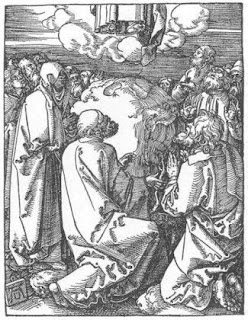
Though technically the Feast of the Ascension was on Thursday, many (if not most) churches will observe it today. I've been told that there are only two feast days in the Episcopal Church that can "legally" be transferred to the following Sunday: Saint Michael and All Angels (September 30), and the patronal feast of a parish, but it's hard to believe, since Ascension, Epiphany, and All Saints' Day seem to be moved all the time. Naturally, non-Episcopalians have no qualms about movable feasts, since they rarely have any sort of worship on weekdays, and I'm not at all up on what the Roman Catholics do.

Anyway, if your church follows the liturgical year, you may be singing this hymn today. It's not as inevitable as Jesus Christ is risen today on Easter, but it's one of the best-known Ascension hymns with a tune everyone knows and sings.

Alleluia! Sing to Jesus!
Thine the scepter, thine the throne.
Alleluia! Thine the triumph,
Thine the victory alone.
Hark! the songs of peaceful Zion
Thunder like a mighty flood.
Jesus, out of every nation
Hast redeemed us by thy blood.

Alleluia! not as orphans
Are we left in sorrow now;
Alleluia! Thou art near us;
Faith believes, nor questions how;
Though the cloud from sight received thee
When the forty days were o’er
Shall our hearts forget thy promise,
“I am with you evermore”?

Alleluia! Bread of Heaven,
Thou on earth our food, our stay;
Alleluia! Here the weary
Flee to thee from day to day:
Intercessor, Friend of sinners,
Earth’s Redeemer, plead for me,
Where the songs of all the faithful
Sweep across the crystal sea.

William Chatterton Dix, 1866; alt.
Tune: HYFRYDOL (8.7.8.7.D.)
Rowland Hugh Prichard, c.1830

The popular HYFRYDOL first appeared in a collection called Haleliwiah Drachefn (Welsh, as if you couldn't guess) in 1855, some years after Prichard is supposed to have written it. It has been used for many, many different hymn texts since that time. One thing that makes this tune especially singable is that the melody is all within a fifth until the last line, which only rises to a sixth, so everyone can find a comfortable range to sing it in.

James Lightwood, in The Music of the Methodist Hymnbook (UK, 1933), writes that "a generous elasticity in its rhythm enables enthusiasts to fit it to other metres than the one for which it was written." I knew of one such enthusiast who was attempting to find a different text for every Sunday of the church year that could be sung to HYFRYDOL. You'd start with Come, thou long-expected Jesus for the First Sunday in Advent, I suppose, and proceed from there, but the congregation would probably mutiny during Epiphany and even the choir couldn't make it to Easter.

P.S. The picture above is a woodcut by Albrecht Durer that I couldn't resist as it depicts the Ascension from a slightly odd angle. Like the way I look at hymns sometimes.