Showing posts with label Virgin Mary. Show all posts

Sunday, December 20, 2015

Proclaiming God's Surprising Word

The Fourth Sunday in Advent often commemorates Mary, the mother of Jesus, for her part in the Incarnation story. Readings may come from Luke 1:26-38 (the Annunciation), or Luke 1:39-56 (the Visitation), which includes the Magnificat, Mary's song of praise which for centuries was taught as an example of her meek compliance and dedication to service. In our time it is more frequently considered to be a revolutionary statement about the coming reign of God, the reversal of the way things have always been and the end of injustice and inequality. With God all things are possible. An unwed, teenage mother denied a place to stay for the night becomes the means by which Jesus comes into our world, and we still remember her "yes" to the angel Gabriel today.

Shall we not love thee, Mother dear,
Whom Jesus loves so well?
And to his glory, year by year,
Thy joy and honor tell?

For thee he chose from whom to take
True flesh his flesh to be;
In it to suffer for our sake,
By it to make us free.

Thy babe, he lay upon thy breast,
To thee he cried for food;
Thy gentle nursing soothed to rest
Th'incarnate Child of God.

Joy to be Mother of the Lord,
And thine the longed-for bliss,
Proclaiming God's surprising Word
Which shall all wrong dismiss.

As Jesus loves thee, Mother dear,
We too will love thee well;
And to his glory, year by year,
Thy joy and honor tell.

Henry Williams Baker, 1868; alt.
Tune: ANGMERING (C.M.)
C. H. H. Parry, 1902


P.S. - This is Leonardo da Vinci's painting of the Annunciation (1475)


Three Years Ago: Praise we the Lord this day


Sunday, December 13, 2015

William Walsham How

William Walsham How, born on this date in 1823, was a priest in the Church of England and eventually Bishop of Wakefield (though he resisted being named a bishop for some years).  He had originally planned to enter the legal profession, but changed his mind while in college at Oxford and went on to divinity school at Durham University.

He was ordained in 1846, and served as rector of Whittington for twenty-eight years (1851-1879).  His first book of poetry was published anonymously, and was updated and enlarged in 1886. His collected hymns, 54 in number, were also published separately.  

He was chair of the committee that produced Church Hymns (1871) for the Society for Promoting Christian Knowledge, and that volume became the second-most widely-used hymnal in the UK (after our old friend Hymns Ancient & Modern). He was also one of the editors for The Children's Hymn Book (1881).

Since Bishop How's birthday falls on the third Sunday in Advent this year I tried to find a text with some connection to the season, so here we have the second stanza about the Annunciation (Luke 1:26-38), which is usually read during Advent though it also has a separate feast day on March 25 - nine months before Christmas.

Jesus! Name of wondrous love!
Name all other names above!
Unto which must every knee
Bow in deep humility.

Jesus! Name decreed of old,
To the maiden mother told,
Kneeling in her lowly cell,
By the angel Gabriel.

Jesus! Name of mercy mild,
Given to the holy Child
When the cup of human woe
First he tasted here below.

Jesus! Name of priceless worth
To your people here on earth!
Jesus! Name of wondrous love!
Human Name of God above!

William Walsham How, 1854; alt.
Tune: ST. BEES (7.7.7.7.)
John Bacchus Dykes, 1862

In 1898 How's son Frederick Douglas How published a memoir of the bishop.  Perhaps not surprisingly, he writes thusly of his father's hymns: "Among the good hymn-writers Bishop Walsham How takes his place without challenge."  Though How wrote fewer hymns than several of his Victorian contemporaries, a good proportion of them are still being sung, so this assessment is not without merit.


Seven Years Ago: William Walsham How

Five Years Ago: Edwin O. Excell

One Year Ago: William Walsham How

Sunday, February 2, 2014

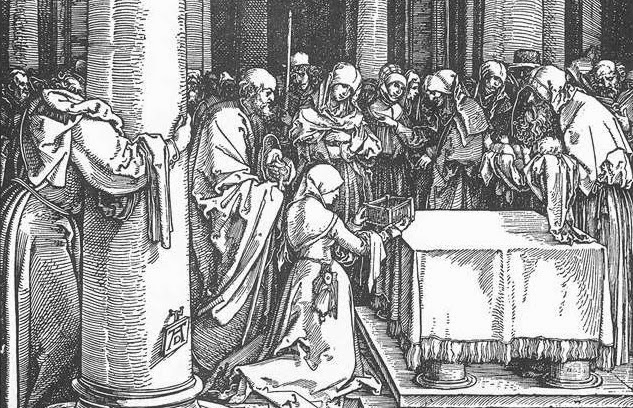
The Feast of the Presentation


 Joy! joy! the Mother comes,
And in her arms she brings
The Light of all the world,
The Ruler of all things,
And in her heart the while
All silently she sings.


Saint Joseph follows near,
In rapture lost, and love,
While angels 'round about
In glowing circles move,
And o'er the Mother broods
The everlasting Dove.


There in the temple court,
Old Simeon's heart beats high,
And Anna feeds her soul
With food of prophecy;
And see! the shadows pass,
The world's true Light draws nigh.


Frederick William Faber, 1854; alt.
Tune: BACA (6.6.6.6.6.6.)
William Henry Havergal,
19th cent.


P.S - The illustration above is from The Presentation of Christ in the Temple by Albrecht Durer.


One Year Ago: In the temple now behold him

Three Years Ago: In peace and joy I now depart

Four Years Ago: O Jerusalem beloved

Five Years Ago: Hail to the Lord who comes

Six Years Ago: O Zion, open wide thy gates

Friday, August 15, 2008

Saint Mary the Virgin

August 15 is the feast day of Mary, the mother of Jesus, on the Episcopal calendar of saints, though some Anglo-Catholic churches apparently celebrate on December 8. On the Roman Catholic calendar, where Mary has a number of days devoted to her, today is the Assumption of Mary, whereupon she was taken into heaven.

Though this does not appear to be a movable feast, I know we will be celebrating it on Sunday in my Episcopal parish, and singing my favorite hymn for the day, Sing we of the blessed mother by George Timms (somewhat rewritten for Episcopal worship in the Hymnal 1982). But since that modern hymn is still under copyright, here is another one we will probably sing, though with a different tune (some would say that this is the only correct tune, and that the Hymnal 1982 is wrong to have another).

Ye who claim the faith of Jesus,
Sing the wonders that were done
When the love of our Creator
Over death the victory won,
When God made the Virgin Mary
Mother of the Promised One.
Hail Mary, hail Mary,
Hail Mary, full of grace.

Blessed were the chosen people
Out of whom the Christ did come;
Blessed was the land of promise
Fashioned for an earthly home;
But more blessed was the mother,
Bearing Jesus in her womb.
Hail Mary, hail Mary,
Hail Mary, full of grace.

Wherefore let all faithful people
Tell the honor of her name;
Let the Church, in her foreshadowed,
Part in her thanksgiving claim;
What Christ's mother sang in gladness
Let Christ's people sing the same.
Hail Mary, hail Mary,
Hail Mary, full of grace.

Vincent Stuckey Stratton Coles, 1906; alt.
Tune: DAILY, DAILY (8.7.8.7.D.)
Traditional French melody

The Hymnal 1982 has a new additional verse by F. Bland Tucker, a metrical Magnificat which logically follows the lines in the third verse "What Christ's mother sang in gladness/Let Christ's people sing the same."

V.S.S. Coles was a priest in the Church of England, but as you may guess he was firmly in the Anglo-Catholic camp. He wrote a few more verses of this hymn which are unlikely to be sung today outside the Roman Catholic church, or perhaps the most Catholic of Anglo-Catholic churches. Even the mention of the Virgin Mary outside the Christmas or Good Friday stories is sometimes controversial in many Protestant churches, so these hymns are not often used.

UPDATE 8/17/08: As expected, we did sing those two hymns, as well as Jerusalem, my happy home (which includes the line Our Lady sings Magnificat...) Ye who claim the faith of Jesus was sung to the tune DEN DES VATERS SINN GEBOREN (with apologies to the fans of DAILY, DAILY). When this tune is used, the first two "Hail Mary"s are left out. Thanks to commenter Leland for the sound file!

The Assumption of the Virgin, 15th century painting by Francesco Botticini