Showing posts with label Easter Hymn (tune). Show all posts

Sunday, April 8, 2012

All the Earth Shall Be Made New


In hundreds of churches all over the world, some version of this hymn was sung this morning, but probably not this particular one. Many more sang at least this tune, but with a different (perhaps related) text.

Jesus Christ is ris'n today, Alleluia!
Our triumphant holy day, Alleluia!
Who did once upon the cross, Alleluia!
Suffer to redeem our loss. Alleluia!

Haste, ye seekers from your fright, Alleluia!
Take to Galilee your flight, Alleluia!
To the sad disciples say, Alleluia!
Jesus Christ is ris'n today. Alleluia!

Lo, the earth awakes again, Alleluia!
From the winter's bond and pain, Alleluia!
Bring we leaf and flower and spray, Alleluia!
To adorn this happy day. Alleluia!

Once again the Word comes true, Alleluia!
All the earth shall be made new, Alleluia!
Now the long, cold days are o'er, Alleluia!
Life and gladness are before, Alleluia!

Jesus Christ is ris'n today! Alleluia!
Christ our Light, our Life, our Way, Alleluia!
Who, by dying conquered death. Alleluia!
Ever sing our love and faith! Alleluia!

Text: Composite
Tune: EASTER HYMN (7.7.7.7. with Alleluias)
Lyra Davidica, 1708; arr. William H. Monk, 19th cent.

As I said, there are, and have been many different versions of this text in English over the last three centuries (it originally derives from a Latin text, perhaps from the fourteenth century). The last stanza here comes from a nine-stanza version published in 1800. The third and fourth stanzas are actually taken from a text by the Unitarian Samuel Longfellow. I can't prove this, but it seems possible that it was written so that Unitarians could get to sing this popular tune also (though it may have only been matched to this tune later).

The second stanza no longer appears in many hymnals, but it actually comes from Lyra Davidica (1708 - full title: Lyra Davidica, or a Collection of Divine Songs and Hymns, partly new composed, partly translated from the High German and Latin Hymns; and set to easy and pleasant tunes), the book where three stanzas of the old Latin text were first translated into English. That version reads:

Jesus Christ is risen today, Halle-Halle-lujah.
Our triumphant Holyday
Who so lately on the Cross
Suffer'd to redeem our loss.

Haste, ye females from your fright
Take to Galilee your flight
To the sad Disciples say
Jesus Christ is risen today.

In our Paschal joy and feast
Let the Lord of life be blest
Let the Holy Trine be prais'd
And thankful hearts to Heaven be rais'd.

The third stanza of this version seems unlikely to be revived; particularly the reference to the "Holy Trine" which does not appear to be a usual shortening of "Trinity," but perhaps an alteration to make it fit the meter of the text.

There is a similar hymn by Charles Wesley which is sometimes sung to this tune: Christ the Lord is risen today, which you might have sung today instead (particularly if you're a Methodist). Many hymnals have even combined stanzas from Wesley and the original.

The tune known now as EASTER HYMN, as first printed in Lyra Davidica is not what we sing today. There it was described as "a little freer air than the grand movement of the Psalm tunes." A later arrangement, closer to what we know, appeared in The Compleat Psalmodist (1749), and this version was later harmonized by William H. Monk. In at least one nineteenth century hymnbook, the tune was matched with a very different text by Charles Wesley: Hark, how all the welkin rings, which we know today by a rather different first line. Christmas might feel a bit different today if that had caught on.


P.S. The art above, The Resurrection of Christ and Women at the Tomb is a fresco by Fra Angelico, from the Convent of San Marco in Florence.


Three Years Ago: Christ is risen! Alleluia!


Sunday, May 4, 2008

Hark! the Songs of Peaceful Zion...

Though technically the Feast of the Ascension was on Thursday, many (if not most) churches will observe it today. I've been told that there are only two feast days in the Episcopal Church that can "legally" be transferred to the following Sunday: Saint Michael and All Angels (September 30), and the patronal feast of a parish, but it's hard to believe, since Ascension, Epiphany, and All Saints' Day seem to be moved all the time. Naturally, non-Episcopalians have no qualms about movable feasts, since they rarely have any sort of worship on weekdays, and I'm not at all up on what the Roman Catholics do.

Anyway, if your church follows the liturgical year, you may be singing this hymn today. It's not as inevitable as Jesus Christ is risen today on Easter, but it's one of the best-known Ascension hymns with a tune everyone knows and sings.

Alleluia! Sing to Jesus!
Thine the scepter, thine the throne.
Alleluia! Thine the triumph,
Thine the victory alone.
Hark! the songs of peaceful Zion
Thunder like a mighty flood.
Jesus, out of every nation
Hast redeemed us by thy blood.

Alleluia! not as orphans
Are we left in sorrow now;
Alleluia! Thou art near us;
Faith believes, nor questions how;
Though the cloud from sight received thee
When the forty days were o’er
Shall our hearts forget thy promise,
“I am with you evermore”?

Alleluia! Bread of Heaven,
Thou on earth our food, our stay;
Alleluia! Here the weary
Flee to thee from day to day:
Intercessor, Friend of sinners,
Earth’s Redeemer, plead for me,
Where the songs of all the faithful
Sweep across the crystal sea.

William Chatterton Dix, 1866; alt.
Tune: HYFRYDOL (8.7.8.7.D.)
Rowland Hugh Prichard, c.1830

The popular HYFRYDOL first appeared in a collection called Haleliwiah Drachefn (Welsh, as if you couldn't guess) in 1855, some years after Prichard is supposed to have written it. It has been used for many, many different hymn texts since that time. One thing that makes this tune especially singable is that the melody is all within a fifth until the last line, which only rises to a sixth, so everyone can find a comfortable range to sing it in.

James Lightwood, in The Music of the Methodist Hymnbook (UK, 1933), writes that "a generous elasticity in its rhythm enables enthusiasts to fit it to other metres than the one for which it was written." I knew of one such enthusiast who was attempting to find a different text for every Sunday of the church year that could be sung to HYFRYDOL. You'd start with Come, thou long-expected Jesus for the First Sunday in Advent, I suppose, and proceed from there, but the congregation would probably mutiny during Epiphany and even the choir couldn't make it to Easter.

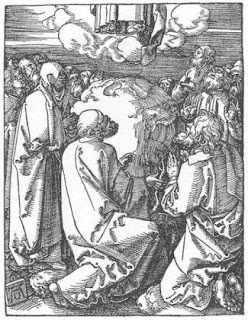
P.S. The picture above is a woodcut by Albrecht Durer that I couldn't resist as it depicts the Ascension from a slightly odd angle. Like the way I look at hymns sometimes.

Thursday, May 1, 2008

The Feast of the Ascension


He is gone—a cloud of light
Has received him from our sight;
Through the veils of time and space,
Passed into the holiest place;
Still his words before us range
Through the ages as they change:
Wheresoe’er the truth shall lead,
Christ will give whate’er we need.

He is gone—towards their goal
World and church must onward roll;
Far behind we leave the past;
Forward are our glances cast:
Though himself no more we see,
Comfortless we will not be:
No, the Spirit still is ours,
Quick'ning, fresh'ning all our powers.

He is gone—but we once more
Shall behold him as before;
In the heaven of heavens the same,
As on earth he went and came;
In the many mansions there,
Place for us he will prepare;
In that world unseen, unknown,
Christ and we shall yet be one.

He is gone—but not in vain,
Wait until he comes again:
Christ is ris'n, he is not here,
Far above this earthly sphere;
Evermore in heart and mind
There our peace in him we find:
To our own eternal Friend,
Thitherward let us ascend.

Arthur P. Stanley, 1859; alt.
Tune: CULFORD (7.7.7.7.D)
Edward J. Hopkins, 1867

This hymn is a bit of a cut-and paste job. The original text appears to be in six verses, though I have mostly seen it in four. I've rearranged a few lines here and there while keeping the same progression of ideas. Admittedly, the tune CULFORD is not particularly well-known. Edward Hopkins wrote a number of hymn tunes, though the only one still familiar to many would be ELLERS. Sullivan's hymn tune ST. PATRICK was specifically written for this text, but it's not one of his better efforts. I almost like ABERYSTWYTH, but the mood is not quite right. The text could also be sung to EASTER HYMN, though I don't think anyone would (matching up the Alleluia sections would be a chore for many).