Showing posts with label Isaac Watts. Show all posts

Monday, January 30, 2017

Ann Taylor Gilbert

Poet and literary critic Ann Taylor Gilbert (1782-1866) was born today in the London neighborhood of Islington. Her mother (also named Ann) had also written poetry and "satiric effusions" as well as seven books of moral and religious advice. Her father, Isaac Taylor, was a metal engraver who later became a Nonconformist minster and moved the family to various towns where he pastored successive congregations.

In her posthumously-published memoir, Ann recalled beginning to write "verses in metre, imitated from Dr. Watts, at that time the only poet on my shelves," at the age of seven or eight. She believed this effort arose from anxiety about her mother's poor health. One early stanza remained in her memory:

Dark and dismal was the weather,
Winter into horror grew;
Rain and snow came down together,
Everything was lost to view.


Ann and her younger sister Jane (best known as the author of Twinkle, twinkle, little star) collaborated on four collections of verse for children:

Original Poems for Infant Minds Volume 1 (1804)
Original Poems for Infant Minds Volume 2 (1805)
Rhymes for the Nursery (1806)
Hymns for Infant Minds (1808)

The sisters may have been inspired by Divine and Moral Songs for Children (1715) by Isaac Watts, perhaps the very book that Ann knew as a child. Their books were extremely popular in the nineteenth century, going through many different editions. An article on children's literature in the Encyclopedia Britannica describes their work (and its popularity) thus: "The Taylor sisters, though adequately moral, struck a new note of sweetness, of humour, at any rate of nonpriggishness." Just which sister wrote each of the poems was not always indicated, and over the years many of Ann's poems were attributed to Jane, though subsequent scholars have sorted most of them out.  One of Ann's poems, The Maniac's Song (1810) is thought by some to be the inspiration for La belle dame sans merci by John Keats.

In 1813, Ann married the Reverend Joseph Gilbert, who had proposed to her before they ever met, because he was familiar with her work, particularly her literary criticism published in The Eclectic Review magazine. After marriage, she continued her writing of verse and prose, often on subjects such as abolition and prison reform (though she was staunchly opposed to women's suffrage). At least one more book of children's verse (compiled by Ann alone) appeared, Hymns for Infant Schools (1827).

Today's hymn text comes from the earlier Hymns for Infant Minds, written on the well-known story of story of Jesus' visit to the home of Mary and Martha (Luke 10:38-42), from where the phrases "one thing needful" and "better part" are taken directly. Like various other "children's hymns" of the eighteenth and nineteenth century, it still has something to say to the adults of the twenty-first century (with just a bit of editorial clean-up).

As Mary sat at Jesus' feet
To learn her Maker's will,
We in the Savior's presence meet
To learn his precepts still.

Oh, for that quick, attentive mind
Which happy Mary showed!
May we the one thing needful find
That was on her bestowed.

'Tis here we learn the glorious name
Of God, who reigns above.
How the descending Spirit came
How great the Savior's love.

God, while we thank you for the grace
That sends this happy news,
We still would sit in Mary's place,
Her better part to choose.

Ann Gilbert, 1806; alt.
Tune: SONG 67 (C.M.)
Orlando Gibbons, 1623;
arr. Henry T. Smart, 19th cent.

Thursday, November 24, 2016

Let Every Tongue Sing Thanks And Praise


Going back to the origins of congregational song, we know that there are a number of psalms on the theme of thanksgiving.  This paraphrase by Isaac Watts encompasses Psalm 107:1-22. As I've said before, I like hymns which reference the book of Exodus, and here Watts makes the reference even more explicit than the original psalmist.

Give thanks to God who reigns above;
Whose thoughts are kind, whose name is Love;
Whose mercy ages past have known,
And ages long to come shall own.
When God’s almighty arm had broke
From Israel the Egyptian yoke,
They traced the desert, wandering round
A wild and solitary ground.

There they could find no leading road,
Nor city for a fixed abode;
Nor food, nor fountain to assuage
Their burning thirst or hunger’s rage.
In their distress, to God they cried;
God was their Savior and their guide,
Who led their march far wandering round:
It was the path to Canaan's ground.

God feeds and clothes us all the way,
And guides our footsteps lest we stray.
God guards us with a powerful hand,
And brings us to the heav’nly land.
O let the saints with joy record
The truth and goodness of the Lord!
How great those works! How kind those ways!
Let every tongue sing thanks and praise!

Isaac Watts, 1719; alt.
Tune: CANDLER (L.M.D.)
Traditional Scottish melody


Six Years Ago: Now thank we all our God


The 'Mother' of Thanksgiving: Sarah Josepha Hale


Sunday, November 6, 2016

William Tansu'ur

English composer William Tansu'ur was baptized on this day in 1706, entered into the parish records at Dunchurch as the son of laborer Edward Tanzer, when he was approximately six years old (his birthdate is unrecorded).

Since he was not born into the upper classes, or educated at famous schools, and did not compose music for public events or large urban churches, most of his life is fairly unrecorded also.  Apparently self-taught, he primarily wrote music for country churches, including an estimated two hundred hymn tunes, and some anthems and other choral music. He published several collections of hymn tunes, and his style became the predominant one in the eighteenth century, eventually replaced by the more "refined" church composers of the Victorian age.

His tunes are said to be very influential on early American church music, apparently known to composers such as William Billings and Daniel Read. However, only a fraction of them seem to have survived the nineteenth century, and practically the only one that still appears in modern hymnals is BANGOR.

We are not so limited here on the blog, and I like today's tune quite well, matched here with an Isaac Watts adaptation (not exactly a paraphrase) of Psalm 98, one of the psalms appointed for today in some lectionaries. It's entirely possible that this text and tune were actually sung together in the lifetimes of Tansu'ur and Watts, before particular hymn texts and tunes were firmly wedded to each other in printed hymnals.

To our almighty Maker, God,
New honors be addressed,
Whose great salvation shines abroad,
And makes the nations blessed.

God spake the word to Abraham first,
God's truth fulfills the grace;
And Sarah made God's name her trust,
And learned God's righteousness.

Let the whole earth God's love proclaim,
With all its different tongues,
And spread the honors of God's name
In melody and songs.

Isaac Watts, 1719; alt.
Tune: ST. ANDREW (C.M.)
William Tansu'ur, 1735


Six Years Ago: William Tansu'ur

Monday, July 25, 2016

Maria Weston Chapman

Maria Weston Chapman (July 25, 1806 - July 12, 1885) was born in Weymouth, Massachusetts, the oldest of eight children.  When she was in her teens, a wealthy uncle took her to England to complete her education, and upon returning to Boston she became the principal of the Young Ladies' High School, a new progressive school.

In 1830 she married Henry Grafton Chapman, a prominent abolitionist. Maria also joined the abolition movement, and in 1833 she was a founding member of the Boston Female Anti-Slavery Society with eleven other women (including two of her sisters).

Maria gradually grew more and more committed to the cause, particularly after she got to know William Lloyd Garrison, perhaps the best-known abolitionist in the country.  She became Garrison's assistant, helping him to run the Massachusetts Anti-Slavery Society and she also edited The Liberator, the weekly abolitionist newspaper he published. She avoided public speaking, and worked behind the scenes, organizing fundraisers and eventually writing her own material for the cause.

In 1836 she compiled, contributed to, and published Songs of the Free, and Hymns of Christian Freedom, which may have been the first songbook of the abolition movement.  In the introduction to the collection, Chapman writes that those who were working for the end of slavery felt the need for "...the encouragement, consolation, and strength afforded by poetry and music." There were new hymn texts by people in her circle, including Garrison, her sisters, and other prominent women writers such as Eliza Follen and Lydia Sigourney, and she interspersed these among hymns by prominent hymnwriters such as Watts, Wesley, James Montgomery, Reginald Heber, and Anna Laetitia Barbauld. Those older hymns had not been expressly written against slavery, but Chapman chose texts that included the same themes of justice and freedom that her contemporaries were using.  She also included other poetry that was not written for singing (that is, in regular meters).

Today's hymn is one of those written by Chapman.

O God of Freedom, bless this night
The steadfast hearts that toil as one,
Till thy sure law of truth and right
Alike in heav'n and earth be done.

A piercing voice of grief and wrong
Goes upward from the groaning earth!
Oh true and holy Lord! how long?
In majesty and might come forth!

Yet, God, rememb'ring mercy too,
Behold th'oppressors in their sin;
Make all their actions just and true,
Renew their wayward hearts within.

From thee let righteous purpose flow,
And find in every heart its home,
Till truth and justice reign below;
On earth thy free dominion come.

Maria Weston Chapman, 1836; alt
Tune: UXBRIDGE (L.M.)
Lowell Mason, 1830

This text was titled Monthly Concert of Prayer for Emancipation, and "this night," as mentioned in the first line of the text, was footnoted "the last Monday night of every month," which was apparently the regular meeting time for Garrison's Society and this may have been emulated in other abolitionist groups.

Songs of the Free contained texts only, no tunes. At the close of the book's introduction, Chapman wrote:

The machinery of metres, names of tunes, numerals, and characters has been omitted, because they are useless to those who are unable to sing, and because the spirit and the understanding are a sufficient directory to those who can.

Song leaders in local abolitionist groups were free to choose whichever tunes they wanted, and likely chose familiar tunes that most people would know (such as the tunes of Bostonian Lowell Mason, which quickly spread within a few years of publication).


Eight Years Ago: Saint James

Sunday, July 17, 2016

Isaac Watts

Today is the birthday of Isaac Watts, surely one of the most widely sung hymnwriters in the Christian world, from his own day right up to the present time. For many years, perhaps as late as the mid-nineteenth century, the hymnbooks of many churches were simply collections of Watts's texts.

Born in 1674 to a staunch Nonconformist minister and his wife, young Isaac later rejected offers from wealthy patrons to send him to a prestigious university such as Cambridge or Oxford, since that choice would have committed him to ministry in the Church of England. Instead he attended the Dissenting Academy in Stoke Newington (now part of London). Following graduation, he became a private tutor for five years before becoming the pastor of the Mark Lane Independent Chapel.  By this time he had already begun his hymnwriting career, which is said to have sprung from a challenge by his father. Isaac had complained that congregational song was uninspiring, consisting almost exclusively of psalm paraphrases that he considered unimpressive, and he soon discovered that he could write better texts.

Poor health forced his premature retirement from church leadership in 1712, only ten years later. He was invited to stay with Sir Thomas Abney (Lord Mayor of London and a parishioner at Watts's church) at his Hertfordshire estate.  Initially planning a visit of a week, Watts remained with the Abney family until his death (November 27, 1748). Though health issues such as his might have made others cynical and resentful, his best hymns (in my opinion) praise the boundless love and power of God.

My God, how endless is your love!
Your gifts are every evening new;
And morning mercies from above
Gently distill like early dew.

You spread the curtains of the night,
Great Guardian of my sleeping hours;
Your sovereign Word restores the light,
And quickens all my waking powers.

I yield my powers to your command,
To you I consecrate my days;
Perpetual blessings from your hand
Demand perpetual songs of praise.

Isaac Watts, 1707; alt.
Tune: ONEONTA (L.M.)
Walter H. Hall, 1918

Nearly 850 of his hymns are currently listed at the Cyber Hymnal site, and more every year are available to see there.


Eight Years Ago: Isaac Watts

Seven Years Ago: Isaac Watts

Six Years Ago: Isaac Watts

One Year Ago: Isaac Watts

Friday, July 17, 2015

Isaac Watts

Influential hymnwriter Isaac Watts was born today in 1674. His father was a Nonconformist, or Dissenter, who was twice jailed for not joining the state Church of England, and the son followed in the father's beliefs. Dissatisfied with the psalm paraphrases which were sung in English churches of his day, young Isaac resolved to write better things to sing, and thus became one of the earliest and most prolific writers in English who wrote hymns that were not scriptural paraphrases. His earliest hymns were published in 1707 and 1709. 

In 1719 he published The Psalms of David Imitated in the Language of the New Testament, his own psalm paraphrases which brought Jesus into many of the texts. These were not the stricter, complete paraphrases of earlier days; Watts left some of the psalms out, as well as ignoring some long sections of those he did include. To explain these so-called discrepancies, he wrote that 

Where the Psalmist describes religion by the fear of God, I have often joined faith and love to it. Where he speaks of the pardon of sin through the mercies of God, I rather choose to mention the sacrifice of Christ, the Lamb of God. Where He promises abundance of wealth, honor, and long life, I have changed some of these typical blessings for grace, glory and life eternal, which are brought to light by the gospel, and promised in the New Testament.

His hymns and psalm paraphrases were derided by critics as "flights of fancy," or even "Watts's whims," and some churches split over the singing of hymns rather than psalms, but obviously hymns eventually gained greater favor with the general public. The noted essayist Samuel Johnson, a contemporary of Watts, wrote that "He was the first who taught the Dissenters to write and speak like other men, by showing them that elegance might consist with piety." 

In all he wrote nearly eight hundred texts (listed here). Today's hymn of praise is not derived from the Psalms, but some sources suggest that it comes partly from the book of Job, proclaiming the infinite greatness of God.

How wondrous great, how glorious bright
Must our Creator be,
Who dwells amidst the dazzling light
Of vast eternity.

Our soaring spirits upwards rise
to reach the glorious throne.
There would we see the blessed Three
In the Almighty One.

Our reason stretches all its wings,
And climbs above the skies;
But still how far below God's feet
Our mortal knowledge lies!

While all the heavenly powers conspire
Eternal praise to bring,
Let faith in humbler notes adore,
The wondrous Mystery sing.

Isaac Watts, 1707; alt.
Tune: ST. NICHOLAS (C.M.)
Maurice Greene, 18th cent.

Earlier printings of this hymn do not include this final stanza, so I am not sure if it is from another hymn entirely, and perhaps is not even by Watts, but this is the form which more recent hymnals have used.

Isaac Watts never married (his one proposal was rejected) and his health was poor for many years.  He pastored a church in London though many of his duties had to be left to an assistant.  In old age, he once wrote "The business of a Christian is to bear the will of God, as well as to do it. If I were in health, I ought to be doing it; and now it is my duty to bear it." He died on November 25, 1748 and was was buried in Bunhill Fields.


Seven Years Ago: Isaac Watts

Six Years Ago: Isaac Watts

Five Years Ago: Isaac Watts


Monday, September 29, 2014

Saint Michael and All Angels


Today's feast-day for Saint Michael and All Angels is not celebrated as widely as it once was, but sometimes churches (such as my own) will observe it on the nearest Sunday (which we did yesterday).

I realized that the hymn I posted last week was really perfect for today, but fortunately there are dozens to choose from, as this partial list indicates.

High on a hill of dazzling light
As first creation’s glory shone,
Vast troops of angels stretched for flight,
Stand waiting round God’s heavenly throne.


Go, says the Lord, "my Gabriel, go --
Salute the Virgin's fruitful womb; 
Make haste, you seraphs down below,
Sing and proclaim the Savior come."


Here a bright squadron leaves the skies,
And thick around Elisha stands;
Again a heav’nly soldier flies,
And breaks the chains from Peter’s hands.


Your wingèd troops, O God of hosts!
Wait on your wandering church below:
When we are sailing to your coasts;
Let angels be our convoy, too.


Are they not all your servants, Lord?
At your command they go and come;
With cheerful haste obey your word,
And guard your children to their home.


Isaac Watts, 1709; alt.
Tune: SALISBURY (L.M.)
Thomas Ravenscroft, 1621

This text reminds us of only a few of the scriptural stories of angels: Gabriel's visit to Mary (Luke 1: 26-38). the heavenly host that appeared to Bethlehem's shepherds (Luke 2:8-14), the angels with flaming chariots that protected the prophet Elisha (2 Kings 6:17), and the liberation of Peter from prison (Acts 12:4-11).

Isaac Watts wrote other hymn texts specifically about Saint Michael's war in heaven, from Revelation 12:7-12, so it may have been a particular interest of his, but not all of them are still likely to be sung in many places.  Texts like From heav'n the sinning angels fell and Down headlong from their native skies are perhaps better left in the past. 


Two Years Ago: O Captain of God's host

Four Years Ago: They are evermore around us

Five Years Ago: Stars of the morning, so gloriously bright

Six Years Ago:  Around the throne of God

Monday, August 12, 2013

Sir Joseph Barnby

August 12 is a shared birthday between two prominent hymn tune composers of the Victorian age: Joseph Barnby (1838-1896) and Frederick Arthur Gore Ouseley (1825-.1889).  Though I have treated them fairly evenly here on the blog, I admit to a slight preference for Ouseley's tunes, though his reputation faded earlier than Barnby's.  Barnby continues to appear in modern hymnals thanks to LAUDES DOMINI, his tune for When morning gilds the skies.  The brand-new hymnal of the Christian Reformed Church, Lift Up Your Hearts (2013) and the Presbyterian Church (USA)'s upcoming Glory to God (Fall 2013) both include LAUDES DOMINI.

Today's Barnby tune is much less known, but it seems to me to be a sturdy tune in Common Meter which could be sung today without embarrassment.  It's matched here to a text by Isaac Watts based partially on Psalm 119.

God, I have made your Word my choice,
My lasting heritage:
There shall my noblest powers rejoice,
My warmest thoughts engage.
  
I'll read the histories of your love,
And keep your laws in sight,
While through your promises I rove
With ever-fresh delight.
  
A broad'ning land of wealth unknown,
Where springs of life arise;
Seeds of immortal bliss are sown,
And hidden glory lies.

Isaac Watts, 1719; alt.
Tune: POWER (C.M.)
Joseph Barnby, 1869

The names of Barnby's tunes were probably not all assigned by the composer.  This happened because many of his tunes first appeared in The Hymnary (1872) where they were identified by numbers rather than by names, even though Barnby was the musical editor (the book is often referred to as Barnby's Hymnary).  Perhaps he didn't think proper names for hymn tunes as significant as many of his contemporaries did, or perhaps he found himself with too many new tunes to name and a fast-approaching deadline.  When those tunes were subsequently used in later hymnals, their names were probably invented by the editors of those books, which is why some of his tunes are known by more than one name.

P.S.: The portrait of Barnby above with his conductors' baton is by the artist John Wallace Knowles, and was retained by Barnby's descendants for nearly a century before being donated to a museum.


Five Years Ago: Joseph Barnby

Four Years Ago: Frederick A. Gore Ouseley

Three Years Ago: Joseph Barnby

One Year Ago: Frederick A. Gore Ouseley

Another Birthday Today: Katharine Lee Bates

Sunday, June 26, 2011

Philip Doddridge

Philip Doddridge (June 26, 1702 - October 26, 1751) is probably the third-most popular hymnwriter from the eighteenth century, behind Isaac Watts and Charles Wesley, in the number of his texts which are still sung today.

Both of his grandfathers were ministers (though he never knew them); his mother's father lived in Germany for a time and returned to England with a Luther Bible, which was passed down to Philip, who was eventually to follow in his grandfathers' profession. His mother, Monica, taught him stories from the Bible when he was a child, pointing out the scenes as painted on Delft tiles surrounding the family fireplace.

For Doddridge's previous birthdays I have used more familiar hymns, but this one is probably not so well-known. Like all his texts, it was not published during his lifetime.

O Zion, tune your voice,
And raise your hands on high;
Tell all the earth your joys,
Proclaim salvation nigh;
Cheerful in God,
Arise and shine
While rays divine
Stream all abroad.

God gilds your mourning face
With beams that cannot fade;
God's all-resplendent grace
Is poured around your head;
The nations round
Your form shall view
With luster new
Divinely crowned.

In honor to God's name
Reflect that sacred light;
And loud that grace proclaim,
Which makes the whole world bright;
Pursue God's praise
Till sovereign love
In worlds above,
The glory raise.

Philip Doddridge, 1755; alt.
Tune:
DARWALL (H.M.)
John Darwall, 1770

The church that Doddridge pastored in Northhampton for more than twenty years is still open today as the Castle Hill United Reformed Church (interior pictured below).

A note on the tune: The
Hallelujah meter, or as it is often written out, (6.6.6.6.8.8.) is not so widely used in modern hymnwriting, and overall there are fewer tunes written for it than some of the more oft-used ones. I think it could be due to the fact that there is only one truly great tune that has been written to fit that meter, the one above by John Darwall. I have used two others previously at the blog, BEVAN and SAMUEL, but neither is a good fit for these words. I looked at several others: ZEBULON was not quite right, and ST. SWITHIN was hopelessly Victorian. LAUS DEO and ST. GODRIC were both closer to the right feel, but really, if anyone was going to sing this hymn today, why would they not choose the familiar DARWALL, which is about as joyful a tune as you could want, proceeding to a powerful climax.


Three Years Ago: Philip Doddridge

Two Years Ago: Philip Doddridge

One Year Ago: Philip Doddridge


Friday, April 22, 2011

Good Friday


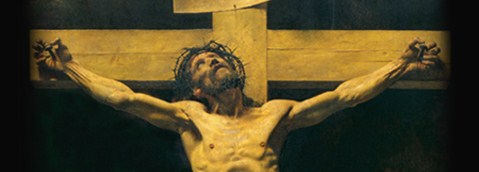
When I survey the wondrous cross
On which the Prince of Glory died,
My richest gain I count but loss,
And pour contempt on all my pride.

See from his head, his hands, his feet,
Sorrow and love flow mingled down!
Did e’er such love and sorrow meet,
Or thorns compose so rich a crown?

Were the whole realm of nature mine,
That were an off'ring far too small;
Love so amazing, so divine,
Demands my soul, my life, my all.

Isaac Watts, 1707
Tune:
ROCKINGHAM (L.M.)
Edward Miller, 1790


(#2 in The Best Church Hymns of 1899 and still fairly high on most lists today)


Two Years Ago: Good Friday

One Year Ago: Good Friday

Sunday, October 31, 2010

Dressed in Living Green


The Jordan River, seen above, sometimes appears in the hymns about heaven that we've seen. The applicable metaphor derives from the story of the Israelites, having escaped from Egypt and spent forty years in the wilderness, finally crossed the Jordan into the land of Canaan, already established in the Old Testament as a place of abundance. Moses, their leader, had seen this promised land across the Jordan (Deuteronomy 34: 1-5) but did not survive long enough to get there.

This text by Isaac Watts draws from that story. It's said to have been inspired partly by a view of green fields over the estuary at Southampton, where Watts often walked. This hymn ranked at #30 in The Best Church Hymns (1899) and still appears in some hymnals, though it might not be quite so highly ranked today. More than one source I consulted called it one of the most beautiful of Watts's hymns.

There is a land of pure delight,
Where saints immortal reign;
Infinite day excludes the night,
And pleasures banish pain.

There everlasting spring abides,
And never with'ring flowers:
Death, like a narrow sea, divides
This heav’nly land from ours.

Sweet fields beyond the swelling flood
Stand dressed in living green:
So to God's people Canaan stood,
While Jordan rolled between.

But timorous mortals start and shrink
To cross this narrow sea;
And linger, shivering on the brink,
And fear to launch away.

O could we make our doubts remove,
Those gloomy thoughts that rise,
And see the Canaan that we love
With unbeclouded eyes!

Could we but climb where Moses stood,
And view the landscape o’er,
Not Jordan’s stream, nor death’s cold flood,
Should fright us from the shore.

Isaac Watts, 1707; alt.
Tune: ROCHESTER (C.M.)
Aaron Wiliams, 1764


Some hymnals have omitted the third and fourth stanzas about doubt, but certainly that was more or less the point for Watts. In his Hymns and Spiritual Songs, where this text was first published, it was titled A Prospect of Heaven Makes Death Easy.

Two hundred years after Watts, Alma White (who would certainly have known this hymn) wrote her own crossing-the-Jordan hymn which we have already seen. Doubt was not a part of her text either, but it doesn't seem that White ever had much to do with doubt, at least in her public persona.

Sunday, September 26, 2010

Safely Reach My Home


Continuing with hymns on the theme of heaven, we come to an interesting collaboration across a century or so. A simple, four stanza text by Isaac Watts, first published in 1707, which appeared under the epigraph The hope of heaven our support under trials on earth speaks of a sort of celestial real estate. It could be set to many different tunes in Common Meter (8.6.8.6.) such as ST. ANNE or WINCHESTER OLD, tunes which were known in Watts's time. However, it has become more familiar in this country with a folk tune from Scotland which was arranged in an early American tune collection titled Kentucky Harmony (1817).

When I can read my title clear
To mansions in the skies,
I'll bid farewell to every fear,
And wipe my weeping eyes.
And wipe my weeping eyes,
And wipe my weeping eyes
I'll bid farewell to every fear,
And wipe my weeping eyes.

Should earth against my soul engage,
And fiery darts be hurled,
Then I can smile at Satan’s rage,
And face a frowning world.
And face a frowning world,
Then I can smile at Satan’s rage,
And face a frowning world.

Let cares, like a wild deluge come,
And storms of sorrow fall!
May I but safely reach my home,
My God, my heav’n, my all.
My God, my heav'n, my all,
May I but safely reach my home,
Ay God, my heav'n, my all.

There shall I bathe my weary soul
In seas of heav’nly rest,
And not a wave of trouble roll,
Across my peaceful breast.
Across my peaceful breast,
And not a wave of trouble roll,
Across my peaceful breast.

Isaac Watts, 1707; alt.
Tune:
PISGAH (8.6.8.6.6.6.8.6.)
Scottish tune, arr. Joseph C. Lowry, 1817


PISGAH, like many hymn tunes, is named for a place in the Bible, the topmost part of Mount Nebo, from which Moses saw the Promised Land. Though a folk tune, we would probably consider it today somewhat more elaborate than a simple Common Meter tune, partly because the tune requires repeating the last two lines over four lines of the tune. Such repetition was more common in eighteenth and early nineteenth century tunes, though not often used in modern hymn tunes (contemporary Christian songs are a different matter; text repetition is one thing often criticized about them).

There may be a few instances of this text in a modern hymnal with a regular Common Meter tune, but I think this is the way it's mostly still remembered and sung.