 This year All Saints' Day falls on a Sunday, meaning that it may be celebrated in more churches than usual (though many places simply observe it on the Sunday nearest November 1). This hymn will undoubtedly be sung by many congregations around the world today, probably as the opening hymn of the service. My own choir will sing this in the “long procession,” the figure-eight path around the sanctuary reserved for special occasions, so it's good this hymn is a long one. In An Annotated Anthology of Hymns (2002), editor J.R. Watson says: The hymn's length is there for a purpose; it allows the mind to dwell on the arduous struggle and its final end in glory. For all the saints, who from their labors rest,
Who thee by faith before the world confessed,
Thy Name, O Jesus, be forever blessed.
Alleluia, Alleluia!
Thou wast their Rock, their Fortress and their might;
Thou, Lord, their Captain in the well-fought fight;
Thou, in their loneliness, their one true Light.
Alleluia, Alleluia!
O blest communion, fellowship divine!
We feebly struggle, they in glory shine;
Yet all are one in thee, for all are thine.
Alleluia, Alleluia!
O may thy soldiers, faithful, true and bold,
Fight as the saints who nobly fought of old,
And win with them the victor’s crown of gold.
Alleluia, Alleluia!
And when the strife is fierce, the warfare long,
Steals on the ear the distant triumph song,
And hearts are brave again, and arms are strong.
Alleluia, Alleluia!
The golden evening brightens in the west;
Soon, soon to faithful warriors comes their rest;
Sweet is the calm of paradise the blessed.
Alleluia, Alleluia!
But lo! there breaks a yet more glorious day;
The saints triumphant rise in bright array;
The host of glory passes on its way.
Alleluia, Alleluia!
From earth’s wide bounds, from ocean’s farthest coast,
Through gates of pearl streams in the countless host,
They sing to Creator, Christ, and Holy Ghost:
Alleluia, Alleluia!
William Walsham How, 1864; alt.
Tune: SINE NOMINE (10.10.10.4.4.)
Ralph Vaughan Williams, 1906This hymn by William Walsham How first appeared in an 1864 collection called Hymns for Saints' Days, and Other Hymns by a Layman (the layman was Horatio Bolton Nelson, not How, who was then a priest and later a bishop in the Church of England). There are three additional stanzas (originally the third, fourth, and fifth) which are not often printed in modern hymnals.
For the Apostles’ glorious company,
Who bearing forth the cross o’er land and sea,
Shook all the mighty world, we sing to thee:
Alleluia, Alleluia!
For the Evangelists, by whose blest word,
Like fourfold streams, the garden of the Lord,
Is fair and fruitful, be thy Name adored.
Alleluia, Alleluia!
For Martyrs, who with rapture kindled eye,
Saw the bright crown descending from the sky,
And seeing, grasped it, thee we glorify.
Alleluia, Alleluia!Though this hymn is generally linked with All Saints' Day it has also been sung on individual saints' days. In some early printings of the hymn, instructions indicated that one of these three stanzas could be sung depending on the status (Apostle, Evangelist, Martyr) of the saint being commemorated. How's text first appeared with music in the Sarum Hymnal (1868), where, as I've mentioned before, it was matched to a tune by Joseph Barnby, also called SARUM, which survived well into the twentieth century. Church Hymns (1874), interestingly, sets it to an Anglican chant tune. Charles Villiers Stanford wrote the tune ENGELBERG for this text in the 1904 edition of Hymns Ancient and Modern, which might have caught on, but two years later, Ralph Vaughan Williams's tune SINE NOMINE appeared in his English Hymnal. SINE NOMINE (literally, “without a name”) is thought to suggest the thousands of saints whose names are unknown to us.SINE NOMINE did not catch on immediately, but by the mid-twentieth century it had generally come to be considered the standard tune for this hymn. Hymns Ancient and Modern resisted the trend, perhaps seeing The English Hymnal as their primary competitor, and matched For all the saints with four different tunes in their 1950 edition (including ENGELBERG and SARUM) but not with SINE NOMINE! However, by 1983, when their New Standard edition was published they finally conceded and used the Vaughan Williams tune, with no alternate suggestions.One Year Ago: The Feast of All Saints
 Composer Charles Villiers Stanford was born on September 30, 1852 in Ireland, but spent most of his life and career in England. He composed a wide variety of pieces: seven symphonies, multiple concertos and chamber works, ten operas, and, of course, much sacred choral music and several hymn tunes (list of works and longer biography at the link above).
He was also an acclaimed organist, conducted several choral groups and festivals, and was named the first professor of composition at the Royal College of Music in 1883. Later, he also taught at Cambridge University. His students included most of the prominent English composers of the next generation: Ralph Vaughan Williams, Samuel Coleridge-Taylor, John Ireland, Charles Wood, and Herbert Howells.
Though Stanford wrote several hymn tunes, only one of them is still in wide use today. ENGELBERG was written in 1904 to be sung with For all the saints, but Ralph Vaughan Williams' tune SINE NOMINE, written only two years later, has become the standard tune for that hymn. Stanford's original version of the tune was much more elaborate than we know it today; each verse had different harmony and not all the verses were sung in unison.
The text most commonly sung today with ENGELBERG is by Fred Pratt Green, and is still under copyright. However, you can see and hear When in our music God is glorified at the Oremus Hymnal site, where they have permission to reproduce it.Some of Stanford's other hymn tunes can be heard at the Cyber Hymnal site, since they are unlikely to be sung in your church. The one I was most curious to hear is called GERONIMO, and I would also like to know how that name came to be matched with the tune. Though it may just be that Stanford thought it was a properly "exotic" one for early 20th-century England.
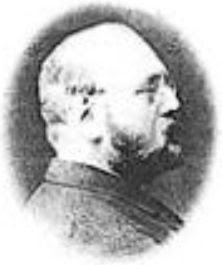 Joseph Barnby (born August 12, 1838) was another Victorian church musician and composer who started his career at an esrly age. At 7 he sang in the choir at York Minster, and at 12 he was already an organist and choirmaster. Later educated at the Royal College of Music, he went on to hold several organist and conductor positions in London. He was knighted in 1892 for his contributions to British music. His compositions include several anthems (one available at the Sibley Music Library site, settings of the evening canticles (one can be found at the Choral Public Domain Library), an oratorio (Rebekah) and a cantata (The Lord is King), as well as many secular partsongs.He edited at least five hymnals, including The Hymnary (1872) and The Home and School Hymnal (1894). Naturally, many of his own hymn tunes found their way into these hymnals, but his tunes were very popular for nearly fifty years, appearing in nearly all the hymnals published in Britain and the US during that time. After his death in 1896, a collection of Barnby's 246 hymn tunes was published (the Cyber Hymnal lists only 58).Here at the blog we have already heard his ST. ANSELM. His tune SARUM was for many years the preferred tune for For all the saints, appearing in many hymnals until SINE NOMINE by Ralph Vaughan Williams became more popular. The same thing happened to most of his tunes as the Victorians fell out of favor with hymnal editors in the mid- twentieth century. His only tune that remains in somewhat wide use is LAUDES DOMINI, for When morning gilds the skies.
This one also remains in some (maybe only Episcopal?) hymnals.Now the day is over,Night is drawing nigh,Shadows of the eveningSteal across the sky.Jesus, give the wearyCalm and sweet repose;With thy tenderest blessingMay mine eyelids close.Grant to little childrenVisions bright of thee;Guard the sailors tossingOn the deep, blue sea.Through the long night watchesMay thine angels spreadTheir bright wings above me,Watching round my bed.When the morning wakens,Then may I arisePure, and fresh, and sinlessIn thy holy eyes.Sabine Baring-Gould, 1867Tune: MERRIAL (6.5.6.5.)Joseph Barnby, 1868This is an somewhat unique tune in that the melody, usually important, is not all that interesting. This hymn really requires the participation of a choir, or at least a congregation that will sing the four-part harmony to have its full effect. Baring-Gould, author of the text, had written a tune of his own for it, called EUDOXIA, but it's Barnby's tune that prevailed.This is another of those Victorian children's hymns that have come to be used in general worship, though it's borderline twee, with the "sailors tossing on the deep, blue sea." Another verse I left out (the original second):Now the darkness gathers,Stars begin to peep,Birds, and beasts and flowersSoon will be asleep.Practically Walt Disney, with the sleeping flowers and the peeping stars.


