Composer and songbook editor John R. Sweney (1837-1899) loved music all his life. He began teaching music in schools and leading Sunday School music as a teen, and a few years later began to study in earnest, taking lessons in piano and violin, while at the same time conducting a number of choral groups both sacred and secular.
It's estimated that he wrote tunes for more than a thousand gospel songs, and wrote texts for some of them as well. He edited many songbooks for the firm of John J. Hood in Philadelphia, as well as a few other publishers, and collaborated with most of the famous songwriters of his day, including, of course, Fanny Crosby. It appears that this Christmas song by Sweney and Crosby was first published in Bright Melodies for the Sunday School and Young People's Societies (1899), though copyrighted a year earlier - probably in time for Sweney's Christmas celebrations in 1898.
Come away, the bells are calling,
Merry bells of Christmas time;
Youthful hearts again are bounding
While we catch their tuneful chime.
Refrain
Merry, merry bells, merry, merry bells,
Listen to their carol and the joy it tells;
Ringing far and near, ringing sweet and clear,
O the blessèd music of the old-time bells.
Come away, they still are calling,
While, to crown our festal scene,
Busy fingers now are twining
Wreaths of holly bright and green
Refrain
Come away, our faith is calling,
And we look with loving eyes
On a lowly manger cradle
Where the infant Savior lies.
Refrain
Fanny Crosby, 1898
Tune: BELLS ARE CALLING (8.7.8.7. with refrain)
John R. Sweney, 1898
Eight Years Ago: A year of precious blessings
Seven Years Ago: John Robson Sweney (with more Christmas Fanny Crosby)
Six Years Ago: William Orcutt Cushing
One Year Ago: The winter night was dark and still
Showing posts with label John R. Sweney. Show all posts
Saturday, December 31, 2016
Sunday, April 17, 2016
Flowing, Ever Flowing
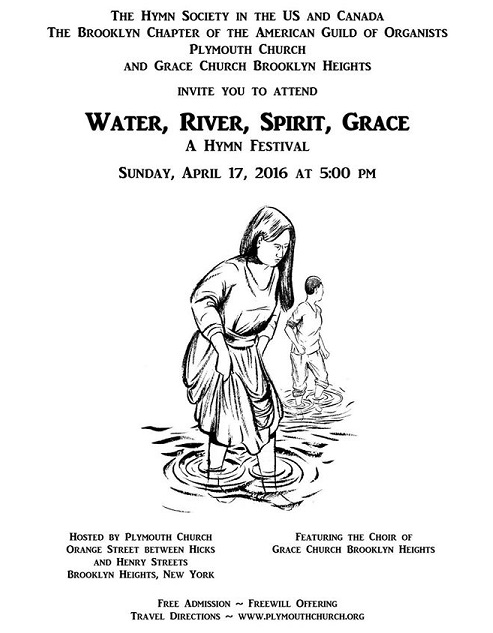
Back to the topic of water today, on my mind because of a hymn festival on this theme which I will attend today (see the flyer below) in Brooklyn at the historic Plymouth Church of the Pilgrims.
Today's song comes from Spiritual Songs (1908), a collection published in Chicago by the Christian Witness Company. It originally appeared with another tune called LOS FELIZ by John M. Harris, the book's editor, but I like this tune by John Sweney better because it varies the rhythm of the lines a bit more.
Oh, this well of living water
Springing up within my soul,
Gives me blessèd satisfaction
While the changing seasons roll;
And in Jesus’ love rejoicing,
Still a song of praise I bring,
For the blessèd gift of heaven,
For this ever-living spring.
Refrain
For this well of living water
That is flowing now for me,
Songs of praise and adoration,
Jesus, may I bring to thee.
From the depths unknown ’tis flowing,
From the depths of Jesus’ love,
It was purchased by the Savior,
Gift divine from heav’n above;
Christ alone can give this water,
Whosoever will may come,
Quench our thirst from this pure fountain,
And from Jesus never roam.
Refrain
So the blessèd news I’m spreading
Of this dear life-giving spring,
Ever pure and free ’tis gushing
As my Savior’s love I sing;
It is flowing, ever flowing
In this grateful heart of mine,
And my tongue shall tell the gladness
Of this matchless grace divine.
Refrain
W.V. Miller, 1908; alt.
Tune: HILLSDALE (8.7.8.7.D. with refrain)
John R. Sweney, 1884
Author W. V. Miller (as listed at the Cyber Hymnal site) may be the same person as Will V. Miller (listed at Hymnary.org as author of a different song published earlier).
Click on the tag below to see several more hymns on the "water" theme that have appeared here on the blog, some familiar and others less so. And who knows, someone reading this may just be in Brooklyn and free to join us this afternoon.
Sunday, February 27, 2011
William James Kirkpatrick
Composer William James Kirkpatrick was born today in 1838 in Duncannon, PA. His father was a music teacher, so William studied music from an early age and learned to play different musical instruments. At sixteen he left home to further his music studies, including composition, in Philadelphia. He supported himself through carpentry and joined the Wharton Street Methodist Episcopal Church, accompanying and singing in the choir. When he was just twenty-one, several of his tunes appeared in Devotional Melodies (1859), published by A.J. Jenks. who, in the book's introduction, thanks "Mr. W. J. Kirkpatrick for the simple and appropriate arrangement of a large number of the musical compositions found in this book." Two years later, during the early years of the Civil War, he served as fife major and principal musician for the 91st Regiment Pennsylvania Volunteers. He returned from the war and went into the furniture business in Philadelphia, though church music remained a very active sideline.
Following the death of his first wife in 1878 he decided to devote himself to music full-time, and for several years thereafter was the organist and music director at Grace Methodist Episcopal Church. His tunes were now in great demand and he also began editing and compiling songbooks either alone or in collaboration with others. John R. Sweney was a friend and frequent collaborator.
His most enduring tune is probably CRADLE SONG, one of the tunes sung with Away in a manger (though it's used with other texts too). Another one already seen here is O spread the tidings round. Many will probably remember this well-known tune of Kirkpatrick's which first appeared in Sweney's Songs of Redeeming Love (1882) with a text by Priscilla Owens, a Methodist Sunday School teacher in Baltimore who wrote several songs for her students which were later published.
Jesus saves! Jesus saves!
Spread the tidings all around:
Jesus saves! Jesus saves!
Bear the news to every land,
Climb the mountains, cross the waves;
Onward! ’tis our God’s command;
Jesus saves! Jesus saves!
Waft it on the rolling tide:
Jesus saves! Jesus saves!
Tell to people far and wide:
Jesus saves! Jesus saves!
Sing, you islands of the sea;
Echo back, you ocean caves;
Earth shall keep the jubilee:
Jesus saves! Jesus saves!
Sing above the battle strife:
Jesus saves! Jesus saves!
Sing of love and endless life:
Jesus saves! Jesus saves!
Shout it brightly through the gloom,
When the heart for mercy craves;
Sing in triumph o’er the tomb:
Jesus saves! Jesus saves!
Give the winds a mighty voice:
Jesus saves! Jesus saves!
Let the nations now rejoice:
Jesus saves! Jesus saves!
Shout salvation full and free;
Highest hills and deepest caves;
This our song of victory:
Jesus saves! Jesus saves!
Priscilla J. Owens, 1882; alt.
Tune: SALVATION (7.6.7.6.7.7.7.6.)
William J. Kirkpatrick, 1882
Kirkpatrick would go on to compile or collaborate on more than eighty songbooks and write more than a thousand vocal compositions, including gospel songs, anthems, and solo songs. You can see about half of the book titles and several of his tunes at his Cyber Hymnal page. He eventually became a publisher himself as president of the Praise Publishing Company. He died in 1921, only four years after marrying his third wife (who had been the widow of John Sweney), while working on one last tune.
Two Years Ago: Charles Hubert Hastings Parry
Thursday, November 18, 2010
R. Kelso Carter
Russell Kelso Carter, born today in Baltimore in 1849, was a man of several careers, including military cadet, professor of chemistry, civil engineering, and advanced mathematics, sheep rancher, Methodist deacon and evangelist, and finally physician. Somewhere in there he also wrote and composed several gospel songs and helped compile two hymnbooks. Carter graduated from the Pennsylvania Military Academy (now Widener University) in 1867. He returned to the Academy shortly thereafter to begin his teaching career, but health problems interrupted it and he moved to California for three years to work an a sheep ranch, returning to the Academy again in 1879. Around this time he started to become involved with the Methodist Episcopal Church, attending camp meetings and starting to write gospel songs. He collaborated with John R. Sweney on Hymns of Perfect Love (1886) and with A.B. Simpson on Hymns of the Christian Life (1891).
The introduction to that second collection (which includes our previously-seen Carter song as #1) begins with a discussion that remains as topical today as it was then:
The musical taste of our day is in a state of transition. Beyond controversy, the people will have new tunes and hymns that move in a more spirited time than those which our fathers (and mothers! CWS) sang. But this fact should not send us to an extreme, and cause us to relegate all the old hymns to the dusty past. (...) Between the Scotch Psalter and the Salvation Army Song Book there is a wide stretch of territory in which the careful explorer will find much that is good, and possessing that rare quality, endurance.
How many hymnals and songbooks before and after Carter's time, right up to the present, contain a similar paragraph!
This is Carter's most well-known song, for which he wrote both words and music, and which first appeared in his earlier collection of 1886. It has been said that it evokes a martial mood similar to songs he might have known from his military school days.
Standing on the promises of Christ, my King,
Through eternal ages let the praises ring,
Glory in the highest, I will shout and sing,
Standing on the promises of God.
Refrain
Standing, standing,
Standing on the promises of God my Savior;
Standing, standing,
I’m standing on the promises of God.
Standing on the promises that cannot fail,
When the howling storms of doubt and fear assail,
By the living Word of God I shall prevail,
Standing on the promises of God.
Refrain
Standing on the promises I cannot fall,
List'ning every moment to the Spirit’s call
Resting in my Savior as my all in all,
Standing on the promises of God.
Refrain
R. Kelso Carter, 1886
Tune: PROMISES (11.11.11.9. with refrain)
Throughout his life Carter faced several serious health challenges, which led him to explore different theories and means of faith healing, which you can read more about here. It appears that a serious dispute developed in the 1890s which may have caused his moving away from his evangelistic work. He studied medicine and became a doctor sometime before 1900, practicing until his death in 1928. He came to believe that both medicine and prayer were necessary for healing, and that God provided both to us for that purpose.

Thursday, February 11, 2010
Fanny Crosby
Last week I mentioned that the Episcopal Church calendar has added many "provisional" commemorations this year, and today is one of the new ones most relevant to hymn lovers.Fanny Crosby has been newly placed on this calendar (one day before the anniversary of her death in 1915), though, as the linked lectionary site points out, none of her works appear in the current denominational Hymnal 1982 (or its immediate predecessor, the Hymnal 1940). In fact, I'm not yet sure whether any of her gospel songs made it to the "official" denominational hymnals of 1871, 1892, or 1916; their indexes are not as robust as modern-day hymnals generally boast, but I haven't found any yet.
However, she has often appeared in supplemental Episcopalian books, from the current Voices Found (2003) which has Blessed assurance and To God be the glory, to Lift Every Voice and Sing II, all the way back to The Mission Hymnal (1885) and the earliest one I've found, the Hymnal for Children (1877), which included Holy, Holy, Holy is the Lord.
This one probably did not appear in any Episcopalian collections, but it's my most recent Fanny "find."
When the clouds hang low and heavy,
And the rolling surge we hear,
When no earthly pow’r can shield us
From the storm that most we fear,
O ’tis then our Savior’s presence
To the trusting heart is shown,
In a bright and glorious vision
Of the rainbow 'round the throne.
Refrain
O the rainbow 'round the throne!
Lovely rainbow 'round the throne!
Ever brilliant, ever sparkling
Shines the rainbow 'round the throne.
When we stand amid the conflict
Of the battle raging high,
When the tempter seems to triumph,
And our friends despairing fly,
With the fleetness of an arrow
God’s protecting care is shown,
In the brightness that descendeth
From the rainbow 'round the throne.
Refrain
When the veil of time is lifted,
And the shadows melt away,
When we fall asleep in Jesus,
And awake in endless day,
When the battle march is ended,
And our cares and tears have flown,
We shall gaze, and gaze forever,
On the rainbow 'round the throne.
Refrain
Fanny Crosby, 1891; alt.
Tune; RAINBOW ROUND (8.7.8.7.D. with refrain)
John R. Sweney, 1891
I think Fanny would have appreciated this honor, even though she herself was a Methodist. She knew that her songs were sung across many denominations, and we know that they still are.
I like the prayer appointed for this day:
O God, the blessed assurance of all who trust in thee: We give thee thanks for thy servant Fanny Crosby, who, though blind from infancy, beheld thy glory with great clarity of vision and spent her life giving voice to thy people’s heartfelt praise; and we pray that we, inspired by her words and example, may rejoice to sing of thy love, praising our Savior all the day long; who livest and reignest with thee and the Holy Spirit, one God in perfect harmony, now and for ever. Amen.
One Year Ago: Washington Gladden
Subscribe to:
Posts (Atom)