Showing posts with label gospel songs. Show all posts
Sunday, May 20, 2018
The Feast of Pentecost
Come, Holy Ghost, my spirit fill,
Till every trembling chord
With love’s ecstatic music thrill,
In full and sweet accord!
Refrain
Open the beautiful windows of heav’n,
The best of thy bountiful blessings send down;
Come, let the Spirit’s anointing be giv’n,
The faith of thy people crown.
Thy will, O God, be done in me;
Attune my will to thine,
That so my life a song may be
Of harmony divine.
Refrain
Then shall my life make melody,
And testify to thee,
Till other hearts enraptured be,
And thy salvation see.
Refrain
Come, Holy Ghost, come in! come in!
Inflame my waiting soul!
Forever dwell and reign within,
With love’s supreme control.
Refrain
Henry B Hartzler, 1891; alt.
Tune: BOUNTIFUL BLESSINGS (C.M. with refrain)
Ira O. Hoffman, 1891
Ten (Liturgical) Years Ago: Joy! because the circling year
Nine (Liturgical) Years Ago: O prophet souls of all the years
Eight (Liturgical) Years Ago: Above the starry spheres
Seven (Liturgical) Years Ago: Hail thee, festival day
Six (Liturgical) Years Ago: Hail festal day! through every age
Five (Liturgical) Years Ago: O God, the Holy Ghost
Four (Liturgical) Years Ago: Spirit of grace and health and pow'r
Three (Liturgical) Years Ago: Come, O come, thou quick'ning Spirit
Two (Liturgical) Years Ago: Our blest Redeemer, ere he breathed
One (Liturgical) Year Ago: Come, Holy Ghost
Sunday, July 23, 2017
Gushing From the Rock Before Me
Fanny Crosby (1820-1915) is definitely in the running to be the most well-known woman to write texts for congregational singing, even today when the musical style that accompanied most of her songs is somewhat out of fashion in many places.
Several contemporary composers around the world have written new tunes for some of her texts, and more than one recording has been made (though this is the only one that seems to be readily available). Since most of her songs were written in the contemporaneous gospel song/Sunday School style, including a refrain that helped with memorization, they don't generally match well to existing tunes.
There are exceptions. I've always thought that this is one of her most accomplished texts (still unused here in the past nine years), and since it does not include the usual refrain, it could be paired with a more conventional hymn tune, and sung in places that might never consider singing one of her songs.
All the way my Savior leads me;
What have I to ask beside?
Can I doubt his tender mercy,
Who through life has been my guide?
Heav’nly peace, divinest comfort,
Here by faith in Christ to dwell!
For I know, whate’er befall me,
Jesus doeth all things well.
All the way my Savior leads me,
Cheers each winding path I tread;
Gives me grace for every trial,
Feeds me with the living bread.
Though my weary steps may falter,
And my soul athirst may be,
Gushing from the rock before me,
Lo! A spring of joy I see.
All the way my Savior leads me
O the fullness of his love!
Perfect rest to me is promised
In my heav'nly home above.
When my spirit, clothed immortal,
Wings its flight to realms of day
This my song through endless ages—
Jesus led me all the way.
Fanny Crosby, 1875; alt.
Tune: WEISSE FLAGGEN (8.7.8.7.D.)
Tochter Sion, 1741
This hardly replaces the original setting by Robert Lowry, which will continue to be sung. However, this text could also work with HYFRYDOL, IN BABILONE, HOLY MANNA, NETTLETON, and other familiar tunes.
The gravestone above (erected in 1955 at her burial site) refers to Crosby's "more than 3000 hymns and poems," which is true as far as it goes, but the real number could be more than twice as many, especially when her unpublished texts are included.
Of course, her songs are still usually sung in their original form, not only as the occasional selection in Sunday worship, but also at special events, such as a Fanny Crosby hymn sing recently held in her home town of Southeast, New York, sponsored by the local historical society. Sometimes churches will use one writer's texts for an entire service, and today's service at MCC of the Coachella Valley in California includes all Crosby songs. Many people would still happily sing the playful refrain:
Pastor, Pastor, hear my irate cry --
When you pick the hymns for Sunday,
Don't pass Fanny by!
(Scroll down at this link for the whole text.)
Sunday, April 16, 2017
Easter Sunday
Happy Easter!
We usually think of gospel songs as general in theme or subject, but given the great volume of them that were produced in the late nineteenth and early twentieth century, many were also written for particular occasions such as Christmas and Easter. Of course, this is true of hymns in general as well. We've seen several of the Christmas gospel songs over the years here, but not so many of those written for the Easter season (with one main exception, which is still often sung today).
Naturally, with approximately eight thousand songs to her credit, Fanny Crosby must have written some for Easter, and here's one.
Jesus Christ is risen today,
He is ris'n indeed!
Jesus Christ is risen today,
He is ris'n indeed!
Who, captive led captivity,
Who robbed the grave of victory,
Who broke the bars of death,
Who broke the bars of death!
Refrain:
Hallelujah, hallelujah,
Hallelujah, Amen.
Hallelujah, hallelujah,
Hallelujah, Amen.
Hallelujah, Amen.
Hallelujah, hallelujah,
Hallelujah, Amen.
And sing with one united voice;
The Savior rose today,
The Savior rose today.
Refrain
Break forth in tuneful melody,
And swell the mighty song,
And swell the mighty song.
Refrain
Fanny Crosby, 1869; alt.
Tune: UNITED VOICE (L.M. with refrain)
Chester G. Allen, 1869
Eight (Liturgical) Years Ago: Christ is risen! Alleluia!
Seven (Liturgical) Years Ago: The strife is o'er, the battle done
Five (Liturgical) Years Ago: Jesus Christ is risen today
Four (Liturgical) Years Ago: Lift your voice rejoicing, Mary
One (Liturgical) Year Ago: Christ Jesus lay in death's strong bands
Saturday, December 31, 2016
John Robson Sweney (Day Seven)
Composer and songbook editor John R. Sweney (1837-1899) loved music all his life. He began teaching music in schools and leading Sunday School music as a teen, and a few years later began to study in earnest, taking lessons in piano and violin, while at the same time conducting a number of choral groups both sacred and secular.
It's estimated that he wrote tunes for more than a thousand gospel songs, and wrote texts for some of them as well. He edited many songbooks for the firm of John J. Hood in Philadelphia, as well as a few other publishers, and collaborated with most of the famous songwriters of his day, including, of course, Fanny Crosby. It appears that this Christmas song by Sweney and Crosby was first published in Bright Melodies for the Sunday School and Young People's Societies (1899), though copyrighted a year earlier - probably in time for Sweney's Christmas celebrations in 1898.
Come away, the bells are calling,
Merry bells of Christmas time;
Youthful hearts again are bounding
While we catch their tuneful chime.
Refrain
Merry, merry bells, merry, merry bells,
Listen to their carol and the joy it tells;
Ringing far and near, ringing sweet and clear,
O the blessèd music of the old-time bells.
Come away, they still are calling,
While, to crown our festal scene,
Busy fingers now are twining
Wreaths of holly bright and green
Refrain
Come away, our faith is calling,
And we look with loving eyes
On a lowly manger cradle
Where the infant Savior lies.
Refrain
Fanny Crosby, 1898
Tune: BELLS ARE CALLING (8.7.8.7. with refrain)
John R. Sweney, 1898
Eight Years Ago: A year of precious blessings
Seven Years Ago: John Robson Sweney (with more Christmas Fanny Crosby)
Six Years Ago: William Orcutt Cushing
One Year Ago: The winter night was dark and still
Wednesday, December 28, 2016
Even Children the Anthem Ring (Day Four)
Peace upon earth! the angels sang,
Good will unto all! the chorus rang,
Glory to God! the Christ has come,
A bright star shines in the clear blue dome.
Refrain
Joyously sing, praises we bring,
Joyously sing, praises we bring!
Loud hallelujahs to Christ we sing!
Peace upon earth! ’tis sounding still,
Glory unto God, to all good will!
Bethlehem’s song, ’tis caught from far,
And lifted up, to that glowing star.
Refrain
Jesus has come! it echoes wide,
Thro’ valley and plain, on mountainside;
But not alone the angels sing,
For even children the anthem ring.
Refrain
Yes! let them sing, for Christ has laid
His hand with a blessing on their head;
Sweeter to him than angels’ tones
Are songs that come from the little ones.
Refrain
Julia A. Mathews, 1871
Tune: PEACE UPON EARTH (8.8.8.9. with refrain)
Robert Lowry, 1871
One genre that has all but disappeared in our modern Yuletide celebrations is the Christmas gospel song, though I have excavated a few in our two previous Twelve Days of Christmas outings (such as the one at the Seven Year link below), and there's at least one more coming up this season. Gospel songs, also known as Sunday School songs, were the contemporary Christian music of their day (peaking between 1870 and 1920 or so) and very few of the thousands of pieces written and published are still sung today, let alone those on the theme of Christ's birth.
Robert Lowry, who wrote both words and music at various times, does have some familiar songs that we still sing today, such as: Shall we gather at the river and Marching to Zion but I'd imagine that it's been many years since anyone sang this Christmas song which was published in his collection Pure Gold for the Sunday School (1871). He did manage to contribute one surviving gospel song to the Easter repertory: Low in the grave you lay.
Seven Years Ago: Peaceful the wondrous night
One Year Ago: Calm on the listening ear of night
Thursday, October 13, 2016
Knowles Shaw
Today is the birthday of evangelist and gospel song writer Knowles Shaw, born near New London, Ohio. He began to play the violin at the age of ten (the instrument was given to him by his dying father), and eventually played at public dances. One story claims that his conversion to Christianity happened suddenly, in the middle of a dance, and he immediately stopped the song he was playing and left the building.
Shaw was baptized in the Churches of Christ in 1852, and over the next few years he married and started a family, initially supporting them by working as a farmhand. In 1858 he was first asked to speak in a worship service, and before long his gifts for speaking and music would lead to the career he would follow for the rest of his life.
He became known as the "Singing Evangelist," traveling around the western and southern United States leading revival meetings. During the day he would introduce himself around town, inviting people to the meeting that night, which he would begin by leading about a half hour of congregational singing, followed by delivering a sermon, and sometimes baptizing several people. Estimates of the number of persons he baptized range from 11,000 to 20,000, depending on which source you read.
He also turned his musical skills and scriptural knowledge to the writing and publishing of gospel songs (sometimes the words, sometimes the music, often both) which he then introduced in his meetings (much like his contemporary Ira Sankey). Between 1868 and 1878 he brought out five songbooks, largely made up of his own songs, including Sparkling Jewels (1871), The Golden Gate (1874) and The Morning Star (1877).
In looking at the writers of hymns and songs from previous generations, it's always a bit remarkable to encounter someone who wrote dozens and dozens of songs, and yet only one of those remains known today. This song by Shaw soon became his most popular, while the dozens of others faded away. The online hymn sites only list a fraction of his work, apparently not having thoroughly mined his five collections.
Sowing in the morning, sowing seeds of kindness,
Sowing in the noontide and the dewy eve;
Waiting for the harvest, and the time of reaping,
We shall come rejoicing, bringing in the sheaves.
Refrain
Bringing in the sheaves, bringing in the sheaves,
We shall come rejoicing, bringing in the sheaves,
Bringing in the sheaves, bringing in the sheaves,
We shall come rejoicing, bringing in the sheaves.
Sowing in the sunshine, sowing in the shadows,
Fearing neither clouds nor winter’s chilling breeze;
By and by the harvest, and the labor ended,
We shall come rejoicing, bringing in the sheaves.
Refrain
Going forth with weeping, sowing for the Savior,
Though the loss sustained our spirit often grieves;
When our weeping’s over, Christ will bid us welcome,
We shall come rejoicing, bringing in the sheaves.
Refrain
Knowles Shaw, 1874; alt.
Tune: BRINGING IN THE SHEAVES (6.6.6.5. with refrain)
George Minor, 1880
When this song was first published in The Golden Gate (it was #9, if you want to check the link above) Shaw had written both text and tune, but that tune was replaced by another after Shaw's death.
On June 7, 1878, Shaw was traveling by train to McKinney, Texas when the train derailed. He died saving the life of another passenger. The Reverend William Baxter, also associated with the Churches of Christ, wrote The Life of Knowles Shaw, the Singing Evangelist (1879).
Sunday, August 28, 2016
Ira David Sankey
Evangelist and composer Ira David Sankey was born today in Edinburg, Pennsylvania (near the Ohio border) in 1840. In his autobiography, he recounts how singing was a part of his life from his earliest memories:
"... it was one of my chief joys to meet with other members of our family around the great log fire in the old homestead, and spend the long winter evenings singing with them the good old hymns and tunes of the church, which was the only music we had in those days."
Church attendance provided him with another place to sing, and by the time he was in high school he was leading the choir at a Methodist church in New Castle. He campaigned for the installation of an organ, which had been considered "wicked and worldly" and eventually succeeded ("Only one or two of the old members left the church during the singing."). After he traveled to Ohio for a musical convention where he met composer William B. Bradbury, his father was unsure about his chosen occupation:
"I am afraid that boy will never amount to anything; all he does is run about the country with a hymn-book under his arm."
Following military service in the Civil War, Sankey returned home, married Fanny Edwards, a member of his choir, and joined his father working for the newly-established Internal Revenue Service, which may have temporarily assuaged his father's misgivings. But Ira met evangelist Dwight Moody in 1870 at a YMCA convention in Indianapolis, and when he joined Moody's organization a few years later his subsequent career could have been characterized as "running about the world with a hymn-book under his arm!" Sankey became the song leader for the internationally-acclaimed revivals that Moody led. Moody had recognized Sankey's talents immediately and knew that the power of congregational singing would be key to the success of his work.
They introduced gospel songs to millions over the course of their careers, believing that style was most conducive to their message. Sankey compiled the songs that they used into a popular series of hymn-books titled Gospel Hymns, and these volumes were later combined into one. The profits from these books enabled Sankey to build a new YMCA building and to buy a lot for his church in his home town, among many other contributions.
Most of the songs used by Sankey and Moody were contemporary works, written and composed by popular names of the day such as Fanny Crosby, Philip P. Bliss, William Howard Doane, Lucy Rider Meyer, Robert Lowry, George C. Stebbins, and many others. However, they also used older texts that would have been known to their audiences, often adding new tunes that were more in keeping with the music of their revival events (as the retuned hymns movement does today). This eighteenth century text by Philip Doddridge (with additional stanzas added some years later by Augustus Montague Toplady) was sung to a new gospel tune (and with an added refrain) by Sankey.
Grace, ’tis a charming sound,
Harmonious to my ear;
Heaven with the echo shall resound,
And all the earth shall hear.
Refrain:
Saved by grace alone!
This is all my plea;
Jesus died for humankind,
And Jesus died for me!
Grace first inscribed my name
In God’s eternal book;
’Twas grace that brought me to the Lamb,
Who all my sorrows took.
Refrain
Grace led my roving feet
To tread the heavenly road,
And new supplies each hour I meet,
While pressing on to God.
Refrain
Grace taught my soul to pray
And made my eyes o’erflow;
’Twas grace which kept me to this day,
And will not let me go.
Refrain
O let thy grace inspire
My soul with strength divine
May all my powers to thee aspire,
And all my days be thine.
Refrain
Philip Doddridge, 1740 (st. 1, 3, 5); alt.
Augustus Montague Toplady, 1776 (st. 2, 4); alt.
Tune: CHARMING GRACE (S. M. with refrain)
Ira David Sankey, 19th cent.
On YouTube you can see a video by a singer named Dave Willetts who portrays Sankey (alongside an unidentified actor as Moody) and leads a choir in some of his songs.
Seven Years Ago: Ira David Sankey
Five Years Ago: William Hiley Bathurst
Three Years Ago: William Hiley Bathurst
Friday, July 29, 2016
Hymns in the News
Last night at the Democratic National Convention, you may have seen the Reverend Dr. William J. Barber II of North Carolina, whose speech culminated with the last stanza of a nineteenth-century gospel song.
Okay, he didn't sing it, but gospel songs in any form don't often make it to the stage of a national political convention.
We praise thee, O God!
For the Son of thy love,
For Jesus who died,
And is now gone above.
Refrain
Hallelujah! Thine the glory.
Hallelujah! Amen.
Hallelujah! Thine the glory.
Revive us again.
We praise thee, O God!
For the Spirit of life,
Who hath shown us our Savior,
And scattered our strife.
Refrain
Revive us again;
Fill each heart with thy love;
May each soul be rekindled
With fire from above.
Refrain
William P. Mackay, 1863; alt.
Tune: REVIVE US AGAIN (5.6.7.5. with refrain)
John J. Husband, 1815
(The whole speech is well worth your time -- watch it again even if you saw it last night.)
Eight Years Ago: Martha and Mary
Six Years Ago: Lazarus, Mary, and Martha
Tuesday, April 26, 2016
Horatio R. Palmer
On the birthday of Baptist composer Horatio Richmond Palmer (1834-1907) we remember a man dedicated to spreading sacred song as far as possible.
Palmer's various musical occupations were described here six years ago (music teacher, choir leader and organizer, writer of gospel song tunes and texts, editor of fifty hymn and song collections, author of several books on music and other subjects) but he was even busier than that. From 1877-1891 he led the Summer School of Music at the Chautauqua Institution, a program that has continued to expand to the present day. While there he must have met hymnwriters Mary Lathbury and William Fisk Sherwin. For eleven years he also directed the choir at the Broome Street Tabernacle in New York City.
Today's tune by Palmer (with text by Fanny Crosby) appeared first in Our Treasury of Song (1883) compiled by Hubert P. Main and published by Biglow & Main, probably the largest producer of Sunday School music and gospel songs in its day. You can imagine this as a popular marching song for children, but adults probably liked it too.
Sing praise to God,
Joyfully sound hosanna,
Praising God with glad acclaim.
Lift up your hearts
Unto the throne with gladness,
Magnify God's holy name.
Marching along
Under that banner bright,
Trust in promised mercy as we go,
God's light divine
Tenderly o’er us will shine,
Guided by God's protecting hand
Now and forever.
Refrain
Steadily marching on,
With our banners waving o’er us;
Steadily marching on,
While we sing the joyful chorus;
Steadily marching on,
Pillar and cloud going before us,
To the realms of glory
To our home on high.
Sing praise to God,
Ruler on high eternal,
Glory be to God on high.
Sing praise to God,
Tell of that loving kindness,
Join the chorus of the sky.
Still marching on,
Cheerily marching on,
In the ranks of heaven we will go,
Home to our rest,
Joyfully home where the blest
Gather and sing our Maker’s name,
Praising forever.
Refrain
Fanny Crosby, 1883; alt.
Tune: STEADILY MARCHING ON (Irregular with refrain)
Horatio R. Palmer, 1883
The picture below is a musical autograph of Palmer's which quotes one of his most famous songs, Yield not to temptation (1868).
Six Years Ago: Horatio R. Palmer
Sunday, April 17, 2016
Flowing, Ever Flowing
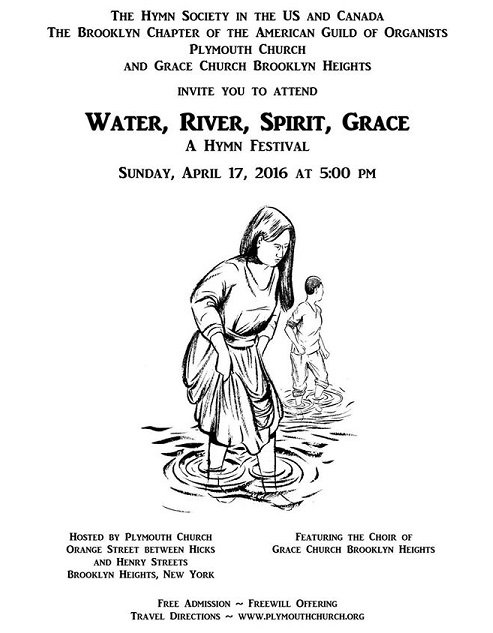
Back to the topic of water today, on my mind because of a hymn festival on this theme which I will attend today (see the flyer below) in Brooklyn at the historic Plymouth Church of the Pilgrims.
Today's song comes from Spiritual Songs (1908), a collection published in Chicago by the Christian Witness Company. It originally appeared with another tune called LOS FELIZ by John M. Harris, the book's editor, but I like this tune by John Sweney better because it varies the rhythm of the lines a bit more.
Oh, this well of living water
Springing up within my soul,
Gives me blessèd satisfaction
While the changing seasons roll;
And in Jesus’ love rejoicing,
Still a song of praise I bring,
For the blessèd gift of heaven,
For this ever-living spring.
Refrain
For this well of living water
That is flowing now for me,
Songs of praise and adoration,
Jesus, may I bring to thee.
From the depths unknown ’tis flowing,
From the depths of Jesus’ love,
It was purchased by the Savior,
Gift divine from heav’n above;
Christ alone can give this water,
Whosoever will may come,
Quench our thirst from this pure fountain,
And from Jesus never roam.
Refrain
So the blessèd news I’m spreading
Of this dear life-giving spring,
Ever pure and free ’tis gushing
As my Savior’s love I sing;
It is flowing, ever flowing
In this grateful heart of mine,
And my tongue shall tell the gladness
Of this matchless grace divine.
Refrain
W.V. Miller, 1908; alt.
Tune: HILLSDALE (8.7.8.7.D. with refrain)
John R. Sweney, 1884
Author W. V. Miller (as listed at the Cyber Hymnal site) may be the same person as Will V. Miller (listed at Hymnary.org as author of a different song published earlier).
Click on the tag below to see several more hymns on the "water" theme that have appeared here on the blog, some familiar and others less so. And who knows, someone reading this may just be in Brooklyn and free to join us this afternoon.
Friday, April 15, 2016
Lelia Naylor Morris
Today is the birthday of Lelia Naylor Morris, who reportedly wrote more than a thousand gospel songs in her lifetime (only a fraction of them are available to see online). Born in Ohio, she and her four siblings were primarily raised by her mother after the death of her father, a Civil War veteran.
Lelia began studying piano as a child, practicing at a neighbor's house because her family could not afford one at home, and by age 12 she was playing the organ for prayer meetings. She learned to sew in her mother's millinery shop and expected that she would probably work there for the rest of her life, even after her marriage to Methodist minister Charles Morris.
She and her husband often attended revivals and outdoor camp meetings, and eventually she tried her hand at writing some songs (both words and music) in that style, which were taken up by the revival leaders and eventually began to be published. She became very successful at this and continued to attend the camp meetings, which in turn inspired her to write more, based on the stories and testimonies of the other worshippers.
Out on life’s ocean with perils ever nigh,
I have a pilot on whom I can rely;
With him to guide me, life’s storms I can defy,
’Tis Christ of Galilee.
Refrain
Jesus, my pilot on life’s stormy sea,
This wondrous Christ of Galilee;
I’m safe in his keeping,
Tho’ storms are round me sweeping,
This pilot of Galilee.
Wondrous his power and matchless is his skill,
Billows and tempests obey his sovereign will.
Hushed into silence at his blest "Peace, be still,"
’Tis Christ of Galilee.
Refrain
Fierce was the tempest once raging in my soul,
When of my bark he, my pilot, took control.
With voice commanding above the thunder’s roll,
’Tis Christ of Galilee.
Refrain
Hear it, ye storm-tossed, with grief and with sin,
Why will ye not take the heav’nly pilot in?
Safely he’ll guide you, the haven blest to win,
’Tis Christ of Galilee.
Refrain
Lelia N. Morris, 1912; alt.
Tune: PILOT OF GALILEE (Irregular with refrain)
Lelia N. Morris, 1912
Eight Years Ago: Ada Rose Gibbs
Seven Years Ago: Lelia Naylor Morris
Five Years Ago: Lelia Naylor Morris
Subscribe to:
Posts (Atom)