Showing posts with label Samuel Sebastian Wesley. Show all posts
Wednesday, June 28, 2017
Saint Peter and Saint Paul
With golden splendor and with roseate hues of morn,
O gracious Savior, Light of light, this day adorn,
Which brings to faithful servants hopes of that far home
Where saints and angels sing the tale of martyrdom.
Good Shepherd, Peter, unto whom the charge was given
To close or open ways of pilgrimage to heaven,
In sin's hard bondage held may we have grace to know
The full remission thou was granted to bestow.
O noble Teacher, Paul, we trust to learn to thee
Both earthly converse and the flight of ecstasy;
Till from the fading truths that now we know in part
We pass to fullness of delight for mind and heart.
Twin olive branches, pouring oil of gladness forth,
Your prayers shall aid us, that for all our earthly worth,
Believing, hoping, loving, we for whom ye plead,
This body dying, may attain to life indeed.
Latin, 6th cent.; tr. Thomas Alexander Lacey, 20th cent.?; alt.
Tune: HAWARDEN (12.12.12.12.)
Samuel Sebastian Wesley, 1872
The Latin text of this office hymn (Aurea luce et decore roseo) for the Feast of Saint Peter and Saint Paul was once attributed to Elpis, the daughter of Festus, a consul of Rome, but more recent scholarship finds no supporting evidence of this.
The second half of the second stanza gave me some pause, suggesting that Peter was the one to grant remission of sin, but I decided this refers only to his position as "keeper of the keys" to heaven.
Seven Years Ago: Saint Peter and Saint Paul
Sunday, March 6, 2016
The True Heart's Friend
The Fourth Sunday in Lent has a number of other names in various churches. Perhaps most traditionally it's known as Laetare Sunday, the Latin word meaning 'rejoice' (which is not a sentiment one usually thinks of during Lent). In England it is sometimes known as Mothering Sunday, because laborers were given the day off to visit their families and their 'mother churches.' This slackening of strict Lenten observance (combined with the 'rejoicing' concept) also led to the name Refreshment Sunday. And it's sometimes called Rose Sunday because the clergy may wear rose-colored vestments.
Spring is coming too, to which many people look forward, so this hymn combines a number of these ideas for the day.
Lift up your heads, rejoice,
Redemption draweth nigh;
Now breathes a softer air,
Now shines a milder sky;
The early trees put forth
Their new and tender leaf;
Hushed is the moaning wind
That told of winter’s grief.
Lift up your heads, rejoice,
Redemption draweth nigh;
O note the varying signs
Of earth, and air, and sky;
The God of glory comes
In gentleness and might,
To comfort and alarm,
To succor and to smite.
God comes, the world to save,
God comes, the true heart’s friend,
New gladness to begin,
And ancient wrong to end;
God comes, to fill with light
The weary waiting eye;
Lift up your heads, rejoice,
Redemption draweth nigh.
Thomas Toke Lynch, 1856
Tune: HAWARDEN (6.6.6.6.D.)
Samuel Sebastian Wesley, 1872
Five Years Ago: Alleluia, song of gladness
Tuesday, June 11, 2013
Saint Barnabas
The Son of Consolation!
Of Levi’s priestly line,
Filled with the Holy Spirit,
And fervent faith divine,
With lowly self-oblation,
For Christ an offering meet,
He laid his earthly riches
At the apostles’ feet.
The Son of Consolation!
Drawn near unto his Lord,
He won the martyr’s glory,
And passed to his reward;
With him is faith now ended,
For ever lost in sight,
But love, made perfect, fills him
With praise, and joy, and light.
The Heirs of Consolation!
O what their bliss shall be
When Jesus Christ shall tell them,
“Ye did it unto me”
The merciful and loving
The Lord of life shall own,
And as his priceless jewels,
Shall set them 'round his throne.
Maud Oswell Coote, 1871; alt.
Tune: AURELIA (7.6.7.6.D.)
Samuel Sebastian Wesley, 1864
Five Years Ago: Saint Barnabas
Three Years Ago: Saint Barnabas
One Year Ago: Saint Barnabas
Of Levi’s priestly line,
Filled with the Holy Spirit,
And fervent faith divine,
With lowly self-oblation,
For Christ an offering meet,
He laid his earthly riches
At the apostles’ feet.
The Son of Consolation!
Drawn near unto his Lord,
He won the martyr’s glory,
And passed to his reward;
With him is faith now ended,
For ever lost in sight,
But love, made perfect, fills him
With praise, and joy, and light.
The Heirs of Consolation!
O what their bliss shall be
When Jesus Christ shall tell them,
“Ye did it unto me”
The merciful and loving
The Lord of life shall own,
And as his priceless jewels,
Shall set them 'round his throne.
Maud Oswell Coote, 1871; alt.
Tune: AURELIA (7.6.7.6.D.)
Samuel Sebastian Wesley, 1864
Five Years Ago: Saint Barnabas
Three Years Ago: Saint Barnabas
One Year Ago: Saint Barnabas
Saturday, September 29, 2012
Saint MIchael and All Angels
The feast day of Saint Michael and All Angels, also known as Michaelmas, is one of the very few church feasts which is allowed to be transferred to the nearest Sunday in the Episcopal Church, so we will observe it tomorow at my chuirch with appropriate hymns, though we will not be singing this one, which I rather like, by two masters of English hymnody, Reginald Heber and Samuel Sebastian Wesley.
O Captain of God’s host, whose awesome might
Led forth to war the armèd seraphim,
And from the starry height,
Subdued in burning light,
Cast down that ancient dragon fierce and grim.
Saint Michael, Christ, we laud in solemn lays,
And all the angels of the crystal sky,
Who ’mid thy glory’s blaze
Their ceaseless anthem raise
And gird thy throne in faithful ministry.
Therefore with angels and archangels we
To thy dear love our thankful chorus raise,
And tune our songs to thee
Who art, and art to be,
And, endless as thy mercies, sound thy praise.
Reginald Heber, 1837; alt.
Tune: ST. MICHAEL NEW (10.10.6.6.10.)
Samuel Sebastian Wesley, 1872
The (brief) story of Saint Michael and the dragon is from Revelation 12:7-12, one of the scripture readings for the day.
P.S. The image above is from a painting fo St. Michael fighting the dragon by the fifteenth-century painter Jean Fouquet.
Four Years Ago: Saint Michael and All Angels
Three Years Ago: Saint Michael and All Angels
Two Years Ago: Saint Michael and All Angels
Sunday, August 14, 2011
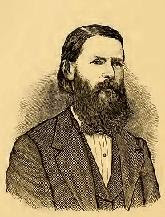
Samuel Sebastian Wesley
Today is the 201st birthday of composer Samuel Sebastian Wesley, the grandson of hymnwriter Charles Wesley. His father, also Samuel, was a composer of some renown in his day but is largely forgotten now. The elder Samuel worked to promote the music of Johann Sebastian Bach in England, and his son (whose middle name came from the German master) would do the same in his day.
Young Samuel Sebastian became a boy chorister at the Chapel Royal at age ten. One story told of his time there claims that his singing caught the attention of King George IV, who gave him a gold watch.
He obtained his first position as an organist at sixteen at St. James Church, Hampstead Road, and over the next five years worked at three additional London churches (sometimes at more than one at a time). In 1832 he became organist at Exeter Cathedral, and would go on to serve at the cathedrals of Winchester and Gloucester. He published the book A Few Words on Cathedral Music (1849) which argued for higher standards (and therefore higher salaries) for cathedral musicians.
Wesley wrote some music for the organ, but most of his output was choral music, both anthems and music for the service, as well as 130 hymn tunes, several of which we have already heard here.
Today's hymn is set to a tune by Wesley which appeared in The European Psalmist (1872), a collection he edited. The text is by an unknown author, but it has been used as a gospel song with a tune by James McGranahan.
O Christ, in thee my soul hath found,
And found in thee alone,
The peace, the joy I sought so long,
The bliss till now unknown.
I sighed for rest and happiness,
I yearned for them, not thee;
But, while I passed my Savior by,
Thy love laid hold on me.
I tried the broken cisterns, Lord,
But, ah, the waters failed;
Even as I stooped to drink they fled,
And mocked me as I wailed.
Now none but Christ can satisfy,
None other Name for me!
There’s love, and life, and lasting joy,
Dear Jesus, found in thee.
Author unknown, 19th cent.; alt.
Tune: WETHERBY (C.M.)
Samuel Sebastian Wesley, 1872
The 'broken cisterns' in stanza three are presumably those in Jeremiah 2:13.
Two Years Ago: Samuel Sebastian Wesley
Sunday, January 2, 2011
Elizabeth Rundle Charles
Today is the birthday of Elizabeth Rundle Charles, born in 1838 in Tavistock, in the county of Devon. She was raised in the Church of England, and would write more than twenty-five books, including several popular books on various aspects of church history.
Her hymns and poems were published in several different places, and she also translated several hymns from various languages. This text comes from her collection The Women of the Gospels: The Three Wakings and Other Poems (1859).
Come and rejoice with me!
For once my heart was poor;
But I have found a treasury
Of love, an endless store.
Come and rejoice with me!
For I have found a Friend
Who knows my heart's most secret depths
Yet loves me without end.
I knew not of this love
Which God had loved so long,
This love, so faithful and so deep,
So tender and so strong.
And now I know it all,
Have heard and known God's Voice,
And hear it still from day to day --
Can I enough rejoice?
Elicabeth Rundle Charles, 1859; alt.
Tune: ADVENT (S.M.)
John Goss, 1872
That same collection also contained a poem entitled New Years' Hymn, probably not a surprising topic for her to write about given her birthday. Its first stanza reads:
What marks the dawning of the year
From any other morn?
No festal garb doth Nature wear
Because a Year is born.
Her hymns and poems were published in several different places, and she also translated several hymns from various languages. This text comes from her collection The Women of the Gospels: The Three Wakings and Other Poems (1859).
Come and rejoice with me!
For once my heart was poor;
But I have found a treasury
Of love, an endless store.
Come and rejoice with me!
For I have found a Friend
Who knows my heart's most secret depths
Yet loves me without end.
I knew not of this love
Which God had loved so long,
This love, so faithful and so deep,
So tender and so strong.
And now I know it all,
Have heard and known God's Voice,
And hear it still from day to day --
Can I enough rejoice?
Elicabeth Rundle Charles, 1859; alt.
Tune: ADVENT (S.M.)
John Goss, 1872
That same collection also contained a poem entitled New Years' Hymn, probably not a surprising topic for her to write about given her birthday. Its first stanza reads:
What marks the dawning of the year
From any other morn?
No festal garb doth Nature wear
Because a Year is born.
Two Years Ago: Elizabeth Rundle Charles
One Year Ago: The Ninth Day of Christmas
Saturday, January 1, 2011
Another Year With Thee
I've written before on this date how hymnwriter Frances Ridley Havergal had an annual New Years' custom of sending a new poem to her many correspondents. Many of these then received wider distribution in her various collections of verse and some have even made their way into hymnals. Today's hymn may be the most well-known of these, from 1874.
Another year is dawning,
Creator, let it be
In working or in waiting,
Another year with thee.
Another year of progress,
Another year of praise,
Another year of proving
Thy presence all the days.
Another year of mercies,
Of faithfulness and grace,
Another year of gladness
In the shining of thy face;
Another year of leaning
Upon thy loving breast;
Another year of trusting,
Of quiet, happy rest.
Another year of service,
Of witness for thy love,
Another year of training
For holier work above.
Another year is dawning,
Creator, let it be
On earth, or else in heaven,
Another year for thee.
Frances Ridley Havergal, 1874; alt.
Tune: AURELIA (7.6.7.6.D.)
Samuel Sebastian Wesley, 1864
Creator, let it be
In working or in waiting,
Another year with thee.
Another year of progress,
Another year of praise,
Another year of proving
Thy presence all the days.
Another year of mercies,
Of faithfulness and grace,
Another year of gladness
In the shining of thy face;
Another year of leaning
Upon thy loving breast;
Another year of trusting,
Of quiet, happy rest.
Another year of service,
Of witness for thy love,
Another year of training
For holier work above.
Another year is dawning,
Creator, let it be
On earth, or else in heaven,
Another year for thee.
Frances Ridley Havergal, 1874; alt.
Tune: AURELIA (7.6.7.6.D.)
Samuel Sebastian Wesley, 1864
Two Years Ago: Bessie Porter Head
One Year Ago: O God, by whom all change is wrought

Friday, March 12, 2010
Robert Lowry
The Reverend Robert Lowry was born today in Philadelphia in 1826. His parents were Presbyterians, but at age eighteen he joined a Baptist church, and following his 1854 graduation from the University at Lewisburg (now Bucknell University) he was ordained as a Baptist minister, going on to lead churches in Pennsylvania, New Jersey and New York over the rest of his life.He was interested in music from an early age, but as a pastor he became interested in the use of music in the church, especially the Sunday school music that was becoming popular in the mid-nineteenth century (the precursor to gospel songs as we know them). He began to write and compose his own songs, which soon became quite successful. Often he wrote both words and music, such as Shall we gather at the river, probably his most popular song, but sometimes he wrote the tune only, or in the case of Marching to Zion, adapted an older text (by Isaac Watts, in this case) into a gospel song by adding a refrain and a compelling melody.
Following the 1868 death of William B. Bradbury, who had been the leading proponent of Sunday school music development, his publishing company hired Lowry to replace him as editor. At first, Lowry was not sure he was qualified, but he undertook more musical study and eventually edited or co-edited (often with William Howard Doane) more than twenty song collections. His own body of work expanded greatly; he continued to write songs of his own and tunes in collaboration with most of the well-known text writers of the day. The company, now known as Biglow & Main, solidified its position as the most successful publisher of Sunday school music and gospel songs for the rest of the nineteenth century.
Looking though his songs for something to present today I came upon this one, for which he originally wrote both words and music for the collection Royal Diadem for the Sunday School (1873). Since Lowry's tune is not available as a sound file, I've matched the text to this older hymn tune which suits it well.
My soul shall rest in hope
Rejoicing in your love
Who, in my sorrow, gives me joy
And lifts my soul above.
My soul shall rest in hope
And live in faith divine,
Supremely blessed, which I can feel,
Your saving love is mine.
My soul shall rest in hope,
Though mortal strength may fail,
Your gentle hand that leads me now
Will guide me through the vale.
My soul shall rest in hope
Until you bid me rise
To see your face and sing your praise
Beyond the earthly skies.
My soul shall rest in hope
Rejoicing in your love
Who, in my sorrow, gives me joy
And lifts my soul above.
Robert Lowry, 1873; alt.
Tune: CAMBRIDGE (S.M.)
Ralph Harrison, 1784
arr. Samuel Sebastian Wesley, 1872
Rejoicing in your love
Who, in my sorrow, gives me joy
And lifts my soul above.
My soul shall rest in hope
And live in faith divine,
Supremely blessed, which I can feel,
Your saving love is mine.
My soul shall rest in hope,
Though mortal strength may fail,
Your gentle hand that leads me now
Will guide me through the vale.
My soul shall rest in hope
Until you bid me rise
To see your face and sing your praise
Beyond the earthly skies.
My soul shall rest in hope
Rejoicing in your love
Who, in my sorrow, gives me joy
And lifts my soul above.
Robert Lowry, 1873; alt.
Tune: CAMBRIDGE (S.M.)
Ralph Harrison, 1784
arr. Samuel Sebastian Wesley, 1872
In researching Lowry for this entry, I came upon the following, which I hope you will enjoy. Apparently Shall we gather by the river so impressed Canadian Dr. D. Morrison of Ontario that he translated it into Latin (for what purpose I can only imagine). The first stanza, all that I could unearth, goes like this:
Fluvione colligemus
Qua'sint seraphim sancti,
Fluvio amœna cujus
Fons est throno Domini?
Two Years Ago: Gregory the Great
One Year Ago: Paul Gerhardt
Sunday, February 7, 2010
Mending Our Fisher Nets

One of the readings today was Luke 5:1-11, with Jesus bringing an enormous catch of fish to fis disciples and explaining its wider meaning. This hymn brings that experience and that calling to us, the modern congregation.
Holy, holy, holy, Christ, thy disciples
Gather in devotion to sing and speak of thee:
Holy, holy, holy, beautiful and gracious,
Still in our hearts we dwell in Galilee.
Holy, holy, holy, still in the morning
Mending our fisher nets, we hail thee by the shore;
Friend and guide and brother, by the wells of evening,
Deep from thy voice we drink thy healing lore.
Holy, holy, holy, Lord, thy disciples
Ever through the ages live again because of thee;
Holy, holy, holy, all thy ways we follow,
From Bethlehem to bleak Gethsemane.
Percy W. MacKaye, 1920; alt.
Tune: TRINITY (11.12.12.10)
Samuel Sebastian Wesley, 19th cent.
Short entry today; I'm off to the Cathedral of St. John The Divine to sing a Choral Evensong with about 130 other singers this afternoon. Should be much fun!
Subscribe to:
Posts (Atom)


