Tuesday, August 30, 2016
George Frederick Root
His early career was as a teacher of music in several schools, and he did not compose much before 1850. Over the next ten years, however, he wrote songs (sometimes both texts and tunes but more often tunes only) which became very popular and by 1860 he went into the music publishing business with his brother and a friend as Root & Cady. The successful firm lost thousands of dollars when their building and inventory burned in the Great Chicago Fire of 1871.
The text of today's hymn (which was apparently originally sung to a melody known as Lord Ellin's Daughter) was shown to Root by his wife, who suggested he write a tune for it. He was not entirely pleased with the result, thinking it too simplistic, and though it was not immediately published, it eventually appeared in many hymnals (at least 552 according to Hymnary.org). As told in Ira Sankey's Story of the Gospel Hymns, Root said "In after years I examined it in an endeavor to account for its great popularity - but in vain." Many writers of congregational song have been similarly baffled when texts or tunes they thought ephemeral became widely sung.
My days are gliding swiftly by;
And I, a pilgrim stranger,
Would not detain them as they fly,
Those hours of toil and labor.
Refrain
For, oh! we stand on Jordan’s strand;
Our friends are passing over;
And, just before, the shining shore
We may almost discover.
We’ll gird our loins, my kindred dear,
Our distant home discerning:
Our waiting Lord has left us word,
Let ev’ry lamp be burning.
Refrain
Should coming days be cold and dark,
We need not cease our singing:
That perfect rest naught can molest,
Where golden harps are ringing.
Refrain
Let sorrow’s rudest tempest blow,
Each cord on earth to sever:
Jesus says, Come, and there’s our home,
Forever, oh! forever.
Refrain
David D. Nelson, 1835; alt.
Tune: SHINING CITY (8.7.8.7. with refrain)
George F. Root, 1855
David D. Nelson (1793-1844) was born in Tennessee and lived for many years in the South, serving as a surgeon in the War of 1812 and later pastoring Presbyterian congregations in Kentucky and Missouri before moving to Illinois (due at least in part to his anti-slavery views: "I will live on roast potatoes and salt before I will hold slaves," he once declared).
This hymn was reportedly a favorite of Henry Ward Beecher and later appeared in the Plymouth Sabbath School Collection of Hymns and Tunes (1865) which was published by William B. Bradbury but compiled from songs used at Beecher's Brooklyn church. Today, I am told this remains a well-loved hymn still sung at the Plymouth Church of the Pilgrims, where they proudly celebrate Beecher's legacy (including his immense contribution to congregational singing in this country).
Eight Years Ago: George Frederick Root
Seven Years Ago: George Frederick Root
Sunday, August 28, 2016
Ira David Sankey
"... it was one of my chief joys to meet with other members of our family around the great log fire in the old homestead, and spend the long winter evenings singing with them the good old hymns and tunes of the church, which was the only music we had in those days."
Church attendance provided him with another place to sing, and by the time he was in high school he was leading the choir at a Methodist church in New Castle. He campaigned for the installation of an organ, which had been considered "wicked and worldly" and eventually succeeded ("Only one or two of the old members left the church during the singing."). After he traveled to Ohio for a musical convention where he met composer William B. Bradbury, his father was unsure about his chosen occupation:
"I am afraid that boy will never amount to anything; all he does is run about the country with a hymn-book under his arm."
Following military service in the Civil War, Sankey returned home, married Fanny Edwards, a member of his choir, and joined his father working for the newly-established Internal Revenue Service, which may have temporarily assuaged his father's misgivings. But Ira met evangelist Dwight Moody in 1870 at a YMCA convention in Indianapolis, and when he joined Moody's organization a few years later his subsequent career could have been characterized as "running about the world with a hymn-book under his arm!" Sankey became the song leader for the internationally-acclaimed revivals that Moody led. Moody had recognized Sankey's talents immediately and knew that the power of congregational singing would be key to the success of his work.
They introduced gospel songs to millions over the course of their careers, believing that style was most conducive to their message. Sankey compiled the songs that they used into a popular series of hymn-books titled Gospel Hymns, and these volumes were later combined into one. The profits from these books enabled Sankey to build a new YMCA building and to buy a lot for his church in his home town, among many other contributions.
Most of the songs used by Sankey and Moody were contemporary works, written and composed by popular names of the day such as Fanny Crosby, Philip P. Bliss, William Howard Doane, Lucy Rider Meyer, Robert Lowry, George C. Stebbins, and many others. However, they also used older texts that would have been known to their audiences, often adding new tunes that were more in keeping with the music of their revival events (as the retuned hymns movement does today). This eighteenth century text by Philip Doddridge (with additional stanzas added some years later by Augustus Montague Toplady) was sung to a new gospel tune (and with an added refrain) by Sankey.
Grace, ’tis a charming sound,
Harmonious to my ear;
Heaven with the echo shall resound,
And all the earth shall hear.
Refrain:
Saved by grace alone!
This is all my plea;
Jesus died for humankind,
And Jesus died for me!
Grace first inscribed my name
In God’s eternal book;
’Twas grace that brought me to the Lamb,
Who all my sorrows took.
Refrain
Grace led my roving feet
To tread the heavenly road,
And new supplies each hour I meet,
While pressing on to God.
Refrain
Grace taught my soul to pray
And made my eyes o’erflow;
’Twas grace which kept me to this day,
And will not let me go.
Refrain
O let thy grace inspire
My soul with strength divine
May all my powers to thee aspire,
And all my days be thine.
Refrain
Philip Doddridge, 1740 (st. 1, 3, 5); alt.
Augustus Montague Toplady, 1776 (st. 2, 4); alt.
Tune: CHARMING GRACE (S. M. with refrain)
Ira David Sankey, 19th cent.
On YouTube you can see a video by a singer named Dave Willetts who portrays Sankey (alongside an unidentified actor as Moody) and leads a choir in some of his songs.
Seven Years Ago: Ira David Sankey
Five Years Ago: William Hiley Bathurst
Three Years Ago: William Hiley Bathurst
Monday, January 24, 2011
John Mason Neale
John Mason Neale (January 24, 1818 - August 6, 1866) is, in some ways, a sort of godparent to this blog. His birthday today is one day after the anniversary of the first posting here in 2009, and, as you may remember, the title up there at the top of the page comes from one of his translated hymns. Looking at a listing of his hymns, I am reminded of several that have already appeared here and several more that I expect to write about in the months (years?) to come. Most of his texts were translations from Latin or Greek, or any of the other languages he had mastered, and any familiarity with ancient hymn texts that we have in our own time is largely due to his work.
This short hymn is from a text (Rerum Deus tenax vigor) ascribed to Ambrose of Milan, the fourth century bishop who was one of the original four Doctors of the Church, so called because of their importance in establishing Christian doctrine. It was an evening hymn in the Liturgy of the Hours.
O God, creation’s secret force,
Thyself unmoved, all motion’s source,
Who from the morn till evening ray
Through all its changes guid’st the day:
Grant us, when this our life is past,
The glorious evening that shall last;
That, by your holy grace attained,
Eternal glory may be gained.
Mighty Creator, hear my cry
Through Christ our Savior, ever nigh,
Who with the Holy Ghost and thee
Doth live and reign eternally.
Ambrose of Milan, 4th cent.
tr. John Mason Neale, 1852; alt.
Tune: OLIVE'S BROW (L.M.)
William B. Bradbury, 1855
I've mentioned before that I think this tune by William B. Bradbury might have been meant to suggest a chant melody.
So we're beginning our fourth year here. Posting has been a bit sparse for the last few weeks, but I am making some plans for some new and different things in the upcoming year, and there are still plenty of hymns and hymnists to write about. Hope you continue to come back to see what's attracting my interest each week in the world of hymnody.
Sunday, October 10, 2010
Thrice Holy Fount, Thrice Holy Fire

One of the oldest hymns of the Holy Spirit, Veni Creator Spiritus, comes down to us from the ninth century. It's a prayer that begins:
Veni, Creator Spiritus,
mentes tuorum visita,
imple superna gratia
quae tu creasti pectora.
The Latin text is now generally attributed to the German monk Rhabanus Maurus, a scholar and author, and later the bishop of Mainz, though in earlier times it was sometimes credited to the Emperor Charlemagne. Rhabanus wrote a fair amount of poetry, though one source claimed that he was "a skillful versifier, but a mediocre poet." Still, this text has survived to the present day, often sung at ordinations, confirmations, and of course at Pentecost.
Martin Luther translated it into German in 1524 as Komm, Gott Schopfer, heiliger Geist. It was first translated into English in 1549, when it was added to the Anglican Book of Common Prayer, where it began:
Come Holy Ghost, eternal God,
Proceeding from above,
Both with the Father and the Son,
The God of peace and love.
Since then there have been more than sixty English translations. Among the best-known are:
Come, Holy Ghost, our souls inspire, (1627) by John Cosin
Creator Spirit by whose aid, (1693) by John Dryden
Come, Holy Ghost, Creator blest, (1877) by Edward Caswall (and others)
Today's hymn is a later adaptation of the Dryden text, in four-line rather than six-line stanzas.
Creator Spirit, by whose aid
The world’s foundations first were laid,
Come, visit every pious mind;
Come, pour thy joys on humankind;
Plenteous of grace, descend from high,
Rich in thy sev'nfold energy,
From sin, and sorrow set us free;
And make us temples worthy thee.
Heal and refine our earthly parts;
But, oh, inflame and fire our hearts!
O'er all may we victorious be
That stands between ourselves and thee.
Thrice holy Fount, thrice holy Fire,
Our hearts with heav’nly love inspire;
Make us eternal truths receive,
And practice all that we believe.
Rhabanus Maurus, 9th cent.;
tr. John Dryden, 1693; adapt.
Tune: BALM (L.M.)
William B. Bradbury, 19th cent.
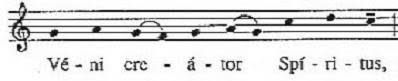
Of course, for most of its existence, Veni Creator Spiritus was sung to plainsong chant (even up to the present), and some of the English translations have also used that melody, partially pictured here.

But plainsong was not always in fashion in many places over the last thousand years, so other tunes have been used too. This particular tune I discovered this week, in preparation for the birthday of William B. Bradbury (which was October 6, and I never finished writing it). I like it because it would seem to have great potential in the hands of a skillful musician; it builds in intensity and reaches its peak in the cascading notes of the last line. It seems made for a text like this one, which is a prayer of supplication.
Two Years Ago: Samuel Johnson
Thursday, October 7, 2010
Charles Crozat Converse
Composer Charles Crozat Converse was born today in Warren, Massachusetts, in 1834 (some sources say 1832). After his secondary schooling in upstate New York, he went to Germany to study music, where he became acquainted with composers Franz Liszt and Louis Spohr. He returned to this country and entered law school in Albany, NY, graduating in 1861. Though he practiced law in Erie, Pennsylvania, he was also composing tunes for Sunday school music and compiling songbooks in association with William B. Bradbury. During these early years he published his music under various pseudonyms, such as "Karl Reden" in this example, perhaps to keep it separate from his law career. Converse composed in other forms besides Sunday school music, including cantatas, oratorios, string quartets, and two symphonies, all unknown today. He also wrote a training manual for the guitar.
This is Converse's only surviving tune but it has been a favorite of many people over the hast hundred and fifty years. Author Joseph Scriven first published it anonymously, and his authorship was only revealed thirty years later, after the song was a great success.
What a Friend we have in Jesus,
All our sins and griefs to bear!
What a privilege to carry
Everything to God in prayer!
O what peace we often forfeit,
O what needless pain we bear,
All because we do not carry
Everything to God in prayer.
Have we trials and temptations?
Is there trouble anywhere?
We should never be discouraged;
Take it to the Lord in prayer.
Can we find a friend so faithful
Who will all our sorrows share?
Jesus knows our every weakness;
Take it to the Lord in prayer.
Are we weak and heavy laden,
Cumbered with a load of care?
Precious Savior, still our refuge,
Take it to the Lord in prayer.
Do thy friends despise, forsake thee?
Take it to the Lord in prayer!
In his arms he’ll take and shield thee;
Thou wilt find a solace there.
Joseph H. Scriven, 1855
Tune: ERIE (8.7.8.7.D.)
C.C. Converse, 1868
Apparently one additional stanza to this hymn exists, though I don't ever recall encountering it before.
Blessèd Savior, thou hast promised
Thou wilt all our burdens bear
May we ever, Lord, be bringing
All to thee in earnest prayer.
Soon in glory bright unclouded
There will be no need for prayer
Rapture, praise and endless worship
Will be our sweet portion there.
One additional unusual item about Converse comes from his Wikipedia entry -- he is said to have originated the intermediate, gender-neutral pronoun "thon" (the th pronounced as in they) to mean "his or her." He came to believe in its necessity through his writing for the law, and in fact it was adopted by two major American dictionaries for several years, as late as 1964. Clearly it never caught on with the general public, which is no surprise to me.
Two Years Ago: Henry Alford
One Year Ago: Henry Alford
Sunday, June 20, 2010
Dorothy Ann Thrupp

Savior, like a shepherd lead us,
Much we need thy tender care;
In thy pleasant pastures feed us,
For our use thy folds prepare.
Blessèd Jesus, blessèd Jesus!
Thou hast bought us, thine we are.
Blessèd Jesus, blessèd Jesus!
Thou hast bought us, thine we are.
We are thine, do thou befriend us,
Be the guardian of our way;
Keep thy flock, from sin defend us,
Seek us when we go astray.
Blessèd Jesus, blessèd Jesus!
Hear, O hear us when we pray.
Blessèd Jesus, blessèd Jesus!
Hear, O hear us when we pray.
Thou hast promised to receive us,
Lost and helpless though we be;
Thou hast mercy to relieve us,
Grace to heal and power to free.
Blessèd Jesus, blessèd Jesus!
Early let us turn to thee.
Blessèd Jesus, blessèd Jesus!
Early let us turn to thee.
Early let us seek thy favor,
Early let us do thy will;
Blessèd Friend and only Savior,
With thy love our bosoms fill.
Blessèd Jesus, blessèd Jesus!
Thou hast loved us, love us still.
Blessèd Jesus, blessèd Jesus!
Thou hast loved us, love us still.
attr. Dorothy Ann Thrupp, 1836; alt.
Tune: BRADBURY (8.7.8.7.D.)
William B. Bradbury, 1859
Thursday, March 18, 2010
Charlotte Elliott

Just as I am, without one plea,
But that thy blood was shed for me,
And that thou bidd'st me come to thee,
O Lamb of God, I come, I come.
Just as I am, though tossed about
With many a conflict, many a doubt,
Fightings and fears within, without,
O Lamb of God, I come, I come.
Just as I am, thou wilt receive,
Wilt welcome, pardon, heal, relieve;
Because thy promise I believe,
O Lamb of God, I come, I come.
Just as I am, thy love unknown
Hath broken every barrier down;
Now, to be thine, yea, thine alone,
O Lamb of God, I come, I come.
Just as I am, of thy great love
The breadth, length, depth, and height to prove,
Here for a season, then above,
O Lamb of God, I come, I come!
Charlotte Elliott, 1835; alt.
Tune: WOODWORTH (L.M.)
William B. Bradbury, 1849
Her sister and brother certainly told the story of this hymn differently; that Charlotte was unhappy because her health made it impossible for her to work at a fundraising event that her brother was heading. This bazaar was to raise money to set up a secondary school for the daughters of clergymen, who were generally unable to afford such schooling. She wrote this hymn, which appeared in the Invalid's Hymn Book, but was also published in a separate pamphlet specifically to raise money for the school, St. Mary's Hall, which it continued to do for several years.
Friday, March 12, 2010
Robert Lowry
The Reverend Robert Lowry was born today in Philadelphia in 1826. His parents were Presbyterians, but at age eighteen he joined a Baptist church, and following his 1854 graduation from the University at Lewisburg (now Bucknell University) he was ordained as a Baptist minister, going on to lead churches in Pennsylvania, New Jersey and New York over the rest of his life.Rejoicing in your love
Who, in my sorrow, gives me joy
And lifts my soul above.
My soul shall rest in hope
And live in faith divine,
Supremely blessed, which I can feel,
Your saving love is mine.
My soul shall rest in hope,
Though mortal strength may fail,
Your gentle hand that leads me now
Will guide me through the vale.
My soul shall rest in hope
Until you bid me rise
To see your face and sing your praise
Beyond the earthly skies.
My soul shall rest in hope
Rejoicing in your love
Who, in my sorrow, gives me joy
And lifts my soul above.
Robert Lowry, 1873; alt.
Tune: CAMBRIDGE (S.M.)
Ralph Harrison, 1784
arr. Samuel Sebastian Wesley, 1872
Tuesday, October 6, 2009
William Batchelder Bradbury
William Batchelder Bradbury (October 6, 1816 - January 7, 1868) was an influential publisher as well as a composer whose tunes are is still sung today.He was born in Maine, and when his family moved to Boston in 1830 he enrolled in Lowell Mason's Boston Academy of Music, and sang in Mason's choir at the Bowdoin Street Church. In 1840 he moved to New York City, where he was the organist at Baptist churches in Brooklyn and Manhattan. He began a series of singing schools there, modeled on the efforts of Lowell Mason in Boston, and was instrumental in the effort to bring music instruction into the public schools of New York. It was during this work with children that he began composing songs for use in his classes.
Bradbury then traveled to Leipzig for two years, studying composition, piano and organ, and music education. While there he attended the funeral of Felix Mendelssohn. After his return, he continued to teach and compose, while becoming more active in publishing collections of Sunday school songs (many of his own composition) and other works, such as the oratorio Esther the Beautiful Queen (1856). His books were extremely popular; fifty-nine collections were published in his lifetime. The musical style of his earlier Sunday school songs led directly to the gospel song style of the later nineteenth century.
We have already seen a number of his tunes here on the blog (click on the Bradbury tag at the end of the entry to see them). One of the earliest songs most children learn is sung to a Bradbury tune: Jesus loves me, this I know. Today's song first appeared in his collection Devotional Hymn and Tune Book (1864), said to be the only Baptist hymnbook published in this country during the Civil War. It is almost certainly this tune that has kept this song in hymnals up to the present day; the text with a different tune may never have lasted.
My hope is built on nothing less
Than Jesus' blood and righteousness.
I dare not trust the sweetest frame,
But wholly lean on Jesus' name.
Refrain:
On Christ, the solid Rock, I stand,
All other ground is sinking sand;
All other ground is sinking sand.
When shadows seem to hide thy face,
I rest on thy unchanging grace;
In every high and stormy gale,
My anchor holds within the veil.
Refrain
Thy oath, thy covenant, thy blood,
Support me in the whelming flood;
When all around my soul gives way,
Thou then art all my hope and stay.
Refrain
When thou shalt come with trumpet sound,
Oh. may I then in thee be found;
Clothed in thy righteousness alone,
Faultless to stand before the throne.
Refrain
Edward Mote, 1834; alt.
Tune: THE SOLID ROCK (L.M. with refrain)
William B. Bradbury, 1863
Edward Mote's text was originally published with six stanzas, but this is the version generally published over the last hundred years, with several of the couplets rearranged into these four stanzas.
Around the time of this tune's writing, Bradbury encountered a poet named Fanny Crosby and suggested that she might write texts for his collections. One of her first published gospel songs, There's a cry from Macedonia, was a collaboration with Bradbury. Following his death, his publishing company became Biglow & Main, probably the most preeminent gospel song publisher in the world between 1870 and 1910.
Sunday, August 30, 2009
George Frederick Root
George Frederick Root (August 30, 1820 - August 6, 1895) was named for the composer Handel, so his parents must have had some interest in music, perhaps even an interest in the musical education of their son. He left home at 18 with the intention of a career in music which was certainly fulfilled. While he later was primarily known as a successful composer, his earlier years also were spent in teaching music and a few church organist positions. With William B. Bradbury he opened a music school in New York City in 1853 that operated until it was destroyed in an 1871 fire.Root's early songs were mostly secular in nature, and his patriotic songs during the Civil War were especially popular. Though later he certainly wrote plenty of hymn tunes and gospel songs (sometimes words as well as music), some of his secular tunes had new sacred texts written to them. Last year hymn blogger Leland reminded us of Jesus loves the little children, whose tune was originally the Civil War song Tramp! Tramp! Tramp! The tune of another Root song, The Little Octoroon, was later used for Ring the bells of heaven.
This is another of Root's gospel songs that I like, though I don't believe it lasted much longer than his lifetime, like many of the others he wrote.
Thou art my Rock in the wide desert land,
Sheltered by thee here in safety I stand;
What though the storms and the tempests may beat,
What though the sun pour its fierce noontide heat:
Refrain
Sheltered by thee, sheltered by thee,
Here in the shadow from danger I’m free.
Once I was wand’ring exposed to the storm,
Refuge there was none to shield me from harm;
One day I found, in the broad desert way,
Christ as my Rock, and with gladness could say:
Refrain
Come to the Rock so majestic and grand;
Here in its shelter a million may stand;
Now we may feel that our hope here is sure,
Here we may say in our safety secure:
Refrain
George F. Root, 1885; alt.
Tune: ROCK OF SHELTER (10.10.10.10. with refrain)
In his later years, George Root was looked upon as one of the elder statesmen of the gospel song, mentioned with affection in the writings of his younger comrades in the field, though many of their songs would far outlive his.
One Year Ago: George Frederick Root
Thursday, August 27, 2009
Thomas Gallaudet
Today the Episcopal Church calendar marks the death of the Reverend Dr. Thomas Gallaudet (June 3, 1822 - August 27, 1902). He was the son of Thomas Hopkins Gallaudet, who founded the first school for the deaf in the US.
After graduating from Trinity College in Hartford, CT, the younger Gallaudet taught at his father's institute for a time before turning to the Episcopal priesthood. In September, 1850, as a deacon, he started a Bible study class for the deaf at St. Stephen's Church in New York City.
Gallaudet was ordained as a priest in 1851. He believed that the formal liturgy of the Episcopalians, which closely follows the Book of Common Prayer, could be easily followed by deaf persons through sign language, and that sign language could be taught to other priests. He started St. Ann's Church, which held its first services on the first Sunday in October in 1852. Both deaf and hearing parishioners worshipped together, and over time the church was known for welcoming all people regardless of race or disability. One of the church's members, Henry Winter Syle, with Gallaudet's encouragement and support became the first deaf person ordained in the Episcopal Church (Syle is also commemorated today).
Gallaudet continued to expand his ministry by traveling to various other churches throughout the country where he taught sign language to priests and established deaf ministries in several other locations. He also founded a home for aged deaf people in Poughkeepsie, NY which continues today as a charitable fund, long after the building was closed.
According to the CyberHymnal, this hymn was written by Thomas Gallaudet, (though some sources attribute it to his father).
Jesus, in sickness and in pain,
Be near to succor me,
My sinking spirit still sustain;
To thee I turn, to thee.
When cares and sorrows thicken round,
And nothing bright I see,
In thee alone can help be found;
To thee I turn, to thee.
Should strong temptations fierce assail,
As if to ruin me,
Then in thy strength will I prevail,
While still I turn to thee.
Through all my pilgrimage below,
Whate’er my lot may be,
In joy or sadness, wealth or woe,
Jesus, I’ll turn to thee.
Thomas Gallaudet, 1845
Tune: JAZER (C.M.)
William B. Bradbury, 1844
This tune by William Bradbury was named for a Biblical city near the Jordan River. The first line probably sounds familiar, but it was written many years before MUELLER, a popular tune for Away in a manger.
One Year Ago: God's All-Inclusive Love
Tuesday, July 21, 2009
Theodore Edson Perkins
Composer Theodore Edson Perkins was born on July 21, 1831 in Poughkeepsie, NY, son of a Baptist minister. All ten children in the family received musical instruction from an early age, and Perkins went on to become a music teacher himself.In 1855, he sought further training at the Normal Academy of Music in Massachusetts, under Lowell Mason and George Root, and then became an assistant instructor there. He next partnered with William Bradbury at the summer Geneseo Institute, a competing enterprise that had earlier caused a rift between Mason and Bradbury, two of the most important figures in American church music at the time. Perkins's decision to work there was probably not popular with Mason and Root, but after a few years Perkins went on to lead a number of music education institutions of his own.
Perkins published his first book of sacred music, The Olive-Branch, in 1860. It sold more than 100,000 copies, which led him to bring out thirty-three more collections over the course of his life. He supplied tunes for many of the text writers of the day, many for Fanny Crosby, with whom he also collaborated on a cantata, The Excursion. Though his most widely used tunes were gospel songs, he also wrote more conventional hymn tunes, such as this one.
Absent from flesh! O blissful thought!
What unknown joys this moment brings!
Freed from the mischiefs sin has brought,
From pains, and fears, and all their springs.
Absent from flesh! illustrious day!
Surprising scene! triumphant stroke
That rends the prison of my clay;
And I can feel my fetters broke.
Absent from flesh! then rise, my soul,
Where feet nor wings could never climb,
Beyond the heav’ns, where planets roll,
Measuring the cares and joys of time.
I go where God and glory shine,
Whose presence makes eternal day:
My all that’s mortal I resign,
For angels wait and point my way.
Isaac Watts, 1707; alt.
Tune: REPENTANCE (L.M.)
Theodore E. Perkins, 19th c.
I had not yet picked a Perkins tune for today but accidentally happened on this one while looking at Isaac Watts hymns for Friday's entry. "Absent from flesh" is no longer how we would refer to death (it comes from 2 Corinthians 5:8) but the verse did appear on Watts's gravestone: Absent fron the body, and present with the Lord.
Perkins continued a busy musical career throughout his life, directing church choirs in several congregations, teaching at various institutions, and writing and publishing his tunes. In 1873 he was the music director for the ten-day meeting of the Evangelical Alliance in New York City, and was thereafter often called upon for similar large-scale events, such as the first meeting of the American Sunday Achool Association, or the golden anniversary of the American Female Guardian Society (where he led a childrens' chorus of more than four thousand). In spite of his many accomplishments, like so many of his contemporaries, his music is mostly unknown today.
Tuesday, March 24, 2009
Fanny Crosby
More than eight thousand gospel songs are reputed to have come from the pen of Frances Jane Crosby, born today in 1820. Some estimates go even higher, though you can only see about five hundred listed at the Cyber Hymnal (fewer than ten percent of them!). Blinded as a child of six weeks by poor medical care, Crosby later entered the New York Institution for the Blind (still operating as the New York Institute for Special Education) in the Bronx. She was a student there for several years and later returned as a teacher of English and history.She began writing poetry at the age of eight, and her first collection, The Blind Girl and Other Poems was published in 1844. The year before, she had traveled with a group from the school to Washington DC to lobby for better educational funding for the blind. While there, she became the first woman to speak on the floor of the US Congress when she read one of her poems (a tribute to the late Secretary of State Hugh Legare) before a joint session. She would return to Washington several times after that, visiting Presidents and other politicians. (Grover Cleveland had once been employed at the New York Institution for the Blind when Crosby was there.)
She published a few more collections of poetry, and in time began to write secular songs. Working with composer George Root she wrote The Flower Queen (1852), said to be the first American cantata. She collaborated with Root on several more songs which were very successful.
In 1863, William B. Bradbury asked her to write a hymn for a collection he was editing. There's a cry from Macedonia was published with music by Bradbury, and neither of them could have foreseen the career that was born. Before long nearly every new gospel songbook and Sunday School collection would include several texts by Fanny Crosby, with music by all the prominent composers of the time. She worked for many years for the publisher Biglow & Main, and would go to their offices to sit and write several texts each day. Eventually she began to write under pseudonyms (nearly 200 have been identified) because publishers didn't want their books to include so many songs by the same author.
She was an accomplished musician, and even wrote the music for a handful of her songs. In 1858 she married Alexander Van Alstyne, another blind musician who taught at the Institution. They were married for more than forty years, though they did not always live together. Fanny was often traveling around the country, lecturing, meeting with her fellow songwriters and composers, and doing various works of charity. She rarely received much remuneration for her hymns and songs, and what she got she usually gave away. By agreement with her husband she continued to be published as Fanny Crosby, the name by which she was best known, though some older hymnals credit her as Mrs. Van Alstyne for propriety's sake.
Several of her songs have already appeared here on the blog (click on the Crosby tag below), some of the most popular as well as more obscure ones. This one falls in the "more obscure" category but I found it interesting and somewhat different from many of her others. It first appeared in the Biglow & Main collection Brightest and Best (1875), and is adapted from the first chapter of the book of Ruth. The Song of Ruth is a ancient poem of fidelity, part of a long progression of Biblical songs proclaimed by both women and men.
Entreat me not to leave thee,
My heart goes with thee now;
Why turn my footsteps homeward?
No friend so dear as thou!
Thy heart has borne my sorrow,
And I have wept for thine;
And now how can I leave thee?
Oh, let thy lot be mine.
Refrain
Entreat me not to leave thee,
Or to return from following after thee;
For where thou goest I will go,
And where thou lodgest I will lodge;
Thy people shall be my people,
And thy God my God,
Thy people shall be my people,
And thy God my God.
I’ll follow where thou leadest;
My love will cling to thee;
And where thy head is pillowed,
My nightly rest shall be;
Thy birthplace and thy kindred
I’ll cherish like my own;
Thy God shall be my refuge,
I’ll worship at God's throne.
Refrain
Where death’s cold hand shall find thee,
There let my eyelids close,
And, in the grave beside thee,
This mortal frame repose:
Oh, do not now entreat me;
No friend so dear as thou;
My heart would break in anguish
If I should leave thee now.
Refrain
Fanny Crosby, 1875
Tune: SONG OF RUTH (7.6.7.6.D. with refrain)
Robert Lowry, 1875
I'm not sure if this song ever appeared in any other hymnals or songbooks, but given the tremendous number of texts by Fanny Crosby, editors always had new ones to consider. So it's not surprising that many interesting ones were set aside in favor of the most popular ones -- even those would be enough to fill a book or two. Similarly, her later songs, those written in the twentieth century, are also little-known.
Fanny published an autobiography in 1906, Memories of Eighty Years, which is almost as interesting for what she leaves out as for what she includes (for example, her marriage is covered in two paragraphs). She continued her work of songwriting and charity up until her death in 1915. For the last several years of her life she had lived in Bridgeport, CT, and her funeral there was the largest that city had seen, larger than that of P.T.Barnum, they said. Only a small stone reading "Aunt Fanny" and "She hath done what she could."originally marked her gravesite, but in 1955 the city erected a larger monument there with the words of Blessed assurance, Jesus is mine inscribed.