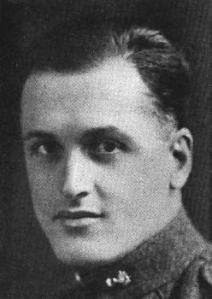
Today is the 130th anniversary of the birth of composer and church musician David McK. Williams (1887-1978), who was born in Wales, but came to Colorado in this country as a child with his family. Some of his earliest musical training was as a boy chorister at the Cathedral of St. John in the Wilderness in Denver, and by age 13 he was the organist at St. Peter's Church in that city.
In 1908 he moved to New York City, where he was organist and music director at Grace Church Chapel and the Church of the Holy Communion (where William Muhlenberg had been rector) with a break to study in Paris (1911-1914) and another to serve in World War I with the Royal Canadian Artillery (his photograph here is from those years).
Not long after his return from Europe in 1920 he became the director of music at St. Bartholomew's Episcopal Church, where he would remain for the next twenty-six years and raise the level of music at that church to become one of the best-regarded in that city. His organ playing, both accompanying the choir and congregation, and in recital, was beloved by his peers, and he was also admired for the force of his personality. He also wrote several hymn tunes (most of them unison settings rather than in traditional four-part harmony - and also still under copyright), anthems and various service music items for Episcopal worship. He served on the committee that produced the Episcopal Hymnal 1940 (which includes six of his tunes).
However, Williams was also openly gay (whatever that would have meant in that time), and was suddenly dismissed from his position in 1946. This would certainly have been known for some time by leadership at St. Bartholomew's, and it's possible that action was not taken earlier because Williams was a close friend and colleague of composer Amy Beach, a parishioner and probably a significant donor to the church (who died in 1944). The congregation was told that Williams had developed hearing problems and would be taking a leave of absence and leaving the city to seek treatment.
Following his forced retirement he remained in New York, in spite of the claims by church leadership, headed the organ department at the Juilliard School of Music and was a faculty member at the School of Sacred Music at Union Seminary. He remained active in church music circles and the local chapter of the American Guild of Organists, where younger people in later years couldn't recall any significant hearing issues.
This 2015 recording of Williams' anthem In the year that King Uzziah died is by the choir of Trinity Lutheran Church in Des Plaines, Illinois, directed by Brad Whaley.
Anthem text is from Isaiah 6:1-8.
Showing posts with label LGBT. Show all posts
Monday, February 20, 2017
Saturday, January 23, 2016
You Give the Winter's Cold
'Tis winter now; the fallen snow
Has left the heavens all coldly clear;
Through leafless boughs the sharp winds blow,
And all the earth lies dead and drear.
And yet God's love is not withdrawn;
God's life within the keen air breathes;
God's beauty paints the crimson dawn,
And clothes each branch with glittering wreaths.
And though abroad the sharp winds blow,
And skies are chill, and frosts are keen,
Home closer draws its circle now,
And warmer glows its light within.
O God, you give the winter's cold,
As well as summer's joyous rays,
You warmly in your love enfold,
And keep us through life's wintry days.
Samuel Longfellow, 1864; alt.
Tune: QUEEN'S CROSS (L.M.)
Kenneth G. Finlay, 1912
Seven Years Ago: Phillips Brooks
Five Years Ago: O star of truth, downshining
Tuesday, December 1, 2015
World AIDS Day
World AIDS Day may not (yet) be a liturgical observance in most places, but I believe
that it is marked in an increasing number of ways. It's not possible for any site to
consolidate and list them all, but there are different sites for different countries and
umbrella organizations. Social media and the internet has made it much easier for
such organizations to help people plan a local event in the last decade, and in many places
churches have stepped up to do their part.
Thinking about the day this year I was reminded of a hymn connection from several years
ago. In 1989 we were just beginning our hymnal project for Metropolitan Community
Church, and sketching out lists of the hymns we wanted to distribute over the next three
years. The worship leaders for the denomination's General Conference to be held that
summer had agreed to use these new resources, endorsing the inclusive and expansive
language and theology of our texts. We then received a special request from the Reverend
Elder Nancy Wilson for a hymn that she particularly wanted to be sung at the conference:
Charles Wesley's And are we yet alive. This hymn was not on our lists at the time (and we
had no former Methodists on our committee who might have suggested it). Left to our own
devices we might not have encountered it at all.
But in that time and place it expressed something important, the affirmation of a community
in crisis. When we gathered for worship, either at an annual conference or even week-to-
week in local churches, we knew that we were in the midst of a great struggle -- fightings
without and fears within / Since we assembled last. It was a significant question: And are
we yet alive, / And see each other's face?
And are we yet alive,
And see each other’s face?
Glory and thanks to Jesus give
For great redeeming grace!
Preserved by power divine
To full salvation here,
Again in Jesus’ praise we join
In Jesus' sight appear.
What troubles have we seen,
What mighty conflicts past,
Fightings without, and fears within,
Since we assembled last!
Yet out of all our God
Hath brought us by great love;
And all along our paths hath trod,
To guard our life above.
Then let us make our boast
Of God's redeeming power,
Which saves us to the uttermost,
Till we can sin no more.
Let us take up the cross
Till we the crown obtain,
And gladly reckon all things loss
So we may Jesus gain.
To full salvation here,
Again in Jesus’ praise we join
In Jesus' sight appear.
What troubles have we seen,
What mighty conflicts past,
Fightings without, and fears within,
Since we assembled last!
Yet out of all our God
Hath brought us by great love;
And all along our paths hath trod,
To guard our life above.
Then let us make our boast
Of God's redeeming power,
Which saves us to the uttermost,
Till we can sin no more.
Let us take up the cross
Till we the crown obtain,
And gladly reckon all things loss
So we may Jesus gain.
Charles Wesley, 1749; alt.
Tune: DENNIS (S.M.)
Hans Nageli, 19th cent.
arr. Lowell Mason, 1845
Over time it became more important for many of the the hymns we sang to include two
additional themes: the life to come (seen here in the final stanza), and the memorialization
of those we loved and lost (see the hymn at the link below). Our churches sang about heaven
with an urgency that the rest of the world did not always comprehend. We came to under-
stand why the hymnwriters of the eighteenth and nineteenth centuries often concluded their
texts with a stanza about heaven, so that even on Christmas Day, when we sang Once in
royal David's city, the final stanza begins:
additional themes: the life to come (seen here in the final stanza), and the memorialization
of those we loved and lost (see the hymn at the link below). Our churches sang about heaven
with an urgency that the rest of the world did not always comprehend. We came to under-
stand why the hymnwriters of the eighteenth and nineteenth centuries often concluded their
texts with a stanza about heaven, so that even on Christmas Day, when we sang Once in
royal David's city, the final stanza begins:
Not in that poor, lowly stable
With the oxen standing by,
We shall see you, but in heaven,
Set at God's right hand on high.
In those earlier times, life expectancy was short (which also inspires Wesley's hymn). The
hope of a life to come was an important comfort. Toward the end of the twentieth century
we understood in a profound way the continuing need for that hope.
hope of a life to come was an important comfort. Toward the end of the twentieth century
we understood in a profound way the continuing need for that hope.
Five Years Ago: World AIDS Day
Wednesday, May 6, 2015
Phebe Hanaford
Phebe Hanaford, born today in 1829, was not only the fourth woman ordained in the United States (in the Universalist Church) but was also an author, activist, poet and hymnwriter.
Born into a Quaker family, she was aware from a young age that women in that tradition were allowed to preach during services, but she tried to put those ideas aside when she married Joseph Hanaford in 1849 and agreed to worship in his Baptist church. A few years later she learned that Lucy Stone, a prominent activist for abolition and women's rights, was speaking at a local church. Knowing that her husband would not approve of her attending the lecture, she stayed outside the church but managed to listen anyway.
Following her ordination in 1868, she led churches in the Massachusetts towns of Hingham and Waltham, but when she was called to a Universalist congregation in New Haven, Connecticut, her husband refused to go with her and they separated. Ellen Miles, a Sabbath school teacher in Phebe's Waltham congregation, accompanied her to New Haven and throughout the rest of her long career, often being called the "minister's wife."
Today's hymn, probably written in the 1860s, not long before Phebe decided to pursue ordination, takes its theme from Exodus 15:20-21, the Song of Miriam, which follows the story of the deliverance of the people of Israel from Egypt. It's not quite a paraphrase of that passage, but takes it as a springboard of sorts.
Miriam’s song we’ll echo now,
Singing praises to the Lord;
Who has triumphed gloriously,
Shout the victory of our God!
Sound the timbrel! Loud and high!
Let the song of praise ascend!
Sound the timbrel, far and nigh!
God is our unchanging friend!
When the Red Sea tide o’erwhelmed
Israel’s foes in that great hour
While they sought the promised land,
Then was seen th’Almighty’s power.
Ever thus shall righteousness
Over wrong victorious be,
And the Lord shall be proclaimed
Ruler over land and sea.
Phebe Hanaford. c.1866; alt.
Tune: EVELYN (7.7.7.7.)
Emma L. Ashford, 1905
Poor health and the loss of Ellen Miles, her companion of more than forty years, prevented Phebe from remaining active in her causes in the final years of her life. She was living unhappily with her granddaughter's family in rural upstate New York, far from the cities and organizations she had loved and led. Though she had worked for years in the cause of women's suffrage, there is no evidence in local voting records that she cast a vote in 1920, the first national election following the passage of the Nineteenth Amendment. At age 91, she was unable to travel to the polls on her own. Fortunately, New York State allowed women to vote a few years earlier, and she did take advantage of that limited opportunity.
She died on June 2, 1921, one month after her 92nd birthday, and was buried in an unmarked grave next to her daughter Florence Hanaford Warner. There were some attempts over the years to have a headstone erected for her, but that did not happen until 1998, when the headstone (pictured below) was funded by the Unitarian Universalist Women's Heritage Society.
P.S. - As we were discussing Abraham Lincoln's funeral services two days ago, it should be noted that Hanaford also wrote a hymn for an ecumenical memorial service for the President at the Old South Congregational Church in Reading, Massachusetts. This is the first stanza:
Hushed today are sounds of gladness
From the mountains to the sea;
And the plaintive voice of sadness
Rises, mighty God, to thee.
Combined choirs from the Congregational, Baptist and Universalist churches sang Phebe's hymn to the tune MOUNT VERNON by Lowell Mason (finally, a historical record of a tune!). She later published it in the closing chapter of her best-selling biography of Lincoln.
***UPDATE*** This hymn is now posted on Facebook with words and music together. Go to "Conjubilant W. Song" and click on "Photos" -- it's in the Downloadable Hymns section.
Six Years Ago: Phebe Hanaford
Five Years Ago: Phebe Hanaford
Three Years Ago: Phebe Hanaford
Born into a Quaker family, she was aware from a young age that women in that tradition were allowed to preach during services, but she tried to put those ideas aside when she married Joseph Hanaford in 1849 and agreed to worship in his Baptist church. A few years later she learned that Lucy Stone, a prominent activist for abolition and women's rights, was speaking at a local church. Knowing that her husband would not approve of her attending the lecture, she stayed outside the church but managed to listen anyway.
Following her ordination in 1868, she led churches in the Massachusetts towns of Hingham and Waltham, but when she was called to a Universalist congregation in New Haven, Connecticut, her husband refused to go with her and they separated. Ellen Miles, a Sabbath school teacher in Phebe's Waltham congregation, accompanied her to New Haven and throughout the rest of her long career, often being called the "minister's wife."
Today's hymn, probably written in the 1860s, not long before Phebe decided to pursue ordination, takes its theme from Exodus 15:20-21, the Song of Miriam, which follows the story of the deliverance of the people of Israel from Egypt. It's not quite a paraphrase of that passage, but takes it as a springboard of sorts.
Miriam’s song we’ll echo now,
Singing praises to the Lord;
Who has triumphed gloriously,
Shout the victory of our God!
Sound the timbrel! Loud and high!
Let the song of praise ascend!
Sound the timbrel, far and nigh!
God is our unchanging friend!
When the Red Sea tide o’erwhelmed
Israel’s foes in that great hour
While they sought the promised land,
Then was seen th’Almighty’s power.
Ever thus shall righteousness
Over wrong victorious be,
And the Lord shall be proclaimed
Ruler over land and sea.
Phebe Hanaford. c.1866; alt.
Tune: EVELYN (7.7.7.7.)
Emma L. Ashford, 1905
Poor health and the loss of Ellen Miles, her companion of more than forty years, prevented Phebe from remaining active in her causes in the final years of her life. She was living unhappily with her granddaughter's family in rural upstate New York, far from the cities and organizations she had loved and led. Though she had worked for years in the cause of women's suffrage, there is no evidence in local voting records that she cast a vote in 1920, the first national election following the passage of the Nineteenth Amendment. At age 91, she was unable to travel to the polls on her own. Fortunately, New York State allowed women to vote a few years earlier, and she did take advantage of that limited opportunity.
She died on June 2, 1921, one month after her 92nd birthday, and was buried in an unmarked grave next to her daughter Florence Hanaford Warner. There were some attempts over the years to have a headstone erected for her, but that did not happen until 1998, when the headstone (pictured below) was funded by the Unitarian Universalist Women's Heritage Society.
P.S. - As we were discussing Abraham Lincoln's funeral services two days ago, it should be noted that Hanaford also wrote a hymn for an ecumenical memorial service for the President at the Old South Congregational Church in Reading, Massachusetts. This is the first stanza:
Hushed today are sounds of gladness
From the mountains to the sea;
And the plaintive voice of sadness
Rises, mighty God, to thee.
Combined choirs from the Congregational, Baptist and Universalist churches sang Phebe's hymn to the tune MOUNT VERNON by Lowell Mason (finally, a historical record of a tune!). She later published it in the closing chapter of her best-selling biography of Lincoln.
***UPDATE*** This hymn is now posted on Facebook with words and music together. Go to "Conjubilant W. Song" and click on "Photos" -- it's in the Downloadable Hymns section.
Six Years Ago: Phebe Hanaford
Five Years Ago: Phebe Hanaford
Three Years Ago: Phebe Hanaford
Labels:
abolition,
Baptist,
downloads,
Emma Ashford,
Evelyn (tune),
Facebook,
LGBT,
Lowell Mason,
Mount Vernon (tune),
Phebe Hanaford,
Presidents,
Quaker,
Universalist,
Women of the Bible
Tuesday, June 18, 2013
Samuel Longfellow

Poet and hymnist Samuel Longlellow was born today in 1819, in Portland, Maine.He attended the Portland Academy, following his elder brother Henry Wadsworth Longfellow, and apparently showed a talent for literary writing from a fairly young age.
I have already recounted his days at Harvard Divinity School, where, with his classmate Samuel Johnson he compiled the Book of Hymns for Public and Private Devotion (1844). In this book, as well as another they worked on later, Hymns of the Spirit (1864), several hymns we know today appeared for the first time, both those of Longfellow and Johnson, as well as some taken from the poetry of others that had not been originally conceived for congregational singing.
Longfellow's birthday does not quite fall during summer's official dates, but the weather is generally here by the eighteenth of June.
The summer days are come again;
Once more the glad earth yields
Its golden wealth of ripening grain,
And breadth of clover fields,
And deepening shade of summer woods,
And glow of summer air,
And winging thoughts, and happy moods
Of love and joy and prayer.
The summer days are come again;
The birds are on the wing;
God’s praises, in their loving strain,
Unconsciously they sing.
We know who gives us all the good
That makes our cup o’erflow;
For summer joy in field and wood
Songs lift from all below.
Samuel Longfellow, 1859; alt.
Tune: FOREST GREEN (8.6.8.6.D.)
Traditional English melody;
arr. Ralph Vaughan Williams, 1906
After living in various parts of New England, New York, and Pennsylvania, Longfellow died in the city of his birth, while on a visit back to Portland on October 3, 1892.
Longfellow remains one of my own favorite hymnwriters, and many of his texts have appeared on the blog, not just on his birthday. You can click on the tag at the very bottom for more beyond the birthday links.
Five Years Ago: Samuel Longfellow
Four Years Ago: Samuel Longfellow
Two Years Ago: Samuel Longfellow
Wednesday, July 4, 2012
God Mend Thine Every Flaw
The debate over the use of patriotic songs in church (and then calling them "hymns") has probably been going on for a very long time, as part of a larger tension between the desires of and allegiances to the church and those of and to the state. Even Jesus was sometimes seen in opposition to Caesar, and the Old Testament recounts various events where God and earthly rulers were not, shall we say, on the same page.
Whether or not you sang the following on Sunday, in recognition of Independence Day here in the US, there was likely some discussion about it, either among those planning the service, or later, among those who attended. Maybe both, I sometimes fear that this is becoming an American equivalent to the UK's Jerusalem, something used in a vaguely patriotic way without any deeper examination. And yet, a closer reading of the full text (rarely sung outside of churches, where everyone has the words in their hymnals) suggests that it's really a sort of prayer -- not a blindly patriotic and jingoistic song. The text really looks to the future, where things will, with God's help, be better than they are today.
So, I guess I am just running it up the flagpole to see who salutes.
O beautiful for spacious skies,
For amber waves of grain;
For purple mountain majesties
Above the fruited plain!
America! America!
God shed his grace on thee,
And crown thy good with brotherhood,
From sea to shining sea.
O beautiful for pilgrim feet
Whose stern impassion'd stress
A thoroughfare for freedom beat
Across the wilderness
America! America!
God mend thine ev'ry flaw,
Confirm thy soul in self-control,
Thy liberty in law.
O beautiful for heroes proved
In liberating strife,
Who more than self their country loved,
And mercy more than life!
America! America!
May God thy gold refine,
Till all success be nobleness,
And every gain divine.
O beautiful for patriot dream
That sees beyond the years
Thine alabaster cities gleam,
Undimmed by human tears!
America! America!
God shed his grace on thee,
And crown thy good with brotherhood,
From sea to shining sea.
Katharine Lee Bates, 1904
Tune: MATERNA (C.M.D.)
Samuel A. Ward, 1882
Katharine Lee Bates wrote the original version of this text in 1893, inspired by an excursion to the top of Pikes Peak, near Colorado Springs. Originally titled America: A Poem for July 4, it was quite different from the text we know today. She revised it extensively in 1904 and it soon began appearing in hymnals., coupled with a number of different tunes no one sings any more. In 1910 it was first matched with the now-familiar MATERNA by Samuel Augustus Ward. Ward's tune was originally written for the hymn O mother dear, Jerusalem, which is where the tune gets its name.
In 1880 Katharine Bates graduated from Wellesley College, then as now a college for women. She returned to Wellesley as an instructor, then full professor, and then head of the English department. She also had a long career as a writer of poetry, travel books and stories for children. Bates lived for twenty-five years with Katharine Coman, who also taught at Wellesley (the first woman professor of statistics), and was later the dean. Coman died of breast cancer in 1915, and Bates said of their relationship: So much of me died with Katharine Coman that I'm sometimes not quite sure whether I'm alive or not. Seven years later she published Yellow Clover, a book of poetry "to or about my Friend."
Bates is still remembered at Wellesley, as you can see from the college's homepage. Apparently they still sing America the beautiful at graduation, but with the line "and crown thy good with sisterhood."
Four Years Ago: God of creation, whose almighty hand
Two Years Ago: Many and great, O God
Whether or not you sang the following on Sunday, in recognition of Independence Day here in the US, there was likely some discussion about it, either among those planning the service, or later, among those who attended. Maybe both, I sometimes fear that this is becoming an American equivalent to the UK's Jerusalem, something used in a vaguely patriotic way without any deeper examination. And yet, a closer reading of the full text (rarely sung outside of churches, where everyone has the words in their hymnals) suggests that it's really a sort of prayer -- not a blindly patriotic and jingoistic song. The text really looks to the future, where things will, with God's help, be better than they are today.
So, I guess I am just running it up the flagpole to see who salutes.
O beautiful for spacious skies,
For amber waves of grain;
For purple mountain majesties
Above the fruited plain!
America! America!
God shed his grace on thee,
And crown thy good with brotherhood,
From sea to shining sea.
O beautiful for pilgrim feet
Whose stern impassion'd stress
A thoroughfare for freedom beat
Across the wilderness
America! America!
God mend thine ev'ry flaw,
Confirm thy soul in self-control,
Thy liberty in law.
O beautiful for heroes proved
In liberating strife,
Who more than self their country loved,
And mercy more than life!
America! America!
May God thy gold refine,
Till all success be nobleness,
And every gain divine.
O beautiful for patriot dream
That sees beyond the years
Thine alabaster cities gleam,
Undimmed by human tears!
America! America!
God shed his grace on thee,
And crown thy good with brotherhood,
From sea to shining sea.
Katharine Lee Bates, 1904
Tune: MATERNA (C.M.D.)
Samuel A. Ward, 1882
Katharine Lee Bates wrote the original version of this text in 1893, inspired by an excursion to the top of Pikes Peak, near Colorado Springs. Originally titled America: A Poem for July 4, it was quite different from the text we know today. She revised it extensively in 1904 and it soon began appearing in hymnals., coupled with a number of different tunes no one sings any more. In 1910 it was first matched with the now-familiar MATERNA by Samuel Augustus Ward. Ward's tune was originally written for the hymn O mother dear, Jerusalem, which is where the tune gets its name.
In 1880 Katharine Bates graduated from Wellesley College, then as now a college for women. She returned to Wellesley as an instructor, then full professor, and then head of the English department. She also had a long career as a writer of poetry, travel books and stories for children. Bates lived for twenty-five years with Katharine Coman, who also taught at Wellesley (the first woman professor of statistics), and was later the dean. Coman died of breast cancer in 1915, and Bates said of their relationship: So much of me died with Katharine Coman that I'm sometimes not quite sure whether I'm alive or not. Seven years later she published Yellow Clover, a book of poetry "to or about my Friend."
Bates is still remembered at Wellesley, as you can see from the college's homepage. Apparently they still sing America the beautiful at graduation, but with the line "and crown thy good with sisterhood."
Four Years Ago: God of creation, whose almighty hand
Two Years Ago: Many and great, O God
Sunday, May 6, 2012
Phebe Hanaford
Universalist minister, activist, author and poet Phebe Hanaford was born on May 6, 1829 in Massachusetts. I have already covered several aspects of her biography in previous entries (linked below), but she led a long and active life.
Her early concern with social justice issues led her to write an anti-slavery novel, Lucretia the Quakeress in 1853, the same year that Harriet Beecher Stowe's more well-known Uncle Tom's Cabin appeared. After the assassination of Abraham Lincoln she wrote a popular biography of the president. Her most popular book, however, was Daughters of America (1883), an encyclopedia of renowned and accomplished women from colonial times to her day.
Today's communion hymn by Hanaford is taken from a poem in one of her collectiions, From Shore to Shore (1871).
The feast of life is sweet;
I am a willing guest,
And joyful, at my Savior's feet
I heed his high behest.
I eat the living Bread,
I drink the Cup divine;
And love within my heart is shed
And light shall 'round me shine.
With what exultant joy
My Savior, I shall sing!
Thy praise shall be my soul's employ
Till heav'n's high arch shall ring,
My soul feeds on thy Word
And strength receives from thee
I weary not of thee, O Lord,
O weary not of me!
Still at the feast of life
For strength let me sit down
Till victor, through thee, in the strife
I wear the glorious crown.
Phebe Hanaford, 19th cent.; adapt.
Tune: FESTAL SONG (S.M.)
William H. Walter, 1872
The tune FESTAL SONG is most often associated with the hymn Rise up, O men of God, by William Pierson Merrill, but that's not a text I would ever be writing about. Contemporary hymn writer Ruth Duck has written a modern text for this tune as a sort of replacement: Arise, your light is come!, which appears in some newer hymnals. I think you should seek it out if possible; it's quite good (and more grounded in scripture than Merrill's).
The picture below depicts Phebe Hanaford in the pulpit of the New Haven Universalist Church which she pastored in the 1870s. Since I first wrote about her a few years ago, a biography of her (the first!) has been published, A Mighty Social Force. One of the contributors, Sarah Barber-Braun, is a long-time scholar of Hanaford and her work, and successfully campaigned for a headstone to finally be placed at Hanaford's unmarked gravesite in 1998.
Three Years Ago: Phebe Hanaford
Two Years Ago: Phebe Hanaford
Saturday, June 18, 2011
Samuel Longfellow
Unitarian minister, hymnwriter and editor Samuel Longfellow (June 18, 1819 - October 3, 1892) was born in Portland, Maine, the younger brother of poet Henry Wadsworth Longfellow.His first major hymnological undertaking was while he was still a student at Harvard Divinity School, when he and his friend Samuel Johnson compiled a new hymnal for Unitarian churches, A Book of Hymns for Public and Private Devotion (1844). The book was successful, selling out and requiring a second edition two years later, which they revised and updated. Several years later the two collaborated again, publishing Hymns of the Spirit (1864), much of which they edited while on an extended European vacation.
These two books were criticized for the liberties which Longfellow and Johnson took with the hymn texts they included. They drew their material from a wide variety of sources, including the hymnals of several different denominations, and were not hesitant to alter the texts to conform to Unitarian beliefs. Longfellow explained their reasons to another Unitarian minister in a letter not long before his death.
It is the principle of adaptation to a special use which is the only justification of changes in hymns that I can offer. It is a question of using or not using which makes it needful to change (1) some verses originally written not as hymns, yet which one wants to use as such; (2) some hymns written by persons of different beliefs from those who are to use the hymn-book, phrases in which could not be conscientiously said or sing by the latter, yet which from their general value of strength, fervor, or tendeness could ill be spared. If I had been making a collection of hymns or religious poetry for private reading, I should not have altered a single word.
Nothing here is particularly unusual; as I have said many times, hymnal editors have always done this, long before Johnson and Longfellow, and right up to the present day. However, they were particularly known in their own day for their editorial changes. The sister of one of their friends, Thomas Wentworth Higginson, wrote the following limerick:
There once were two Sams of Amerique
Who belonged to a profession called clerique.
They hunted up hymns and cut off their limbs,
These truculent Sams of Amerique.
Of course, the hymns that the two men wrote themselves did not have to be altered, though sometimes they were altered when included in later hymnals edited by others (no one gets a pass). This hymn of Longfellow's has appeared in at least a hundred collections, according to Hymnary.org.
God of the earth, the sky, the sea!
Maker of all above, below!
Creation lives and moves in thee,
Thy present life in all doth flow.
Thy love is in the sunshine's glow,
Thy life is in the quickening air;
When lightnings flash and storm winds blow,
There is thy power; thy law is there.
We feel thy calm at evening's hour,
Thy grandeur in the march of night;
And when the morning breaks in pow'r,
We hear thy Word, “Let there be light.”
But higher far, and far more clear,
Thee in our spirits we behold;
Thine image and thyself are there,
Indwelling God, proclaimed of old.
Samuel Longfellow, 1864
Tune: DUKE STREET (L.M.)
John Hatton, 1793
Longfellow's collected texts were published after his death as Hymns and Verses (1894), edited by his niece, Alice Longfellow. They continue to appear in hymnals today, and not just Unitarian ones. I have presented a number of others over the last few years on other dates than his birthday, which you can find by clicking his tag/label below.
There is a fairly recent Longfellow biography, The Quiet Radical (2007) by Joseph C. Abdo which I have not yet read but hope to soon. And tomorrow, at least one of Longfellow's hymns will be sung in this hymn festival in California, though I have not heard which one yet.
Three Years Ago: Samuel Longfellow
Two Years Ago: Samuel Longfellow
Sunday, June 13, 2010
In the Desert Ways I Sing

It's the Third Sunday after Pentecost, and we are well into the part of the church year called ordinary time. This will go on for quite a while, until we get around again to the First Sunday in Advent, and there are not many Sundays between now and then that have any particular commemorations. So, as in previous years I have picked a few themes for our Sunday hymns in these "ordinary" Sundays.
The first, always appropriate for the post-Pentecost season, will be hymns of the Holy Spirit. And yes, I used this theme two summers ago, but I am sure we won't run out of good hymns; honestly, the Holy Spirit doesn't get much play in many churches during the rest of the church year, which is mostly constructed around the life of Jesus.
Holy Spirit, Truth divine,
Dawn upon this soul of mine;Word of God and inward Light
Wake my spirit, clear my sight.
Holy Spirit, Love divine,
Glow within this heart of mine;
Kindle every high desire;
Perish sin in your pure fire.
Holy Spirit, Power divine
Fill and nerve this will of mine;
Grant that I may strongly live,
Bravely bear, and nobly strive.
Holy Spirit, Joy divine,
Gladden now this heart of mine;
In the desert ways I sing,
“Spring, O Well, forever spring.”
Holy Spirit, Peace divine,
Still this restless heart of mine;
Speak to calm this tossing sea,
Stayed in your tranquility.
Holy Spirit, Right divine,
Now within my conscience reign;
Be my Law, and I shall be
Firmly bound, forever free.
Samuel Longfellow, 1864; alt.
Tune: CANTERBURY (7.7.7.7.)
Orlando Gibbons, 1623
This hymn has appeared in many different denominational hymnals regardless of the fact that its author, Samuel Longfellow, was a Unitarian. Some hymnals have attributed it as a collaboration between the American Longfellow and Andrew Reed of England, who wrote a similar hymn in 1817 called Holy Ghost, with light divine, and some have even claimed that Longfellow simply rewrote Reed's text for inclusion in Hymns of the Spirit (1864), one of the hymnals Longfellow edited. Longfellow's niece Alice addressed this in the preface to her uncle's collected Hymns and Verses (1897) which she published after his death: The hymn bears some resemblance to one by Andrew Reed, but after careful investigation they appear to be quite distinct.
There's also another Holy Ghost, with light divine written by Rowland Hill in 1783, and I think Reed's text is closer to Hill's than to Longfellow's. I also think it likely that Longfellow knew of one (if not both) of these earlier texts and chose to write his own version of a hymn that would call upon the different aspects of the Holy Spirit; more than that he did not take from either Hill or Reed. When we used this in our hymnal project, we did rearrange a few stanzas, feeling that Firmly bound, forever free was the best closing line for the text as a whole (Longfellow's final line was Spring, O Well, forever spring, certainly not a bad choice either).
P.S. I chose a text by Longfellow on purpose today, even though his birthday is coming up later this week. This afternoon, at a hymn festival in Berkeley, California, he will be presented to many people in a somewhat new light, and they will be singing this hymn of his.
Thursday, May 6, 2010
Phebe Hanaford
Phebe Hanaford, the fourth woman minister ordained in this country, was born today in 1829. Though raised in a Quaker household, and converting to the Baptist faith upon her marriage in 1849, she later became intrigued with Universalism, and preached her first sermon to a group of family and friends at a private function.Family financial troubles had already forced her to turn to writing for additional income, and after her Baptist minister made his objections to her Universalist leanings plain, she left his church and took a job as the editor of The Ladies' Repository and The Myrtle, two Universalist magazines, for an annual salary of $600. This brought her into contact with leading Universalists, including Olympia Brown, the first ordained woman in the US, which probably contributed to her own desire to enter the ministry.
This hymn by Phebe dates from 1852, the early days of her writing career and well before her ordination in 1868. It did appear in several nineteenth- and early twentieth-century hymnals, though often anonymously for some reason.
Cast your bread upon the waters,
Do not think it thrown away;
God has said that you shall gather
It again some future day.
Cast your bread upon the waters.
Wildly though the billows roll,
They will help your work to prosper,
Truth to spread from pole to pole.
Cast your bread upon the waters;
Why do you still doubting stand?
Bounteous God will send the harvest
If you sow with liberal hand.
Give then freely of your substance,
O'er this purpose God shall reign;
Cast your bread and work with patience.
You will labor not in vain.
Phebe A. Hanaford, 1852; alt.
Tune: AGAWAM (8.7.8.7.)
Thomas Whittemore, 1841
Hanaford's lifelong commitment to women's rights brought her into contact with the leading suffragists of her day. She was one of twenty-six collaborators with Elizabeth Cady Stanton who published The Women's Bible in 1895. This book was a commentary on the various passages of the Bible that had been used over centuries against women 's equality, particularly in the church, and Hanaford certainly knew those arguments firsthand. The suffragist movement was divided with regard to this book; many believed that it would damage their cause. Some do say that women's right to vote was delayed in part because The Women's Bible was used by religious leaders to denounce the movement; the title alone was considered shocking to many and only the title needed to be brought up to suggest the things that might happen if women were actually allowed to participate in the political process. No familiarity with the work itself was required (I can think of similar bugaboos today).
Phebe Hanaford officiated at the burial of Elizabeth Cady Stanton in 1902; this is part of the prayer she offered:
O Thou Infinite and Eternal Power whom so many of thy children love to call Our Father and Our Mother, into thy hands we commit the spirit of our beloved one, assured that all is right where thy rule extends.
Hanaford is, not surprisingly, remembered most in the Unitarian Universalist church, but many feel that she should be more widely known. I plan to keep looking for more information and more of her hymns (as well as those of her companion of more than forty years, Ellen Miles).
One Year Ago: Phebe Hanaford
Wednesday, April 21, 2010
Georgia Harkness
Methodist theologian and hymnwriter Georgia Elma Harkness was born today in 1891. After graduating from Cornell University in 1912 she taught school for a few years before entering graduate studies in religion at Boston University. She was ordained in the Methodist Church in 1926, but women were not given full clergy privileges and responsibilities until 1956.
She became the first woman professor of theology at a major seminary, first at Garrett Biblical Institute in 1940 and then at the Pacific School of Religion in Berkeley, CA. She also accepted visiting professorships in Japan and the Philippines.
Harkness was a prolific writer, publishing more than thirty books, the last published posthumously after her death in 1974. Three of those books were poetry, and included some of her hymns. In 1954 she wrote her most well-known hymn, Hope of the world, which was the winning entry in a contest sponsored by the Hymn Society of America, for a hymn to be sung that year at the opening service of the World Council of Churches (an organization that Harkness had helped found). Hope of the world was included in many hymnals published over the next forty years; it's likely to be in your own church's hymnal.
Harkness's hymns were written on a variety of subjects. Hope of the world is a hymn of social justice, perhaps illustrating a quote from her that "it is easier to praise Jesus than to follow him." At the 2008 Hymn Society Conference, we sang a number of her less-familiar hymns, including one on the subject of recovery from depression. Harkness herself went through a long period of depression in the early 1940s, after a period of illness and isolation. In 1944 her pastor introduced her to another member of their congregation, a musician named Verna Miller. The two women moved in together and remained together until Harkness died thirty years later. After Harkness retired from the Pacific School of Religion, she and Miller wanted to move into a retirement residence in nearby Claremont but were denied, so they bought the house next door and were fully part of the social circle of the other retirees.
Her books were out of print for many years but a new collection of her early essays was published last month, Georgia Harkness: the Remaking of a Liberal Theologian.
One Year Ago: Reginald Heber
Two Years Ago: Saint Anselm
Subscribe to:
Posts (Atom)


