Showing posts with label Lutheran. Show all posts

Friday, December 30, 2016

The Loveliest Blooming Rose (Day Six)


This carol comes from the Kancional (1602) a songbook of the Bohemian Brethren collected by Tobias Zavorka Lipensky (1554-1612). It still appears in Lutheran and Mennonite hymnals today. Zavorka was a pastor in the Bohemian city of Doubrava (now in the Czech Republic), and his influential hymnal contained more than a thousand hymns, songs, and antiphons. The most information available about Lipensky online (which still isn't much) is found only in the Czech version of Wikipedia (though you can translate it with the button at the top of that page).

Let our gladness have no end,
Hallelujah!
For to earth did Christ descend.
Hallelujah!

Refrain
On this day God gave us
Jesus Christ, to save us;
Jesus Christ, to save us.

Prophesied in days of old,
Hallelujah!
Humbly born, as was foretold,
Hallelujah!

See, the loveliest blooming Rose,
Hallelujah!
From the branch of Jesse grows.
Hallelujah!
Refrain

Into flesh is made the Word.
Hallelujah!
Christ, our refuge and our Lord.
Hallelujah!
Refrain

Kancional, 1602; 
tr. unknown; alt.
Tune: NARODILSE KRISTUS PÁN (7.4.7.4. with refrain)
Bohemian carol, 15th cent.

P.S. - If you followed a Facebook link to get here you can click on the blog logo above to see the rest of the current Twelve Days of Christmas celebration.


Eight Years Ago: William Croft

Seven Years Ago: Music I love -- but ne'er a strain

Four Years Ago: Like the sound of many waters


Sunday, December 4, 2016

With Fruit From Life's Glad Tree

In Advent we sing of the coming reign of God -- of justice and mercy and healing -- just as often as we sing about the imminent birth of a baby.

John Johns (1801-1847) was either a Presbyterian (as he was minister to that church in Crediton for sixteen years) or a Unitarian; sources differ.  In 1836 he was appointed Minister to the Poor in Liverpool. While tending to the needs of his people he contracted a fever and died, afterward being long remembered for his life of service. Today's hymn, written during his Liverpool years, clearly rose from his experience there. It first appeared in the Unitarian book A Collection of Hymns for Public and Private Worship (1837) by Dr. John R. Beard, along with thirty-four other texts by Johns.

Come, commonwealth of God!
Sweet reign of light and love!
Shed peace and hope and joy abroad,
And wisdom, from above.

Over our spirits first
Extend thy healing reign;
Then come and quench our urgent thirst
That ne'er shall pain again.

Soon may we all be blest
With fruit from life’s glad tree;
And in its shade like kindred rest,
All of one family.

John Johns, 1837; alt.
Tune: POTSDAM (S.M.)
Johann Sebastian Bach, 1742;
adapt. John Goss (?), 1854

The tune POTSDAM, which in the twentieth century seems to have appeared primarily in Lutheran hymnals, is attributed to J. S. Bach because the melody is derived from the second E Major fugue (BWV 878) from his The Well-Tempered Clavier (though it may be difficult to excavate).  It first appeared as a four-part hymn tune in The Church Psalter and Hymn Book (1854) along with other tunes taken from Bach. The book's preface claims that it was musical editor John Goss who "rigidly revised and, whenever necessary, corrected and rearranged" the older melodies, though I have not seen Goss credited anywhere else for this tune.


More Hymns for the Second Sunday of Advent:

Eight (Liturgical) Years Ago: Hark! the glad sound

Seven (Liturgical) Years Ago: Hail to you, God's Anointed

Six (Liturgical) Years Ago: Watcher, tell us of the night

Four (Liturgical) Years Ago: O come, O come, Emmanuel

Thursday, November 10, 2016

Martin Luther


From the great reformer Martin Luther (November 10, 1483 - February 18, 1546), a hymn asking for the intervention of the Holy Spirit to bring us clarity and strength that we may persevere in the right:

Come, Holy Spirit, God and Lord!
Let all your graces be outpoured
On each believer’s mind and heart;
Your fervent love to us impart;

And by the brightness of your light,
In holy faith all folk unite
Of every land and every tongue;
This to your praise, O God, be sung.

From every error keep us free;
Let none but Christ our Teacher be,
That we in living faith abide,
In Christ with all our might confide.

O holy Fire, our Comfort true,
Grant us the will your work to do
And in your service to abide,
Let trials turn us not aside.

And by your power prepare each heart,
Unto our weakness strength impart,
That bravely here we may contend,
Through life and death to you ascend.

Martin Luther, 1524;
tr. Catherine Winkworth, 1855, and others
Tune: DAS NEUGEBORNE KINDELEIN (L.M.)
Melchior Vulpius, 1609;
harm. Johann Sebastian Bach, 1724


Eight Years Ago: Martin Luther

Seven Years Ago: Martin Luther

Sunday, October 23, 2016

Hymns in the News

A few hymn-related articles have caught my eye in recent days that you might be interested to read.

On Friday, the website of the Baptist Press brought tidings of a new online resource for hymn researchers. The New Orleans Baptist Theological Seminary is starting the process of scanning their 400 rare hymnals (in a library of 5000+) to make them available on the web. Though at present they seem to have scanned less than ten percent of their collection, they have started a Center for Hymnological Research where you (or I) can view or downlead them. It sounds like many of these have not previously been available online, and are older than the majority of hymnals you can see at Google Books or the Internet Archive (which are mostly nineteenth century or newer).  The article is also quite informative about the process of scanning books for online posting, if you've ever wondered about that.

From Wisconsin, the Wausau Daily Herald brought news of a concert held last Sunday in tribute to hymnwriter and composer Joy F. Patterson, who is celebrating her 85th birthday and her fortieth year of creating congregational song. Patterson's congregation (since the 1950s), the First Presbyterian Church of Wausau, filled their "Afternoon of Joy" with her hymns and choir anthems, which have been sung across several denominations and across the country.  According to their Facebook page, it was a "most festive event."

I know that many readers here are church musicians themselves, and understand the unique, powerful, and long-lived commitment that we often see in each other. For this reason, I always like to see those commitments recognized (personal shout-out to Merion F!).  Last month, the Mankato Free Press told the story of Iris Davis of Lewisville, MN, who was retiring as the organist of Zion Lutheran Church after 65 years and "thousands of hymns." She plans to continue teaching piano lessons and to write her autobiography -- I wish her the best.


Eight Years Ago: Saint James of Jerusalem

Tuesday, September 13, 2016

Catherine Winkworth.

Catherine Winkworth, born today in 1829 in London, remains one of the most prolific and most well-known translators of German hymns into English. Though contemporary hymnal editors (Lutheran and others) are always looking for modern translations, Winkworth's are still prominently included.

We have covered much of her biographical information in previous years, and included many of her translations at other times of the year (click on the tag below), but a few items caught my attention this year in reading about her again.

Catherine and her sister Susanna were mostly educated at home, but they also studied with the Reverend William Gaskell, the Unitarian minister of the Cross Street Chapel in Manchester. Gaskell and his wife, Elizabeth, the popular novelist (whose books are still read and adapted for television today) were family friends of the Winkworths.  Catherine was also acquainted with other literary women of her day, including Charlotte Bronte and Harriet Martineau.

Catherine's first book of translated German hymn texts, the first volume of Lyra Germanica, was published in August of 1855. Within weeks of its appearance, Catherine began receiving requests from hymnbook editors for permission to include her translations in the collections they were preparing. The book had fortuitously arrived during a period of great change in congregational singing; the long resistance to hymns in the worship of the Church of England was coming to a close and there was great demand for new hymns. Six of Winkworth's translations appeared in the first edition of Hymns Ancient and Modern (1860), which probably spread them even faster and farther, and before long she was included in the hymnals of many denominations in the English-speaking world.  Closer to our own time, she is mostly known in Lutheran hymnals, though some of her hymns still cross denominational lines.

Today's hymn is from the second volume of Lyra Germanica (1858).

All depends on our possessing
God’s abundant grace and blessing,
Though all earthly wealth depart.
They who trust with faith unshaken
In their God are not forsaken
And will keep a dauntless heart.

God, who to this day has fed me
And to many joys has led me
Is and ever shall be mine.
God who did so gently school me,
God who still doth guide and rule me,
Will remain my Help divine.

When with sorrow I am stricken,
Hope anew my heart will quicken,
All my longing shall be stilled.
To God's lovingkindness tender
Soul and body I surrender;
For on God alone I build.

Well God knows what best to grant me;
All the longing hopes that haunt me,
Joy and sorrow have their day.
I shall doubt God's wisdom never—
As God wills, so be it ever—
Freely I commit my way.

As on earth my days are lengthened,
God my weary soul has strengthened;
All my trust in God I place.
Earthly wealth is not abiding,
Like a stream away is gliding;
Safe I anchor in God's grace.

Anonymous, from Nurnburg Gesang-Buch, 1676;
tr. Catherine Winkworth, 1858; alt.
Tune: ALLES IST AN GOTTES SEGEN (8.8.7.8.8.7.)
Johann Löhner, 1691; adapt. Johann B. König, 1737

Catherine died of heart trouble in France in 1878. She had traveled to Europe to help care for her invalid nephew Frank Shaen.  After her death, her sister Susanna (who was a noted translator of German prose) began to write a memorial volume drawn from family correspondence, but she died in 1884 before completing the work. Years later, their niece Margaret Shaen took up the project and finished it, and it was finally published in 1908, Memorials of Two Sisters: Susanna and Catherine Winkworth.


Eight Years Ago: Catherine Winkworth

Seven Years Ago: Catherine Winkworth

One Year Ago: Catherine Winkworth

Sunday, July 3, 2016

As a Gracious Shower Descend


For the Sundays after Pentecost (which will continue until Advent), a hymn of the Holy Spirit is never inappropriate.

Spirit, come, dispel our sadness;
Share your fire by day and night.
Come, O source of joy and gladness,
Breathe your life, and spread your light.
From the height which knows no measure,
As a gracious shower descend,
Bringing down the richest treasure
We can wish, or God can send.

Author of the new creation,
Come, anoint us with your power.
Make our hearts your habitation;
With your grace our spirits shower.
Hear, O hear our supplication,
Blessed Spirit, God of peace!
Rest upon this congregation
With the fullness of your grace.

Paul Gerhardt, 1648
tr. John C. Jacobi, c.1725; alt.
Tune: NEW SOUTH WALES (8.7.8.7.D)
Frank M. Davis, 1878

Paul Gerhardt (1607-1676) is ranked second only to Martin Luther as a hymnwriter for the Lutheran church.  However, Gerhardt's firm belief in the primacy of God's love has ensured that his hymns have been widely sung across many other denominations as well.

Rather than choosing a German chorale tune or something equally predictable, I have instead matched this text with a tune by the gospel song writer Frank Marion Davis. Davis wrote both texts and tunes, sometimes together and sometimes not, but I think this lively tune works well with Gerhardt's text on the generous gifts of the Spirit.


Three Years Ago: Charlotte Perkins Gilman

Eight Years Ago: Charlotte Perkins Gilman

Sunday, March 27, 2016

The Sun That Warms and Lights Us


Christ Jesus lay in death’s strong bands,
For our offenses given;
But now at God’s right hand he stands,
And brings us life from heaven.
Wherefore let us joyful be,
And sing to God right thankfully
Loud songs of Alleluia! Alleluia!

It was a strange and dreadful strife
When life and death contended;
The victory remained with life;
The reign of death was ended.
Stripped of power, no more it reigns,
An empty form alone remains
Death’s sting is lost forever! Alleluia!

So let us keep the festival
Where to our God invites us;
Christ is himself the joy of all,
The sun that warms and lights us.
By his grace he doth impart
Eternal sunshine to the heart;
The night of death is ended! Alleluia!

Then let us feast this Easter day
On the true Bread of heaven;
The Word of grace hath purged away
The old, forgotten leaven.
Christ alone our souls will feed,
Who is our meat and drink indeed;
Faith lives upon no other! Alleluia!

Martin Luther, 1524; tr. Richard Massie, 1854; alt.
Tune: CHRIST LAG IN TODESBANDEN (8.7.8.7.7.8.7. with Alleluia)
Martin Luther, 1524; harm. J. S. Bach, 1724


Seven (Liturgical) Years Ago: Christ is risen! Alleluia!

Seven (Calendar) Years Ago: George Matheson

Six (Liturgical) Years Ago: The strife is o'er, the battle done

Six (Calendar) Years Ago: George Job Elvey

Five (Calendar) Years Ago: George Matheson

Four (Liturgical) Years Ago: Jesus Christ is risen today

Three (Liturgical) Years Ago: Lift your voice rejoicing, Mary

Another Birthday Today: Emma Ashford

Sunday, September 13, 2015

Catherine Winkworth

Catherine Winkworth (September 13, 1827 - July 1, 1878) is best known for her translations of German hymns into English.  She contributed to at least three major collections: Lyra Germanica (1855), Chorale Book for England (1863, and Christian Singers of Germany (1869). In our time, she is regarded as the most significant single individual to make the heritage of German hymns known to the English-speaking world. A memorial stone on the wall of Bristol Cathedral commends her for "open(ing) a new source of light, consolation, and strength in many thousand homes."

Winkworth was also active in the social causes of the Victorian era, particularly in the area of women's education. While living in Bristol, she served as secretary for the Clifton Association for Higher Education for Women, and supported the Clifton High School for Girls, founded in 1877. She also served as governor of the Red Maids' School.

Today's hymn, originally written in seventeenth-century Germany, was by Tobias Clausnitzer (1619-1684).  Nearly two hundred years later it was translated by Winkworth, and two hundred years after that it will still be sung.

Blessèd Jesus, at thy Word
We are gathered all to hear thee;
Let our hearts and souls be stirred
Now to seek and love and fear thee,
By thy teachings sweet and holy,
Drawn from earth to love thee solely.

All our knowledge, sense and sight
Lie in deepest gloom enshrouded,
'Til thy Spirit breaks our night
With the beams of truth unclouded.
Thou alone to God canst win us;
Thou must work all good within us.

Glorious Lord, thyself impart!
Light of light, from God proceeding,
Open thou our ears and heart;
Help us by thy Spirit’s pleading;
Hear the cry the earth upraises;
Hear and bless our prayers and praises.

Tobias Clausnitzer, 1663;
tr. Catherine Winkworth, 1858; alt.
Tune: LIEBSTER JESU (7.8.7.8.8.8.)
Johann R. Ahle, 1664

This hymn is still widely sung across denominations and appears in many newer hymnals. As Winkworth herself wrote in the preface to Lyra Germanica, hymns like this can "make us feel afresh what a deep and true Communion of Saints exists among all the children of God in different churches and lands."


Seven Years Ago: Catherine Winkworth

Six Years Ago: Catherine Winkworth

Saturday, March 12, 2011

Paul Gerhardt

Lutheran pastor and hymnwriter Paul Gerhardt was born today in 1607 near Wittenburg in Germany. He enrolled in the university there in 1628, where one of his most influential instructors, Paul Röber, often used hymns as sermon texts and encouraged their instructional use.

At this time, the destructive Thirty Years War was raging in Germany (it's estimated that the population of Germany declined by thirty percent during those years) and due to its disruption Gerhardt was not ordained and assigned to a parish until 1651, when he settled in Mittenwalde, southeast of Berlin.

Gerhardt could not avoid the religious conflict between the Lutherans and the Reformed Church, which eventually led to his losing his position since the secular authorities supported the other side. Ironically, by that time his hymns were already sung and loved by both the Lutheran and the Reformed sides.

After his death, his hymns were published in a collected edition edited by his son, and a collection translated into English by John Kelly, Spiritual Songs of Paul Gerhardt, appeared in 1867, though many of his texts had previously been translated by various poets.

This text, O du allersüsste Freude, comes to us through a translation by John Christian Jacobi which was then adapted by Samuel Longfellow in the Unitarian Book of Hymns (1848).

Holy Spirit, source of gladness,
Come in all your radiance bright;
O’er our weariness and sadness
Breathe your life and shed your light!

Send us your illumination,
Banish all our fears at length;
Rest upon this congregation,
Spirit of unfailing strength.

Let that love which knows no measure,
Now in quickening showers descend,
Bringing us the richest treasures
We can wish or God can send.

Hear our earnest supplication,
Every struggling heart release;
Rest upon this congregation,
Spirit of untroubled peace!

Paul Gerhardt, 1648;
tr. John C. Jacobi, c.1725;
adapt. Samuel Longfellow, 1848; alt.
Tune: SHIPSTON (8.7.8.7.)
Traditional English melody,
arr. Ralph Vaughan Williams, 1906

The chaotic times that Gerhardt lived through, as well as the disruption of his professional life and the deaths of his wife and four of five children, led him to be described as a "theologian sifted in Satan's sieve," an inscription written on a full-length portrait painted after his death in the church at Lübben.


Three Years Ago: Gregory the Great

Two Years Ago: Paul Gerhardt

One Year Ago: Robert Lowry


Wednesday, February 2, 2011

The Feast of the Presentation

We come round again to our fourth Feast of the Presentation here at the blog. The story is told in Luke 2:22-40, how Jesus was brought to the temple forty days after his birth, there to be recognized by Anna and Simeon as the fulfillment of ancient prophecy.

The Song of Simeon, which begins in verse 29, also known as the Nunc dimittis, has been a part of Christian liturgy for hundreds of years. It is often sung in various musical settings, but today's version was set as a hymn by Martin Luther, and adapted from a translation by Catherine Winkworth.


In peace and joy I now depart,
According to thy will;
For full of comfort is my heart,
So calm and still.

For thou in mercy unto all
Hast set this Savior forth;
To Christ's dominion thou dost call
The whole wide earth.

Christ is the Hope, the saving Light,
That earthly nations need,
And those who know thee now aright
Will teach and lead.

Martin Luther, 16th cent.
tr. Catherine Winkworth, 1869; adapt.
Tune:
WREFORD (8.6.8.4.)
Edmund S. Carter, 1874

The weather in many parts of the country today has probably cancelled many midweek observances of the day (including ours here in CT) but here you have four hymns for the occasion to consider without going outside in the cold.


Three Years Ago: O Zion, open wide thy gates


One Year Ago: O Jerusalem beloved


Sunday, January 16, 2011

As Christ, the Morning Star

The Epiphany season continues in many churches, with lessons about Christ revealing his glory to the world. The image of Jesus as the Morning Star comes from Revelation 22:16, and we know it from another popular hymn often sung during this season. This text is even earlier, and still appears in Lutheran hymnals.

The Savior sent from heaven,
Foretold by ancient seers,
By our Creator given,
In human form appears.
No sphere his light confining,
No star so brightly shining,
As Christ, our Morning Star.

O time of God appointed,
O bright and holy morn!
The Sovereign One anointed,
The Christ, the virgin-born,
Grim death to vanquish for us,
To open heav'n before us,
And bring us life again.

Awaken now our spirit
To know and love you more,
In faith to stand unshaken,
In spirit to adore,
That we, through this world moving,
Each glimpse of heaven proving,
May reap in fullness there.

Creator, here before you,
With God the Holy Ghost,
And Jesus, we adore you,
O pride of angel-host.
Before you mortals lowly
Cry "Holy, Holy, Holy,"
Eternal Trinity!

Elizabeth Cruciger, 1524
tr. Arthur Tozer Russell, 1851; alt.
Tune:
MEIN FREUD (7.6.7.6.7.7.6.)
Erfurt Enchiridion, 1524


Elizabeth Cruciger was the first Lutheran woman to write hymns. Born around 1500, she married Caspar Cruciger, a student of Martin Luther whom Luther encouraged and helped in various ways. Elizabeth also became a friend of Luther's wife Katherine. This text appeared in the Enchiridion, published in Erfurt in 1524, one of the first Protestant hymnals, and Luther later included it in some of his own hymn collections. It was first translated into English by Arthur Tozer Russell in his Psalms and Hymns (1851), an Anglican hymnbook.

The tune was selected by Cruciger hersself, but it was based on an older German folk tune often matched with the secular text Mein Freud mocht such wohl mehren. Like many other chorale melodies set down in the Enchiridion, it was used by Johann Sebastian Bach in some of his cantatas and organ works.


Two Years Ago: Wisdom eternal, brooding o'er creation

Sunday, November 28, 2010

Let New and Nobler Life Begin


A new year for the church begins today with the First Sunday in Advent as we prepare for the Incarnation later this month. The theme of the day in many churches is often not specifically about the birth of a baby, but closer to last week's Christ the King commemoration, talking about the coming of Jesus as the ruler of the world.

For our third Advent here at the blog we begin with a German Lutheran hymn from the seventeenth century,based in part on Psalm 24:7-10, translated by Catherine Winkworth in 1861 and appearing in many different versions across different denominations.

Lift up your heads, ye mighty gates;
Behold, the King of glory waits;
The Word of Life is drawing near;
The Savior of the world is here!

O blest the land, the city blest,
Where Christ the Ruler is confessed!
O happy hearts and happy homes
To whom this Fount of Justice comes!

Fling wide the portals of your heart;
Make it a temple, set apart
From earthly use for heaven’s employ,
Adorned with prayer and love and joy.

Redeemer, come, with us abide;
Our hearts to Thee we open wide;
Let us thy inner presence feel;
Thy grace and love in us reveal.

So come, my Sovereign, enter in!
Let new and nobler life begin;
Thy Holy Spirit guide us on,
Until the glotious crown is won.

Georg Weissel, 1642;
tr. Catherine Winkworth, 1861; alt.
Tune: TRURO (L.M.)
Psalmodia Evangelica, Part II, 1789;
harm. Lowell Mason, 19th cent.

The longer version of this text, in Weissel's original meter, with eight-line stanzas, can be seen here. A modern translation by Gracia Grindal, Fling wide the door, which first appeared in the Lutheran Book of Worship (1978), uses the original German tune, MACHT HOCH DIE TUR, named for the first line of Weissel's text).

The annual Advent debate in undoubtedly underway in many places: Can we sing Christmas carols in worship during Advent? The answer here is still "No."


Sunday, August 1, 2010

More Voices Found: Alice Nevin

Today we celebrate the birthday of the little-known composer Alice Nevin, born in 1837 in Pittsburgh. Her father, John Williamson Nevin, was a theologian in the German Reformed Church and taught at various seminaries before becoming the president of Franklin & Marshall College in Lancaster, Pennsylvania in 1866. It was in Lancaster that Alice lived for most of her adult life, and where she is still remembered today.

As with many other women hymn tune composers, only scraps of information can be gathered from various sources. For example, a house that she lived in after 1903 is today part of a walking tour of historic homes in Lancaster. By that time she was quite well-known there, having founded the Iris Club in 1895. She invited seventy women to her home and proposed the formation of a women's club (to be named for the the Greek goddess of the rainbow) which would "further the education of women and encourage movements for the betterment of society, and foster a generous spirit in the community." The Iris Club founded the first free kindergarten in Lancaster and also a well baby clinic in its early years. It remains in existence today, and its facilities (a historic house bought by the club in 1898) can apparently be rented for special events. Another Lancaster history site adds that Nevin was active in the cause of women's suffrage.

For several years Nevin was the organist at the First Reformed Church. While there, she edited a hymnbook which was published by the Philadelphia firm of J.B. Lippincott, Hymns and Carols for Church and Sunday School (1879). Unfortunately it is not yet available online, but it was well-reviewed in its day. From the Reformed Quarterly Review:

The object of the author was to provide something above the light, jingling tunes that have run Sunday-school singing into a sort of secular jollification, and that are fast becoming a nuisance. (...) It is music that will wear. Let our Sunday-schools test it by a fair trial, and we are sure it will win favor.

More succinctly, The Churchman said that the book was of "a much higher order than usual, and it deserves to become popular."

Today's tune by Nevin was published in that same year (probably in her hymnal) but it had perhaps been sung earlier in her church. It was written for The Lord of Life is risen, an Easter hymn originally in German that was translated by Henry Harbaugh, an earlier pastor of the First Reformed Church, in 1860. Since we're rather past the Easter season, I've matched it to another general text (also originally in German and translated by Catherine Winkworth).

The golden morn is breaking;
I thank you, God once more,
Beneath your care awaking,
I find the night is o’er.
I thank you that you call me
To life and health anew;
I know, whate’er befalls me,
Your care will still be true.

O Israel’s Guardian, hear me,
Watch over me this day;
In all I do be near me.
For others, too, I pray;
Grant us your peace and gladness,
Give us our daily bread,
Shield us from grief and sadness,
On us your blessings shed.

You are the Vine -— oh, nourish
Your heirs on shore and sea,
And let them grow and flourish,
A fair and fruitful tree.
Your Spirit pour within us
Such boundless gifts of grace,
And life eternal win us,
That all shall sing your praise.

Johannes Mühlmann, 1618
tr. Catherine Winkworth, 1863; adapt.
Tune:
RESURRECTION (7.6.7.6.D.)
Alice Nevin, 1879

Nevin's tune has also been matched with The day of resurrection, another translation by John Mason Neale, but the tune name shouldn't limit it to Easter texts alone. I think it's pretty singable. Though the Cyber Hymnal lists only this tune by Alice Nevin, I have found three others in various hymnals, and I suspect that her own hymnal might contain more.

She died in 1925, and The Lord of Life is risen was sung at her funeral, which was held in the chapel at Franklin & Marshall College. As described later, the people gathered there heard Nevin's RESURRECTION once more, "its triumphant notes ringing from the old organ which had often responded to her own fingers..."

Friday, April 9, 2010

Jane Laurie Borthwick

Jane Laurie Borthwick was born on this date in Edinburgh in 1813. Like her contemporaries Catherine Winkworth and Frances Cox, she is known today for her translations of Lutheran hymns from the German.

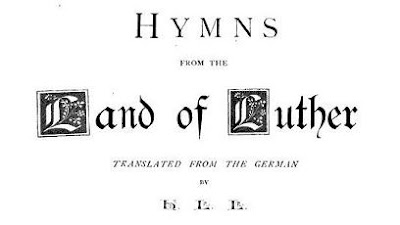
Borthwick's family belonged to the Free Church of Scotland, and she apparently became interested in German-language hymns during a trip to Switzerland, where a friend suggested that she try translating them. After returning to Scotland, her father also encouraged that idea. Jane and her sister, Sarah Borthwick Findlater, worked over the next several years and eventually brought out four volumes titled Hymns From the Land of Luther between 1854 and 1862. The total number of translated hymns was 122; 69 by Jane.

This Borthwick translation of a text by Count Nicholas von Zinzendorf first appeared in The Free Church Magazine in 1846, and was slightly revised for the first volume of Hymns From the Land of Luther.

Jesus, still lead on,
Till our rest be won,
And, although the way be cheerless,
We will follow calm and fearless,
Guide us by your hand
To your promised land.

If the way be drear,
If the foe be near,
Let no faithless fears o’ertake us,
Let not faith and hope forsake us,
For through many a woe
To our home we go.

When we seek relief
From a long felt grief;
When temptations come alluring,
Make us patient and enduring;
Show us that bright shore
Where we weep no more.

Jesus, still lead on,
Till our rest be won;
Heavenly Leader, still direct us,
Still support, control, protect us,
Till we safely stand
In your promised land.

Nicholas von Zinzendorf, 1721
tr. Jane Laurie Borthwick, 1846; alt.
Tune: SEELENBRAUTIGAM (5.5.8.8.5.5.)
Adam Drese, 1698

The four volumes of translated texts were attributed to "H.L.L.," a pseudonym shared by the sisters. Borthwick also published other books of poetry and original hymn texts as well as books of religious instruction for children as H.L.L. She was apparently quite unhappy when her real identity was revealed by hymn compiler Charles Rogers in Lyra Britanica, a Collection of British Hymns (1867).

Her most famous translation today is certainly Be still, my soul, which became much more popular after 1933 when it was first matched with the tune FINLANDIA, which was adapted from a portion of the instrumental tone poem of the same name by Finnish composer Jean Sibelius. Her most known original text may be one we have already seen here: Come, labor on.

Tuesday, November 10, 2009

Martin Luther


German reformer Martin Luther (November 10, 1483 - February 18, 1546) was born in the town of Eisleben. In college, at the University of Erfurt, he studied many subjects, even law briefly, but eventually entered the Augustinian friary in Erfurt and became a monk.

His conflicts with the Catholic Church are better documented elsewhere, but it's useful to remember that theological disputes in his time were not polite exchanges across dueling dissertations or magazine articles. When he refused to recant his Ninety-Five Theses, which had been declared heretical by church authorities in Germany and in Rome, the Holy Roman Emperor Charles V presided at a trial in 1521 (the
Diet of Wurms) which pronounced him an outlaw, subject to arrest. Luther's writings were banned and it was now a crime for anyone to give him food or shelter. Fortunately he still had influential friends; Frederick III of Saxony had him taken to Wartburg Castle, where he remained in protective custody for a year. It was during this time that he translated the New Testament from Latin to German. He remained committed to bringing religious practice into the language of his people, both through his translation of Scripture (eventually completed after his Wartburg stay and updated frequently until his death) and his hymns in German, meant to be sung by the congregation.

This hymn of Luther's may not be particularly well known, even to Lutherans, but it caught my eye because I had been looking at All Saints' Day hymns last week. In 1523, two Augustinian monks, were arrested and tried for heresy in Brussels and were burned at the stake. Luther was incensed by the actions of the Inquisition and inspired by the martyrdom of the monks. He must have thought that the same fate could have come upon him.


Flung to the heedless winds,
Or on the waters cast,
The martyrs’ ashes, watched,
Shall gathered be at last.

And from that scattered dust,
Around us and abroad,
Shall spring a plenteous seed,
Of witnesses for God.

Their loving God received,
Their latest living breath,
And vain is any boast
Of victory in their death.

Still, still, though dead, they speak,
And, trumpet-tongued, proclaim,
To many a wakening land,
The one availing Name.

Martin Luther, 1523
tr, John A, Messenger, 1843: alt.
Tune:
MARIA JUNG UND ZART (6.6.6.6.)
Geistliche Kirchengesäng, 1623


One Year Ago: Martin Luther

Saturday, October 3, 2009

Karolina Sandell-Berg

Karolina Wilhelmina Sandell-Berg, sometimes called “the Fanny Crosby of Sweden,” was born on this date in 1832. She is reported to have written about 650 hymns and songs, not matching Crosby in numbers, but probably in popularity in her own country.

Her father, a Lutheran pastor, drowned on a family outing when she was 26, and this tragic story is often cited as her inspiration for writing, but in fact she had written hymns before this happened. Like many women of her time, she preferred to remain nearly anonymous, signing her verses only “L.S.” The name of Lina Sandell would not be known for some time.

Her hymns were popularized in Sweden with the help of composer Oskar Ahnfelt, who wrote the music for them and traveled through the country singing them, accompanying himself on the guitar. Also, the opera star Jenny Lind (who had a nickname of her own, the “Swedish Nightingale”) often sang the Sandell/Ahnfelt hymns in recitals and financed the publication of an edition of the composer's songs (many of which had words by Lina). Sandell was married to C.O. Berg in 1867 and died in 1903.

Thus far it appears to me that her hymns were not translated into English until later in the twentieth century and are thus still under copyright in this country (though you can find some online in other places). Our Canadian commenter AuntE just this week posted on her blog about her first encounter with Lina's most well known hymn (here in the US at least), Children of the heavenly Father, which is sung to Ahnfelt's tune TRYGGARE KAN INGEN VARA (actually, the opening words of the hymn in the original Swedish). I'll keep looking for earlier translations of other Sandell-Berg hymns; it seems likely that at least a few were available earlier.