Wednesday, February 5, 2014

Thomas Turton

Bishop Thomas Turton (February 5, 1780 - January 7, 1864) was born in the town of Hatfield, in South Yorkshire, the son of Thomas and Ann Turton.

He graduated from St. Catherine's College (part of the University of Cambridge) in 1805, and treturned there to teach, eventually serving as Professor of Mathematics (1822-1826) and of Divinity (1827-1842). In 1834 he published a pamphlet opposing the admission of non-Anglicans for univerity degrees.  During his teaching career, he also served in various clerical capacities following his ordination in the Church of England in 1813, which led to his inclusion in The Extraordinary Black Book (1832) by John Wade, a catalog of corruption and abuse in church and state. After leaving St. Catherine's, he became Dean of Westminster Abbey for three years, and in 1845 he was made Bishop of Ely.

He was also a composer of some church music, and two hymn tunes (including today's) were included in Hymns Ancient and Modern.

O thou, in all thy might so far,
In all thy love so near,
Betond the range of sun and star,
And yet beside us here.

What heart can comprehend thy Name,
Or searching, find thee out,
Who art within, a quick'ning Flame,
A Presence 'round about.

Yet though we know thee but in part,
We ask not, God, for more,
Enough for us to know thou art,
To love thee, and adore.

Frederick Lucian Hosmer, 1876; alt.
Tune: ST. ETHELDREDA (C.M.)
Thomas Turton, 1860

This tune was named for Saint Etheldreda, the patron saint of the Diocese of Ely, while Turton's other tune in Hymns Ancient and Modern was called ELY.

Turton was in poor health during much of his term as Bishop and died in 1864, leaving much of his estate to charity.  He was buried next to his friend Dr. Thomas Musgrave, Archbishop of York.

This text, by Frederick Lucian Hosmer, written while he was pastor of the Unitarian congregation in Quincy, Illinois, is described in Hymn Lore (1932) by Calvin Laufer as suggestive of Psalm 139.


Five Years Ago: Joy is like the rain

Four Years Ago: Roger Williams

Sunday, February 2, 2014

The Feast of the Presentation


 Joy! joy! the Mother comes,
And in her arms she brings
The Light of all the world,
The Ruler of all things,
And in her heart the while
All silently she sings.


Saint Joseph follows near,
In rapture lost, and love,
While angels 'round about
In glowing circles move,
And o'er the Mother broods
The everlasting Dove.


There in the temple court,
Old Simeon's heart beats high,
And Anna feeds her soul
With food of prophecy;
And see! the shadows pass,
The world's true Light draws nigh.


Frederick William Faber, 1854; alt.
Tune: BACA (6.6.6.6.6.6.)
William Henry Havergal,
19th cent.


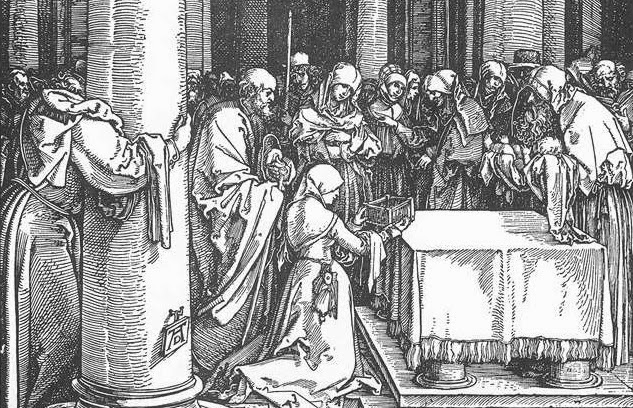
P.S - The illustration above is from The Presentation of Christ in the Temple by Albrecht Durer.


One Year Ago: In the temple now behold him

Three Years Ago: In peace and joy I now depart

Four Years Ago: O Jerusalem beloved

Five Years Ago: Hail to the Lord who comes

Six Years Ago: O Zion, open wide thy gates

Sunday, January 12, 2014

The Baptism of Christ


The Sunday after the Feast of the Epiphany sometimes commemorates the baptism of Jesus in the Jordan River by his cousin John, as told in Matthew 3: 13-16.  Infant or adult baptisms are often performed today in churches which mark this day, but even if there are no such celebrations the people of the congregation may renew their baptismal vows together.

O God, our strength in weakness,
We pray to you for grace,
Patience to trust your promise,
And speed to run the race;
When your baptismal waters
Were poured upon our brow,
We then were made your children
And pledged our earliest vow.

So we on earth are blessèd
For we shall see the Lord,
Forever and forever,
By seraphim adored;
And we shall drink the pleasure
Such as no tongue can tell
From heav'ns clear crystal river,
And life’s eternal well.

Then sing to our Creator,
Who formed us with great love;
And sing to God the Savior
Who leads to realms above;
Sing we with saints and angels
Before the heavenly throne,
To God the Holy Spirit,
Sing to the Three in One.

Christopher Wordsworth, 1881; alt.
Tune: STOKE (7.6.7.6.D.)
Mrs. G. E. Cole, 1889

Christopher Wordsworth wrote this text toward the end of his life, long after his major collection The Holy Year (1862).  He was Bishop of Lincoln from 1868 until his death in 1885, and apparently wrote this hymn for the handbook of the Lincoln Girls' Friendly Society.   Many of his other hymns have already appeared here (click on the tag below).

I am unable to find anything more about Mrs. G. E. Cole, whose tune first appeared in the 1889 supplement of Hymns Ancient and Modern (not even her name!).  It's likely that the initials belong to her husband.


Five Years Ago: 'I come,' the great Redeemer cries

Monday, January 6, 2014

The Feast of the Epiphany


Twelve days after Christmas we come again to the Feast of the Epiphany, marked by the familiar story of three royal visitors to the infant Jesus (Matthew 2:1-12).  

Many churches probably celebrated this occasion yesterday but there will be some service today in various places.

Lo! the pilgrim magi
Leave their royal halls,
And with eager footsteps
Speed to Bethlehem's walls;
As they onward journey,
Faith, which firmly rests,
Built on hope unswerving,
Triumphs in their breasts.


Refrain: 
Praise to the Creator,
Fount of Life alone;
who unto the nations,
made Christ's glory known.


O what joy and gladness
Filled each heart, from far
When, to guide their footsteps,
Shone that radiant star;
O'er that home so holy,
Pouring down its ray,
Where the cradled infant
With his mother lay.

Refrain

Costly pomp and splendor
Earthly kings array;
Christ, a mightier Monarch,
Hath a nobler sway;
Straw may be his pallet,
Mean his garb may be,
Yet with power transcendent
He all hearts can free.

Refrain

At his crib they worship,
Kneeling on the floor,
And their God there present,
In that babe adore;
To our God and Savior
We, as seekers true,
Give our hearts o'erflowing,
Give our tribute due.

Refrain

Charles Coffin, 1736;
tr, John David Chambers, 1857; alt.
Tune: ARMAGEDDON (6.5.6.5.D. with refrain)

Luise Richardt, 19th cent.;
adapt. John Goss, 1871 

The Roman Catholic Charles Coffin wrote his hymns in Latin, most for the Paris Breviary (1736).  We saw a much more familiar Epiphany hymn by Coffin a few years ago.

Luise Reichardt (1779-1826), born in Berlin, was the daughter of two composers, Juliane Reichardt and Johann Friedrich Reichardt.  One of her grandfathers had been concert master in the court of Frederick the Great.  Her earliest published songs appeared in 1800 in a collection of her father's work.  This particular melody was adapted into a hymn tune by John Goss, and has been used most often with the text Who is on the Lord's side.


Five Years Ago: Saw you never, in the twilight

Four Years Ago:  Earth has many a noble city

Three Years Ago: What star is this, with beams so bright

Two Years Ago: As with gladness those of old

One Year Ago:  O thou, who by a star didst guide

Sunday, December 15, 2013

Prophet to the Multitudes

John the Baptist always gets a week or two to himself during Advent worship, and several Advent hymns are about John and his proclamations about the coming Savior.

Today's gospel lesson in many churches was Matthew 11:2-11.  John was in jail again for his unpopular preaching, but was questioning whether Jesus (his cousin!) was truly the Promised One that John had been talking about.  Jesus responds with reminders of his works thus far, and praises John for his prophetic voice.

Today's hymn traces the whole of John's life, all the way to his death at the hands of King Herod. 

Herald, in the wilderness,
Breaking up the road,
Sinking mountains, raising plains,
For the path of God;

Prophet, to the multitudes
Calling to repent,
In the way of righteousness
Unto Israel sent;

Messenger, God’s chosen one
Foremost to proclaim,
Proffered titles passing by,
Pointing to the Lamb.

Captive, for the word of truth
Boldly witnessing;
Then in Herod’s dungeon cave,
Faint and languishing;

Martyr, sacrificed to sin
At that feast of shame;
As his life foreshowed the Word,
In his death the same—

Holy Jesus, when he heard,
Went apart to pray:
Thus may we our lesson take
From this saint today.

Henry Alford, 1866; alt.
Tune: BRUCE (7.5.7.5.)
The Hymnal, 1907


Five (Liturgical) Years Ago: On Jordan's bank the Baptist's cry

Four (Liturgical) Years Ago: The great forerunner of the morn

One (Liturgical) Year Ago: O Wisdom, spreading mightily

Sunday, December 1, 2013

Knowing You Are On Your Way

Another year in the church's calendar begins today, with the first Sunday in Advent.  These four Sundays before Christmas serve as a time of waiting and expectation as the commemoration of the birth of Christ approaches.  We have seen many Advent hymns over the last five years here at the blog, and they aren't used up yet.

Emily May Grimes (May 10, 1864 - July 9, 1927) was born in England but went to South Africa as a missionary in 1893.  In 1903, she married Dr. T. W. W. Crawford, another missionary in the Anglican church who was stationed in Africa.  Many of her hymns (such as today's) were written before her marriage and were attributed to 'E. May Grimes.'

Her texts seems to have appeared in more and more hymnals as the twentieth century progressed, unlike many of her contemporaries, though this is probably largely due to her most well-known hymn, Speak, Lord, in the stillness.

In the Advent light, O Savior,
We are living day by day;
Waiting, working, watching ever,
Knowing you are on your way.

In the Advent light rejoicing!
Songs of praise along the road
Seem to make the journey shorter,
Mounting upward to our God!

So from glory unto glory,
Gladdened by the Advent ray;
All the path is growing brighter,
Shining unto perfect day.

Christ is coming! Christ is coming!
Pass the heavenly watchword on!
Go we forth to meet the Savior
Hail! the heavn'ly promised one!

E. May Grimes, 1902; alt.
Tune: RESTORATION (8.7.8.7.)
The Southern Harmony, 1835


Five (Liturgical) Years Ago: Lo! Christ comes with clouds descending

Four (Liturgical) Years Ago: Jesus came, adored by angels

Three (Liturgical) Years Ago: Lift up your heads, ye mighty gates

Two (Liturgical) Years Ago: The King shall come when morning dawns

One (Liturgical) Years Ago: Once he came in blessing

Another Anniversary Today: World AIDS Day

Saturday, October 19, 2013

Claudia Frances Hernaman

Claudia Frances Hernaman was born in the village of Addlestone, Surrey on this day in 1838, the daughter of W. H. Ibotson, a Church of England minister.  Like many clerical daughters, she grew up to marry another minister, the Reverend J. W. D. Hernaman, in 1858. Not much else seems to be known of her life except the more than 150 hymns she wrote or translated from Latin, mostly for children.  These were published in several books written by her.

We have already seen her most familiar hymn, first published in her collection The Child's Book of Praise (1873), which still appears today in many modern hymnals.  Today's hymn, appropriate for this season of Hernaman's birthday, is matched with a sprightly tune that children would probably like to sing.

Come, children, lift your voices, 
And sing with us today,
As to the Lord of harvest
Our grateful vows we pray,
We thank thee, God, for sending
The gentle showers of rain,
The summer suns which ripened
The fields of golden grain.

Come join our glad procession
As onward still we move,
Rejoicing in the tokens
Of our Creator's love;
All good is God's creation,
All beautiful and fair,
Birds, insects, beasts and fishes
Our harvest gladness share.

May we by holy living
Thy praises echo forth,
And tell thy boundless mercy
To all the list'ning earth;
May we grow up as branches
Of Christ, the one true Vine,
Bear fruit to life eternal,
And be forever thine.

Claudia Frances Hernaman, 1878; alt.
Tune: BRITISH GRENADIERS (7.6.7.6.D.)
Traditional English melody, 17th cent.

The well-known and traditional tune BRITISH GRENADIERS was used since the eighteenth century as a march for several different divisions of the British and Canadian military, though it has since been heard in many different contexts.  I actually remember it from a long-ago television commercial for Chef Boy-ar-dee's Beefaroni.


Five Years Ago: Emily Swan Perkins

Four Years Ago: Emily Swan Perkins

Four Years Ago: John White Chadwick

Wednesday, September 4, 2013

Edwin Hatch

Edwin Hatch (September 4, 1835 - November 10, 1889) was a member of the Anglican clergy and a renowned theologian and Biblical scholar.

He was ordained in 1859 after graduating from Oxford, and moved to Canada, where his first position was professor of classics at Trinity College in Toronto.  He returned to England in 1867, and worked at Oxford as vice-principal of St. Mary Hall until 1885.

Most of his writing was scholarly in nature, his most famous book being The Influence of Greek Ideas and Usages Upon the Christian Church (1897).  Published after his death, it was compiled from a series of lectures he delivered in 1888.

His hymns and poetry, a much smaller percentage of his writing, were collected as Toward Fields of Light (1890).  Today's hymn had appeared earlier in Hatch's privately printed book, Between Doubt and Prayer (1878), and then in The Congregational Psalmist Hymnal  (1886).  J. R. Watson, in An Annotated Anthology of Hymns (2002), describes how the hymn "moves through various stages of Christian experience and discipline towards a unity with God."

Breathe on me, Breath of God,
Fill me with life anew,
That I may love what thou dost love,
And do what thou wouldst do.


Breathe on me, Breath of God,
Until my heart is pure,
Until with thee I will one will,
To do and to endure.


Breathe on me, Breath of God,
Till I am wholly thine,
Until this earthly part of me
Glows with thy fire divine.


Breathe on me, Breath of God,
So shall I never die,
But live with thee the perfect life
Of thine eternity.


Edwin Hatch, 1878
Tune: TRENTHAM (S.M.)
Robert Jackson, 1888

The tune TRENTHAM, by Robert Jackson, often appears with this text in American hymnals, but according to Watson, several different tunes are used in the United Kingdom.

Hatch continues to appear in hymnals to the present day, many more than in his own lifetime, thanks to this particular text which remains well-known.


Wednesday, August 28, 2013

William Hiley Bathurst

Hymnwriter and Anglican minister William Hiley Bathurst was born today in 1796. He was actually William Hiley Bragge at birth, but took his uncle's last name in 1820, when he was installed as parish priest in the church at Barwick-in-Elmet, which was on his uncle's West Yorkshire estate.  He remained in that post for thirty-two years, but eventually left the church over doctrinal differences.

Bathurst wrote more than three hundred hymns and psalm paraphrases, but only one of them still appears in some hymnals. However, as you know, I never feel constrained by popularity (for better or worse).

Eternal Spirit, by whose pow'r
Are burst the bonds of death,
On earthly hearts your blessings show'r,
And stir them with your breath.

And thus you point the heav'nly way,
Each rising fear control,
And with a warm, enliv'ning ray
to melt the icy soul.

And thus you bring God's mighty word
And write it on our heart;
There its reviving truths record,
And there its peace impart.

Almighty Spirit, visit then
Our hearts, and guide our ways;
Pour down your quick'ning grace on us,
And tune our lips to praise.

William Hiley Bathurst, 1831; alt.
Tune: IRISH (C.M.)
A Col­lect­ion of Hymns and Sac­red Po­ems, 1749


Four Years Ago: Ira Sankey

Two Years Ago: William Hiley Bathurst

Sunday, August 18, 2013

Charles H. Gabriel

Charles Hutchinson Gabriel, one of the most prolific writer-composers of gospel songs, was born today in 1856, the son of a farmer who was also a singing-school teacher.  Most of his musical education was received at home, where he taught himself to play the reed organ at age 16.

He began writing and composing gospel songs which quickly proved popular, and began collaborating with others, writing either words or music or both.  After a time, most of his work was published by the firm of Homer Rodeheaver, who was also the music director for the evangelistic crusades of Billy Sunday.  This association caused his songs to be sung by many thousands more people.

Today's song was introduced in Sunday's Philadelphia campaign in 1915, and later that year was published in the Rodeheaver collection Songs for Service, but has since appeared in dozens more books (187, according to hymnary.org, which is probably missing at least a few).

What a wonderful change in my life has been wrought
Since Jesus came into my heart!
I have joy in my soul for which long I had sought,
Since Jesus came into my heart!
Refrain
Since Jesus came into my heart,
Floods of joy o’er my soul
Like the sea billows roll,
Since Jesus came into my heart.
I have ceased from my wandering and going astray,
Since Jesus came into my heart!
And my sins, which were many, are lifted away,
Since Jesus came into my heart!
Refrain
There’s a light in the valley of death now for me,
Since Jesus came into my heart!
And the gates of the city beyond I can see,
Since Jesus came into my heart!
Refrain
I shall go there to dwell in that city, I know,
Since Jesus came into my heart!
And I’m happy, so happy, as onward I go,
Since Jesus came into my heart!
Refrain

Rufus H. McDaniel, 1914; alt.
Tune: McDANIEL (11.8.11.8. with refrain)
Charles H. Gabriel, 1915

I have to admit that the sound file here is a bit on the dull side, and doesn't give much of a sense of the song.  I recall some pretty raucous renditions (in the best sense o the word) by some accomplished keyboard players that raised the roof, as they say.


Four Years Ago:  Charles H. Gabriel


Thursday, August 15, 2013

Saint Mary the Virgin


Many Roman Catholic, Episcopal, and Orthodox churches observe this feast day dedicated to Mary, the mother of Christ.  This hymn for the day begins with the same words as an ancient antiphon to Mary, Ave regina caelorum, which is still part of the daily office of the church.  It also refers to another title for her that you may have heard, the ocean star, or Star of the sea.

Hail, Queen of heav'n, the ocean star,
Guide of the wand'rer here below;
Thrown on life's surge, we claim thy care;
Save us from peril and from woe,
Mother of Christ, star of the sea,
Pray for the wand'rer, pray for me.

Sojourners in this vale of tears,
To thee, blest advocate, we cry,
Pity our sorrows, calm our fears,
And soothe with hope our misery.
Refuge in grief, star of the sea,
Pray for the mourner, pray for me.

And while to Christ who reigns above,
In Godhead One, in Persons Three,
The source of life, of grace, of love,
Honor we pay each day to thee.
Heavenly Queen, star of the sea,
Pray for all people, pray for me.

Latin; tr. John Lingard, 18th cent.; alt.
Tune: STELLA (8.8.8.8.8.8.)
Henri F. Hemy, 1851

Henri Frederic Hemy was a Roman Catholic composer, and this tune first appeared in his collection Easy Hymn Tunes for Catholic Schools (1851).  It it supposedly based on an English folk melody and has been matched with this text ever since.


Five Years Ago:  Ye who claim the faith of Jesus

Four Years Ago: Hail, holy Queen

Three Years Ago: Sing, sing, ye angel bands

Two Years Ago: Virgin-born, we bow before thee

One Year Ago: Let this day, above all other

Wednesday, August 14, 2013

Jonathan Myrick Daniels


Jonathan Myrick Daniels, a martyr for the civil rights movement in this country, is remembered today in the calendar of the Episcopal Church.  Daniels was a seminary student in 1965 when he heard a televised appeal by Dr. Martin Luther King Jr. for more clergy of all denominations to become involved in voter registration of African-Americans  in Southern states.  Daniels wrote that he was inspired by the words of the Magnificat, Mary's prophetic song of liberation from the Gospel of Luke, and became convinced that he was being called to engage in this work.

Daniels was working in Alabama when he and other protesters were arrested and jailed for six days.  On August 20, upon release, they were looking for transportation out of town when they were confronted by a man with a shotgun, who aimed at Ruby Sales, a sixteen year old girl.  Daniels pushed her aside and was shot in the chest himself, dying immediately. His killer was later acquitted at trial on the grounds of self-defense.

This murder of a young seminarian brought more attention to the civil rights struggle.  In 1991 Daniels was declared "a martyr and witness to the Gospel" by the Episcopal Church, to be commemorated on this day, the anniversary of his arrest (because August 20 was already marked for another saint). I have used this hymn before, several years ago, but it seems appropriate again on this day.

O pure reformers! not in vain
Your trust in humankind;
The good which bloodshed could not gain,
Your peaceful zeal shall find.

The truths you urge are borne abroad
By every wind and tide;
The voice of nature and of God
Speaks out upon your side.

The weapons which your hands have found
Are those which heav'n has wrought:
Light, truth, and love -- your battleground,
The free, broad field of thought.

Press on! and if we may not share
The glory of your fight,
We'll ask at least, in earnest prayer,
That God will bless the right.

John Greenleaf Whittier, 1843; alt.
Tune: MARTYRDOM (C.M.)
Hugh Wilson,1800; arr. Ralph E. Hudson, c.1885

A fellowship in his name has been established at the Episcopal Divinity School in Cambridge, Massachusetts, where Daniels was a student.  Next fall, the Episcopal diocese of Rhode Island plans to open the Jonathan Daniels House in Providence, where Daniels also engaged in ministry before traveling south.

Ruby Sales, the girl whose life was saved that day, has continued her involvement in the civil rights struggle up to the present day.


Four Years Ago: Samuel Sebastian Wesley 

Two Years Ago: Samuel Sebastian Wesley
 

Monday, August 12, 2013

Sir Joseph Barnby

August 12 is a shared birthday between two prominent hymn tune composers of the Victorian age: Joseph Barnby (1838-1896) and Frederick Arthur Gore Ouseley (1825-.1889).  Though I have treated them fairly evenly here on the blog, I admit to a slight preference for Ouseley's tunes, though his reputation faded earlier than Barnby's.  Barnby continues to appear in modern hymnals thanks to LAUDES DOMINI, his tune for When morning gilds the skies.  The brand-new hymnal of the Christian Reformed Church, Lift Up Your Hearts (2013) and the Presbyterian Church (USA)'s upcoming Glory to God (Fall 2013) both include LAUDES DOMINI.

Today's Barnby tune is much less known, but it seems to me to be a sturdy tune in Common Meter which could be sung today without embarrassment.  It's matched here to a text by Isaac Watts based partially on Psalm 119.

God, I have made your Word my choice,
My lasting heritage:
There shall my noblest powers rejoice,
My warmest thoughts engage.
  
I'll read the histories of your love,
And keep your laws in sight,
While through your promises I rove
With ever-fresh delight.
  
A broad'ning land of wealth unknown,
Where springs of life arise;
Seeds of immortal bliss are sown,
And hidden glory lies.

Isaac Watts, 1719; alt.
Tune: POWER (C.M.)
Joseph Barnby, 1869

The names of Barnby's tunes were probably not all assigned by the composer.  This happened because many of his tunes first appeared in The Hymnary (1872) where they were identified by numbers rather than by names, even though Barnby was the musical editor (the book is often referred to as Barnby's Hymnary).  Perhaps he didn't think proper names for hymn tunes as significant as many of his contemporaries did, or perhaps he found himself with too many new tunes to name and a fast-approaching deadline.  When those tunes were subsequently used in later hymnals, their names were probably invented by the editors of those books, which is why some of his tunes are known by more than one name.

P.S.: The portrait of Barnby above with his conductors' baton is by the artist John Wallace Knowles, and was retained by Barnby's descendants for nearly a century before being donated to a museum.


Five Years Ago: Joseph Barnby

Four Years Ago: Frederick A. Gore Ouseley

Three Years Ago: Joseph Barnby

One Year Ago: Frederick A. Gore Ouseley

Another Birthday Today: Katharine Lee Bates

Saturday, August 10, 2013

Mary Artemesia Lathbury

Mary Lathbury, born today in 1841, will always be remembered for two simple hymns that she wrote for the Chautauqua Institution: Break thou the Bread of Life and Day is dying in the west.  Charles Sumner Nutter, author of Hymns and Hymn Writers of the Church (1905).wrote:

It could be wished that we had a dozen or more hymns from her pen in our Hymnal if all of them could be as poetic and devotional as these two beautiful lyrics. 

Nutter's book was specifically about hymns and their writers which were contained in the Methodist Hymnal of 1905, which did not, in fact, contain any more of Lathbury's hymns, though she wrote many more.

Today's hymn comes from a collection called Crystal Songs (1877), which contains many texts about water, used in various metaphorical ways.

O river of the Life of God,
Foreseen by saint and seer
No witness of thy glory tells
Thy coming drawing near,
The rising of the tides we feel,
The living floods we hear.

Beyond the waters, crystal clear,
The Holy City lies.
Its glory groweth day by day
Upon our raptured eyes
Who watch upon the shore until
The sacred river rise.

Then rise, O holy waters, rise,
Till waste and wilderness
Shall feel the overflowing tide;
And truth and righteousness
Shall spring, a miracle of bloom,
The whole round earth to bless.

Mary A. Lathbury, 1877; alt.
Tune: BROTHER JAMES' AIR (8.6.8.6.8.6.)

James Leith Macbeth Bain, 1915

W
ater was often a sort of code word used in hymns and songs on the topic of temperance in the late nineteenth century and some of the material in Crystal Songs reflects this.  Though Lathbury did write more overtly pro-temperance songs, this does not appear to be one of them.  Frances Willard, one of the founders and later president of the Women's Christian Temperance Union was a close friend of Lathbury, and wrote of her:

A high courageous faith, a loyalty to the best ideals, and a devotion to the truth that gave inspiration to all with whom she came in contact, characterized 'our Mary.'


Five Years Ago: Mary Artemesia Lathbury

Four Years Ago: Mary Artemesia Lathbury

Three Years Ago: Mary Artemesia Lathbury

Monday, July 22, 2013

Saint Mary Magdalene

For the feast day of Mary Magdalene, we have a very familiar hymn that may seem out of place at first glance. 

As we have seen, older hymns for this day sometimes emphasize the story of the 'fallen woman,' which modern scholarship does not seem to support.  Contemporary hymns about Mary Magdalene are more likely to depict her as a follower of Jesus (almost but not quite one of the twelve disciples). and especially to recount her role as Apostle to the apostles on Easter morning, the first witness to the Resurrection (but see the Five Years Ago link below for Charles Wesley's eighteenth-century text on that very subject).

Hymnwriter Charles Austin Miles was fairly prolific, but this particular text and tune has been far and away his most popular.  He claimed that the inspiration for it came to him in a dream, after reading the resurrection account in John 20, 'the story of the greatest morning in history,' as he called it.  As we sing this text, we should remember that it is written in the voice of Mary Magdalene.

I come to the garden alone
While the dew is still on the roses
And the voice I hear falling on my ear
The risen Christ discloses.


Refrain
And he walks with me, and he talks with me,
And he tells me I am his own;
And the joy we share as we tarry there,
None other has ever known.

He speaks, and the sound of his voice,
Is so sweet the birds hush their singing,
And the melody that he gave to me
Within my heart is ringing.

Refrain

I’d stay in the garden with him
Though the night around me be falling,
But he bids me go; through the voice of woe
His voice to me is calling.

Refrain

C. Austin Miles, 1912; alt.
Tune: IN THE GARDEN ( with refrain)


Five Years Ago: Saint Mary Magdalene

Four Years Ago: Emily E. S. Elliott 

Three Years Ago: Saint Mary Magdalene

One Year Ago: Saint Mary Magdalene

Thursday, July 11, 2013

John Quincy Adams


Today is the birthday of John Quincy Adams, the only US President known to have written a number of hymns and psalm paraphrases. As described here before, Adams wrote metrical versions of all 150 Psalms, though unfortunately they were never collected and published in one edition.  Several appeared in The Christian Psalter (1841) and others were published in Poems of Religion and Society (1849).

Of course, this would include a version of the well-known Psalm 23, perhaps the most widelly adapted of all the Psalms.  Adams's version begins:

My Shepherd is the Lord on high,
His hand supplies me still;
In pastures green he makes me lie,
Beside the rippling rill.

His lifelong interest in religion and the Bible made him open to different interpretations of scripture.  He converted from Congregationalism to the Unitarian faith, but, as President, he habitually attended at least two Sunday services, one Unitarian (he had been a founding member of the First Unitarian Church of Washington - now All Souls Unitarian - in 1821) and another, either Episcopalian or Presbyterian.  He once wrote  "I can frequent without scruple the church of any other sect of Christians, and join with cheerfulness the social worship of all without subscribing implicitly to the doctrines of any . . . "  (He was, however, rather bored by his experience at a Quaker meeting, conducted in silence.)

Today's text is his paraphrase of Psalm 65, a song of thankfulness for the bounties of God.

For thee in Zion waiteth praise,
O God, O thou that hearest prayer;
To thee the suppliant voice we raise,
To thee shall humankind repair;
On thee the ends of earth rely,
In thee the distant seas confide;
By thee the mountains brave the sky,
And girded by they strength abide.

Thou speakest in the tempest peace,
The roaring wave obeys thy nod;
The tumults of the people cease,
Earth marvels at the voice of God;
The morning's dawn, the evening's shade
Alike thy pow'r with gladness see;
The fields from thee the rains receive,
And swell with fruitfulness from thee.

Thy river, gracious God, o'erflows,
Its streams for human wants provide;
At thy command the harvest grows,
By thy refreshing show'rs supplied.
Thy bounty clothes the plains with grass,
Thy path grows fruitful as it goes;
And wheresoe'er thy footsteps pass,
The desert blossoms like the rose.

Thy goodness crowns the circling year,
The wilderness repeats thy voice;
The mountains clad with flocks appear,
The hills on every side rejoice.
New harvests from the valleys spring,
The reaper's sickle they employ;
And hark! how hill and valley ring
With universal shouts of joy!

John Quincy Adams, 
Tune: DUANE STREET (L.M.)
George Coles, 1835


Four Years Ago: John Quincy Adams