Monday, November 22, 2010

Successive Cecilias

I have mentioned before my ongoing interest in the women composers of worship music, including hymn tunes, gospel songs, and service music. It seems that today, the feast day of Saint Cecilia, the patron saint of music, might be an appropriate time to share some of what I've learned over the last few years.

Over the last century there has been a good deal of interest in women who wrote hymn texts. There are a number of books on that topic, from Lady Hymn Writers (1897) and Songs from the Heart of Women (1903) up to Sing the Wondrous Love of Jesus (2005). But the women who wrote the music for hymn texts are not so often studied or written about. While there has been increased interest in women composers in general over the last thirty years or so, most often they are women who wrote in larger forms, like symphonies or operas (such as Amy Beach), and the general books about them take no notice of the many women writing tunes for congregational singing.

Using the internet you can probably access more hymnals and songbooks than you'd find in most university or seminary libraries. I've downloaded hundreds of them and looked through many more that I didn't need cluttering up my hard drive. I also have a collection of hymnals in the dozens. Thus far I have unearthed over a thousand pieces composed by more than three hundred and fifty women, from standard four-part hymn tunes, gospel songs and children's songs to service music and Anglican chants. I'm focusing primarily on works in the public domain, published in this country before 1923, but most of these women are unknown to the singers of today. Most of their tunes appeared only in one book and never made it into the next generation of books.

These are the women thus far with more than a dozen tunes I've seen. I've written about some of them (the ones that are linked) but not others for various reasons (little or no information available about them, including birth or death dates, no sound files available, etc). Even most of these women rarely appear in the hymnals of today.

Mary Shaw Attwood
Pluma Brown
Grace Weiser Davis
Mari R. Hofer
Lucy Rider Meyer
Emma T. Mitchell
Emma Mundella

Having looked through many many nineteenth-century hymnals I've also compiled a list of the dozen or so women who had at least one tune that appeared in multiple hymnals before 1900.

Elizabeth Barker -- ST. JOHN DAMASCENE
Charlotte Barnard -- BROCKLESBURY
Mary Ann Browne -- PLYMOUTH ROCK
Elizabeth Cuthbert -- HOWARD
Frances Ridley Havergal -- HERMAS, EIRENE
Phoebe Knapp -- ASSURANCE
Alice Nevin -- RESURRECTION, WILLIAMSON
Mary Palmer -- CLARE MARKET
Ann Baird Spratt -- KEDRON
Sarah Stock -- MOEL LLYS (not named at that page, but that's it)
Charlotte Streatfield -- LANGTON
Maria Tiddeman -- IBSTONE
Lizzie Tourjée -- WELLESLEY

I would guess that only four of these tunes remain in somewhat common use today: BROCKLESBURY, HERMAS, ASSURANCE, and WELLESLEY. Some are simply not in a style that we would find melodic or interesting today, and some were written for a particular text in an unusual meter that is no longer sung.

Much of this music is perhaps not worthy of reconsideration. Much of it may never be sung again. But I believe that there are definitely things among these thousand-plus compositions that could be brought out in the open again. When we consider the whole vast body of musical composition for our hymns and songs, a certain percentage survives over time because it's good and singable. Another (far larger) percentage is discarded and forgotten, and deservedly so in many cases. But there are always things that were left behind because they never received a wide distribution. Tunes that appeared in one book with a minimal print run may deserve a second look, and we may find singable and serviceable music that can still be used in our worship.

I'm still looking, and the more I look, the more I suspect that I may have just scratched the surface of what is out there. The women of specific denominations and smaller groups wrote music that was seen and preserved by even fewer people, such as the Shakers or the Salvation Army. Religious communities of women have produced their own books for worship, such as the Holy Face Hymnal (1891), which was published by the Sisters of Mercy in Providence, RI. Most tunes in that book bear only the attribution "Music by S. of M." - we will probably never know the names of the women who wrote them.

If you have an obscure hymnal or two and think you may have something by a woman I haven't found, I'd be happy to hear about it. I think there are some further aspects to the subject that I'll write more about from time to time.


P.S. The illustration above is from Saint Cecilia at the Organ (1671), by Carlo Dolci


One Year Ago: Saint Cecilia


Sunday, November 21, 2010

The Feast of Christ the King

We have come around again to the last Sunday in the church year, celebrated in many churches as the Feast of Christ the King. This is a relatively recent celebration, introduced in the Roman Catholic Church by Pope Pius XI in 1925. He decreed it in response to what he saw as growing nationalism and secularism in the early twentieth century, to be marked on the last Sunday in October. In 1969 Pope Paul VI moved the feast to its present date, and over the years a number of other denominations have come to observe it.

Given its relative newness, there isn't the same hymnic tradition that stretches back for a few centuries as with older celebrations such as Epiphany or Pentecost, but it was not an unexplored theme either. "King" as another name or attribute of Jesus is scriptural, and there are plenty of appropriate hymns to use. Sometimes, some of the hymns sung at Ascension are sung again today.

Hail, thou once-despised Jesus!
Hail, thou Galilean King!
Thou didst suffer to release us;
Thou didst free salvation bring.
Hail, thou universal Savior,
Bearer of our sin and shame,
By thy merit we find favor:
Life is given through thy Name.

Jesus, hail! enthroned in glory,
There for ever to abide;
All the heavenly hosts adore thee,
Seated at thy Father's side.
Worship, honor, power, and blessing
Thou art worthy to receive;
Highest praises, without ceasing,
Right it is for us to give.

Help, ye bright angelic spirits,
Bring your sweetest, noblest lays;
Help to sing our Savior's merits,
Help to chant Emmanuel's praise!
In that blessed contemplation,
We for evermore shall dwell;
Crown'd with bliss and consolation,
Such as none below can tell.

John Bakewell, 1757;
st. 3 Martin Madan, 1760; adapt.
Tune:
IN BABILONE (8.7.8.7.D.)
Dutch traditional melody;
arr. Julius Rontgen, 1906

John Bakewell was a follower of John and Charles Wesley, but his authorship of this text is tenuous and appears to be based more on tradition than on any actual evidence. At any rate, if he did write it, he probably only wrote the first and second stanzas, which appeared in a 1757 "pamphlet" of 71 pages titled A Collection of Hymns addressed to The Holy, Holy, Holy, triune God, in the Person of Christ Jesus, our Mediator and Advocate. Various other alterations were made by Martin Madan in a few different books which followed; in some nineteenth century hymnals this appears as a five-stanza text. The hymn has appeared in American Methodist hymnals "virtually from the beginning," according to the Companion to the (Methodist) Hymnal (1970), and in Episcopal hymnals since 1874.

The familiar tune IN BABILONE comes from Oude en Nieuwe Hollantse Boerenlities en Contradanseu (Old and New Dutch Peasant Songs and Country Dances), published in the Netherlands in 1710. The arrangement by Julius Röntgen first appeared in Ralph Vaughan Williams's English Hymnal (1906), though it has been reharmonized several times since by composers such as T. Tertius Noble and Ellen Jane Lorenz.


Two (Liturgical) Years Ago: The Feast of Christ the King

One (Calendar) Year Ago: Ada Cambridge


Thursday, November 18, 2010

R. Kelso Carter

Russell Kelso Carter, born today in Baltimore in 1849, was a man of several careers, including military cadet, professor of chemistry, civil engineering, and advanced mathematics, sheep rancher, Methodist deacon and evangelist, and finally physician. Somewhere in there he also wrote and composed several gospel songs and helped compile two hymnbooks.

Carter graduated from the Pennsylvania Military Academy (now Widener University) in 1867. He returned to the Academy shortly thereafter to begin his teaching career, but health problems interrupted it and he moved to California for three years to work an a sheep ranch, returning to the Academy again in 1879. Around this time he started to become involved with the Methodist Episcopal Church, attending camp meetings and starting to write gospel songs. He collaborated with John R. Sweney on Hymns of Perfect Love (1886) and with A.B. Simpson on Hymns of the Christian Life (1891).

The introduction to that second collection (which includes our previously-seen Carter song as #1) begins with a discussion that remains as topical today as it was then:

The musical taste of our day is in a state of transition. Beyond controversy, the people will have new tunes and hymns that move in a more spirited time than those which our fathers (and mothers! CWS) sang. But this fact should not send us to an extreme, and cause us to relegate all the old hymns to the dusty past. (...) Between the Scotch Psalter and the Salvation Army Song Book there is a wide stretch of territory in which the careful explorer will find much that is good, and possessing that rare quality, endurance.

How many hymnals and songbooks before and after Carter's time, right up to the present, contain a similar paragraph!

This is Carter's most well-known song, for which he wrote both words and music, and which first appeared in his earlier collection of 1886. It has been said that it evokes a martial mood similar to songs he might have known from his military school days.

Standing on the promises of Christ, my King,
Through eternal ages let the praises ring,
Glory in the highest, I will shout and sing,
Standing on the promises of God.

Refrain
Standing, standing,
Standing on the promises of God my Savior;
Standing, standing,
I’m standing on the promises of God.


Standing on the promises that cannot fail,
When the howling storms of doubt and fear assail,
By the living Word of God I shall prevail,
Standing on the promises of God.
Refrain

Standing on the promises I cannot fall,
List'ning every moment to the Spirit’s call
Resting in my Savior as my all in all,
Standing on the promises of God.
Refrain

R. Kelso Carter, 1886
Tune:
PROMISES (11.11.11.9. with refrain)

Throughout his life Carter faced several serious health challenges, which led him to explore different theories and means of faith healing, which you can read more about here. It appears that a serious dispute developed in the 1890s which may have caused his moving away from his evangelistic work. He studied medicine and became a doctor sometime before 1900, practicing until his death in 1928. He came to believe that both medicine and prayer were necessary for healing, and that God provided both to us for that purpose.

Sunday, November 14, 2010

Eliza Scudder

Hymnwriter Eliza Scudder was born today in Massachusetts in 1821. In childhood she was very close to her older sister Rebecca; this closeness lasted throughout their lives, and the sisters actually died on the same day in 1896.

Scudder was greatly influenced by the abolotionist movement and two of its leaders in particular: the philanthropist Gerrit Smith and the author Lydia Maria Child. It is believed that her association with Child led her away from the Congregational faith of her family and into an interest in the Unitarian Church (though it's not clear she ever formally joined it), which caused a break with many of her friends. Some years later she was drawn to the Episcopal Church through the preaching and then the friendship of Phillips Brooks, the popular rector of Trinity Church in Boston.

This flexibilty in her religious thought probably means that it's difficult to assign her hymn texts to any particular set of beliefs, and her hymns were indeed sung in several different denominations. Her short 1880 collection, Hymns and Sonnets, contained this text.

Grant us your peace, down from your presence falling
As on the thirsty earth cool night-dews sweet,
Grant us your peace, to your own paths recalling,
From distant ways, our worn and wand'ring feet.

Grant us your peace, through winning and through losing,
Through gloom and gladness of our pilgrim way,
Grant us your peace, safe in your love's enclosing,
Who o'er all things in heav'n and earth hold sway.

Grant us your peace, that like a deep'ning river
Swells ever onward to a sea of praise;
Jesus, of peace the only Source and Giver,
Grant us your peace, O Savior, all our days!

Eliza Scudder, 1880; alt.
Tune:
EIRENE (11.10.11.10)
Frances Ridley Havergal, 1871


Two Years Ago: Eliza Scudder


Thursday, November 11, 2010

Anne Steele

Today we mark the anniversary of the death of Anne Steele in 1778 (born sometime in May of 1716 in Hampshire), the first widely-known and sung woman hymnwriter. During her lifetime she wrote under the pen name of Theodosia (meaning "gift of God"), publishing her first collection, Poems on Subjects Chiefly Devotional in 1760.

Her hymns received wider recognition in 1769 when the fourth edition of A Collection of Hymns Adapted to Public Worship appeared with sixty-two of her hymns, quite a large number for a "newcomer." This Baptist hymnal was compiled by Caleb Evans, a minister and hymnologist who later wrote a memoir of Steele and greatly admired her verse.

Today's hymn was perhaps not intended by Steele for congregational singing, as she originally wrote it in thirty-nine stanzas. John Julian's Dictionary of Hymnology (1892) lists five different arrangements of stanzas which had appeared in hymnals up to that time; this is a sixth.

Come, heav'nly Love, inspire my song
With thy immortal flame,
And teach my heart, and teach my tongue
The Savior's lovely name.

The Savior! oh, what endless charms
Dwell in that blissful sound!
Its influence ev'ry fear disarms,
And spreads sweet comfort 'round.

Oh, the rich depths of love divine!
Of grace, a boundless store!
Dear Savior, let me call thee mine;
I cannot wish for more.

On thee alone my hope relies;
Beneath thy cross I fall
My Love, my Life, my Sacrifice,
My Savior, and my All!

Anne Steele, 1760; alt.
Tune:
REDCLIFFE (C.M.)
Phyllis Skene, c. 1902


Julian noted that the different versions of Steele's hymn sometimes had different opening lines; the original (as seen here) was altered in these ways:

Come, heav'nly Dove, inspire my song

Come, Holy Ghost, inspire our songs

Come, Holy Spirit, guide my song

Anne Steele's hymns remained popular through the nineteenth century but mostly have not survived into our time. Her complete works, finally collected and published in 1863, were republished by the Gospel Standard Baptist Trust of London in 1967, but did not, apparently, inspire a new generation of hymnal editors to reexamine her work.


Two Years Ago: Anne Steele


Sunday, November 7, 2010

And All Its Flocks Unite

The theme of unity can be an awkward one to discuss among Christians. given our multiplicity of denominations and doctrinal differences. The number of things we all agree on seems to grow smaller all the time when compared to the number of things we don't.

This text by Presbyterian minister Henry Van Dyke seems to me to come out of the early twentieth century's conception of the social gospel, from which we have received several of the great hymns of the church. That concept is under attack today by churches who believe that concern for others is far less important than the purity of their own beliefs. Van Dyke says that while our churches may never attain unity here on earth, our actions may at least come to some accord.

No form of human framing,
No bond of outward might,
Can bind thy church together, Lord,
And all its flocks unite;
But, Jesus, thou hast told us
How unity must be:
Thou art with God and Spirit one,
And we are one in thee.

The mind that is in Jesus
Will guide us into truth,
The humble, open, joyful mind
Of ever-learning youth;
The heart that is in Jesus
Will lead us out of strife,
The giving and forgiving heart
That follows love in life.

Where people do thy service,
Though knowing not thy sign,
Our hand is with them in good work,
For they are also thine.
Forgive us, Christ, the folly
That quarrels with thy friends,
And draw us nearer to thy heart,
Where every discord ends.

Henry J. Van Dyke, 1922; alt.
Tune:
PATMOS (7.6.8.6.D.)
Henry J. Storer, 1891

This text first appeared in a short collection by Van Dyke, Thy Sea is Great, Our Boats are Small, and Other Hymns of Today (1922), prefacing the text with a verse from John 10:16: Other sheep I have, which are not of this fold. Van Dyke's most familiar hymn came several years earlier, Joyful, joyful we adore thee.


One Year Ago: Will L. Thompson

Saturday, November 6, 2010

William Tans'ur

William Tans'ur (1700 - 1783) was a composer and teacher of music, baptized on this day in 1706, the earliest known date connected with his life. Though born to parents Edward and Joan Tanzer, according to the parish register at Dunchurch, Warwickshire, the adult William began signing his name with the internal apostrophe; "an affectation," according to some sources.

Little is known about Tans'ur's life before adulthood. He was a teacher of music and published The New Musical Grammar in 1746, a textbook that remained in popular use for nearly a century. He taught psalmody and community singing in several different locations before settling in the town of St. Neot's, where he had a bookshop and continued to teach.

His first important volume of psalm tunes was A Compleat Melody, or the Harmonies of Zion (1734). It was republished several times, sometimes under other titles, and eventually in the American colonies in 1767. William Billings, the first significant American composer, is said to have been influenced by Tans'ur. Tans'ur's total output is estimated to be approximately two hundred tunes, as well as other choral anthems and service music.

Today's familiar tune comes from that 1746 volume by Tan'sur, where it was set to a paraphrase of Psalm 11, In God the Lord I put my trust. The first text I always associate with it is the Good Friday hymn Alone thou goest forth, a 1938 (copyrighted) translation by F. Bland Tucker that first appeared in the Episcopal Hymnal 1940, but many other texts have been matched to it over the years and it still appears in many, if not most, American hymnals.

O God, thy pow'r is wonderful,
Thy glory passing bright;
Thy wisdom, with its deep on deep,
A never-failing light.

I see thee in th'eternal years
In glory all alone,
Ere round thine uncreated fires
Created light had shone.

Still, still incomprehensible,
I see thee all through time;
Thy patience and compassion seem
New attributes sublime.

Angelic spirits, countless souls,
Of thee have drunk their fill;
And to eternity will drink
Thy joy and glory still.

O little heart of mine! shall pain
Or sorrow make thee moan,
When all this God is all for thee,
A Comfort all thine own?

Frederick W. Faber, 1854; alt.
Tune:
BANGOR (C.M.)
William Tans'ur, 1734


The city of Bangor, Maine, apparently took its name from this tune by accident. The Reverend Seth Noble was sent to Boston in 1791 to fill out the paperwork for incorporation of the town, which was intended to be called Sunbury. The story goes that Noble was humming Tans'ur's tune while giving the necessary information to a clerk, and when asked the name, unwittingly gave the name of the tune rather than the name of the town, and "Bangor" was officially entered.

It seems possible to me that this is the tale that the Reverend Mr. Noble told his neighbors upon returning, that perhaps in truth he didn't particularly care for "Sunbury" himself, and decided to name his town for a hymn tune he particularly liked.

I know people who would do something like that.

Thursday, November 4, 2010

James Montgomery

James Montgomery, born today in 1771, was orphaned at a young age when his missionary parents died in the Caribbean. Young James had been left in the care of the Moravian community in Ireland and he attended their school. Later, intending to study for the ministry at the Fulneck Seminary near Leeds, he was expelled because he spent too much time writing poetry, and was apprenticed to a baker.

Apparently determined to write and not to bake, he ran away in 1787 and eventually traveled to London, looking unsuccessfully for opportunities to publish his poetry. In 1792 he was hired as the assistant to Joseph Gales, who published the Sheffield Register newspaper. Two years later Gales fled the country to avoid prosecution for publishing inflammatory political articles, and Montgomery took over the paper. He renamed it the Sheffield Iris and ran it for the next 33 years. Montgomery further followed in Mr. Gales's footsteps by being prosecuted twice; once for publishing a song in praise of the fall of the Bastille, and again for an article about a riot in Sheffield, which criticized the actions of the police.

His later interest in hymnwriting may have been increased through his friendship with Thomas Cotterill, the vicar of St. Paul's Church in Sheffield. Cotterill also wrote hymns, and had compiled a hymnal for use in his church which was forbidden by his bishop. The controversy over the hymnal lasted for some time, and Montgomery supported Cotterill in his efforts to encourage congregational singing. Cotterill's Se­lect­ion of Psalms and Hymns, for Public and Private Use, Adapt­ed to the Fes­tiv­als of the Church of Eng­land was finally approved for use in worship in 1820.

Montgomery's own hymns, approximately four hundred (only a fraction of which can be seen here), were published after this time, largely in three books: Songs of Zion, The Christian Psalmist, and The Christian Poet, and were later collected in one volume, Original Hymns for Pub­lic, Pri­vate and So­cial De­vo­tion (1853). Several of his hymns are still sung today, most of which we have already seen here (click on the tag below). This lesser-known text is his paraphrase of Psalm 23.

Thou, Lord, art my Shepherd, no want shall I know;
I feed in green pastures, safe folded I rest;
Thou leadest my soul where the still waters flow,
Restor'st me when wand’ring, redeem'st when oppressed.

Through valley and shadow of death though I stray,
Since thou art my Guardian, no evil I fear;
Thy rod shall defend me, thy staff be my stay;
No harm can befall, with my Comforter near.

In midst of affliction my table is spread;
With blessings unmeasured my cup runneth o’er;
With perfume and oil thou anointest my head;
O what shall I ask of thy providence more?

Let goodness and mercy, my bountiful God,
Still follow my steps till I meet thee above;
I seek, by the path which my forebears hath trod,
Through land of their sojourn, thy household of love.

James Montgomery, 1822; alt.
Tune:
CRADLE SONG (11.11.11.11.)
William J. Kirkpatrick, 1895


I suppose not everyone will want to sing this text to CRADLE SONG by William Kirkpatrick, better known as one of the tunes used at Christmas for Away in a manger. An alternative is the tune assigned by the Cyber Hymnal, GOOD SHEPHERD by Joseph Barnby, but in this case I like the more familiar tune.


Two Years Ago: James Montgomery

Another Birthday Today: Augustus Montague Toplady

Monday, November 1, 2010

The Feast of All Saints


The saints of God! their conflict past,
And life’s long battle won at last,Add Image
No more they need the shield or sword,
They cast them down before their Lord:
O happy saints! forever blest,
At Jesus' feet how safe your rest!

The saints of God! their wand’rings done,
No more their weary course they run,
No more they faint, no more they fall,
No foes oppress, no fears appall:
O happy saints! forever blest,
In that dear home how sweet your rest!

The saints of God! life’s voyage o’er,
Safe landed on that blissful shore,
No stormy tempests now they dread,
No roaring billows lift their head:
O happy saints! forever blest,
In that calm haven of your rest!

O God of saints! to thee we cry;
O Savior! plead for us on high;
O Holy Spirit! Guide and Friend,
Grant us thy grace till life shall end;
That with the saints our rest may be
In that bright paradise with thee!

William Dalrymple Maclagan, 1869
Tune: BEATI (8.8.8.8.8.8.)
John Stainer, 1873


Sunday, October 31, 2010

Dressed in Living Green


The Jordan River, seen above, sometimes appears in the hymns about heaven that we've seen. The applicable metaphor derives from the story of the Israelites, having escaped from Egypt and spent forty years in the wilderness, finally crossed the Jordan into the land of Canaan, already established in the Old Testament as a place of abundance. Moses, their leader, had seen this promised land across the Jordan (Deuteronomy 34: 1-5) but did not survive long enough to get there.

This text by Isaac Watts draws from that story. It's said to have been inspired partly by a view of green fields over the estuary at Southampton, where Watts often walked. This hymn ranked at #30 in The Best Church Hymns (1899) and still appears in some hymnals, though it might not be quite so highly ranked today. More than one source I consulted called it one of the most beautiful of Watts's hymns.

There is a land of pure delight,
Where saints immortal reign;
Infinite day excludes the night,
And pleasures banish pain.

There everlasting spring abides,
And never with'ring flowers:
Death, like a narrow sea, divides
This heav’nly land from ours.

Sweet fields beyond the swelling flood
Stand dressed in living green:
So to God's people Canaan stood,
While Jordan rolled between.

But timorous mortals start and shrink
To cross this narrow sea;
And linger, shivering on the brink,
And fear to launch away.

O could we make our doubts remove,
Those gloomy thoughts that rise,
And see the Canaan that we love
With unbeclouded eyes!

Could we but climb where Moses stood,
And view the landscape o’er,
Not Jordan’s stream, nor death’s cold flood,
Should fright us from the shore.

Isaac Watts, 1707; alt.
Tune: ROCHESTER (C.M.)
Aaron Wiliams, 1764


Some hymnals have omitted the third and fourth stanzas about doubt, but certainly that was more or less the point for Watts. In his Hymns and Spiritual Songs, where this text was first published, it was titled A Prospect of Heaven Makes Death Easy.

Two hundred years after Watts, Alma White (who would certainly have known this hymn) wrote her own crossing-the-Jordan hymn which we have already seen. Doubt was not a part of her text either, but it doesn't seem that White ever had much to do with doubt, at least in her public persona.

Saturday, October 30, 2010

Adelaide Anne Procter

Today is the birthday of Adelaide Anne Procter (born in 1825), who wrote the text of one of the most popular songs of the nineteenth century, The Lost Chord, though she did not live to see her words joined to Arthur Sullivan's music.

In the book Lady Hymn Writers (1892) by Emma Raymond Pitman, we learn a few details of Procter's childhood. Even before she learned to write she was captivated by poetry, and

"...she made for herself a tiny album of note-paper, into which her favorite poems were copied for her, at her urgent request, by her mother. (...) This little album was cherished and carried around by the child, much as dolls are by other little girls."

Years later, her own poetry was published, first by Charles Dickens in his magazine Household Words, and later collected in Legends and Lyrics (1858-60). A smaller volume of primarily devotional poems followed, A Chaplet of Verses (1862). Some of her texts were later set to music and appeared in hymnals, such as this one.

My God, I thank thee, who hast made
The earth so bright,
So full of splendor and of joy,
Beauty and light;
So many glorious things are here,
Noble and right.

I thank thee, too, that thou hast made
Joy to abound;
So many gentle thoughts and deeds
Circling us round,
That in the farthest spot of earth
Some love is found.

I thank thee, God, that thou hast kept
The best in store;
We have enough, yet not too much
To long for more:
A yearning for a deeper peace
Not known before.

Adelaide Anne Procter, 1858
Tune:
WENTWORTH (8.4.8.4.8.4.)
Frederick C. Maker, 1876

Procter died in 1864, reportedly worn down by the charitable work which to her was much more significant than her poetry. Dickens wrote of her:

"Perfectly unselfish, swift to sympathize and eager to relieve, she wrought at such designs with a flushed earnestness that disregarded season, weather, time of day or night, food, rest. Under such a hurry of the spirits, and such incessant occupation, the strongest constitution will commonly go down. (...) And so the time came when she could move about no longer and took to her bed."

The popularity of her poetry continued to increase after her death for many years to come, and undoubtedly there were many other little girls who loved her works before they had learned to write. I hope some of them had mothers who wrote down their favorites for them to carry about.


One Year Ago: Adelaide Anne Procter

Two Years Ago: Christopher Wordsworth


Thursday, October 28, 2010

Saint Simon and Saint Jude


When thou, O Christ, didst send the Twelve,
Thy work of grace to do,
Conjoined in holy bands of love
They went forth, two and two.

Today, O Lord, before us here
Two blest Apostles stand,
Forever in thy realm above
United hand in hand.

Jude bids us in our holy faith
With zeal to seek the right,
And zeal shines brightly in the name,
Simon the Canaanite.

So send thou down into our hearts
Thy Spirit from above,
And give us ever-fervent zeal
Tempered with holy love.

And may we with these servants then
In heav'nly glory be!
For fellowship in holy love
Is unity in thee.

Christopher Wordsworth, 1862; alt,
Tune:
WINCHESTER OLD (C.M.)
The Whole Book of Psalmes, 1592
arr. William H. Monk, 1861


Bishop, scholar, hymnwriter and hymnal editor Christopher Wordsworth (whose birthday is coming up this Saturday) wrote this text for the day and included it in his collection The Holy Year (1862). WINCHESTER OLD is another psalter tune that has been sung with many texts over the last four hundred years, though the version most used today was harmonized by William Henry Monk, as you can probably guess by now, for Hymns Ancient and Modern (1861) .


Two Years Ago: Saint Simon and Saint Jude

One Year Ago: Saint Simon and Saint Jude

Sunday, October 24, 2010

Sweet Will Be the Flower


Continuing a look at the psalter tunes that originally set the style for hymn tunes as we know them today, we come to the Scottish Psalter. The version of 1650 is the best-known today, and was used most often by various churches, but there were earlier ones as well. Today's familiar tune comes from the 1615 version, published in Edinburgh by Andro Hart, a printer and bookseller. The tune we know as DUNDEE was one of twelve tunes included in Common Meter (C,M,. or 8.6.8.6. - four-line stanzas beginning with a line of eight syllables) which were not specifically assigned to a particular psalm. Since many, if not most, of the psalm paraphrases were also written in Common Meter, they could be sung to FRENCH TUNE, as DUNDEE was originally called (though no French origin has yet been traced). The tunes in Hart's psalter were melody-only.

In 1621 The Whole Booke of Psalmes, based on the earlier psalm paraphrases of Sternhold and Hopkins, was published by composer Thomas Ravenscroft, which included FRENCH TUNE, now arranged in four-part harmony and called DUNDY TUNE, and matched with a paraphrase of Psalm 36. (You can see the original page from Ravenscroft's psalter here; scroll down for a version of Psalm 36 we would not likely sing today; the familiar melody is found in the tenor part). Ravenscroft re-named the tune in honor of the city of Dundee, which was known at that time as the Scottish Geneva because of its importance in the Reformation in Scotland. However, the name FRENCH TUNE persisted in many hymn and psalm collections well into the nineteenth century, while others came to call it DUNDEE. The Companion to the Baptist Hymnal (1976) calls it "a sturdy tune that should not be sung at too rapid a tempo."

Under whichever name this tune has been sung consistently for nearly four hundred years to a wide variety of texts. In addition to many many psalms, one hymn we have already seen here, and this text by William Cowper is also frequently sung to it.

God moves in a mysterious way,
Great wonders to perform;
And, planting footsteps in the sea,
God rides upon the storm.

Deep in unfathomable mines
Of never failing skill
God treasures up all bright designs
And works one sovereign will.

Ye fearful saints, fresh courage take;
The clouds ye so much dread
Are big with mercy and shall break
In blessings on your head.

Judge not our God by feeble sense,
Trust only for God's grace;
Behind a frowning providence
God hides a smiling face.

God's purposes will ripen fast,
Unfolding every hour;
The bud may have a bitter taste,
But sweet will be the flower.

Blind unbelief is sure to err
And scan God's work in vain;
God is the one interpreter,
And God will make it plain.

William Cowper, 1774; alt.
Tune:
DUNDEE (C.M.)
Scottish Psalter, 1615

In 1635, Andro Hart, who first published this tune, published another psalter which matched each paraphrase to a particular tune, and the tunes in this book were in four-part harmony. A tune very similar to DUNDEE, called CAITHNESS (named for a county in Scotland), first appeared in this book, and they sometimes get confused, though they only share the first five notes. But I have stood next to people who started singing a hymn to DUNDEE and ended up singing it to CAITHNESS. I'm sure none of my readers would ever do that.


One Year Ago: Sarah Josepha Hale


Saturday, October 16, 2010

Frederick Lucian Hosmer

Today is the 170th birthday of Unitarian minister and hymnwriter Frederick Lucian Hosmer who was born in Framingham, Massachusetts. Educated at Harvard University and Harvard Divinity School, he was ordained in the Unitarian church shortly after graduation in 1869, and served his first church in Northboro, MA for three years before moving westward in his career, to churches in Ohio, Illinois, Missouri, and California.

As described here before, he and his friend William Channing Gannett produced two important Unitarian hymnals, Unity Hymns and Chorals (1880) and The Thought of God in Hymns and Poems (1885), both of which they revised in later editions. According to a quote in the later Unitarian collection Hymns for the Celebration of Life (1964), Gannett was the better poet, Hosmer the better hymnwriter.

Hosmer wrote today's hymn for the 1891 commencement ceremony of Meadville Theological School in Meadville, PA. Canon Percy Dearmer, who was at least partly responsible for introducing Hosmer's hymns to Great Britain, believed this text to be "one of the noblest hymns in the language."

God's time shall come! Forever so
The passing ages pray;
And faithful souls have longed to know
On earth that promised day.

But the slow watches of the night
Not less to God belong;
And for the everlasting right
The silent stars are strong.

And lo, already on the hills
The flags of dawn appear;
Go forth in joy, ye prophet souls,
Proclaim the day is near.

The day in whose clear shining light
All wrong shall stand revealed,
When justice shall be throned in might,
And every hurt be healed.

When knowledge, hand in hand with peace,
Shall walk the earth abroad;
The day of perfect righteousness,
The promised day of God.

Frederick Lucian Hosmer, 1891; alt.
Tune:
CREDITON (C.M.)
Thomas Clark, 1807


Two Years Ago: Frederick Lucian Hosmer

One Year Ago: Frederick Lucian Hosmer

Tuesday, October 12, 2010

Cecil Frances Alexander

Irish hymnwriter Cecil Frances Alexander died on this day in 1895 (the date of her birth in 1823 is not recorded). Her first published writing was in a series of religious tracts she produced with her friend Lady Harriet Howard. They were both influenced by the Oxford Movement (also sometimes called the Tractarian Movement because its precepts were laid out in a series called Tracts for the Times, published from 1833 to 1841). Harriet and Fanny (as she was known) decided to put out their own tracts in 1842. Harriet supplied the prose and Fanny the poetry, intended to reflect and expand upon Harriet's themes. The tracts attracted much interest and were collected into a book in 1848.

By that time she had already published two collections of poetry: Verses for Holy Seasons (1846) and Hymns for Little Children, and texts from these collections began appearing in hymnals. Several more collections followed, and hymnal editors often contacted her for a new text or two for their books. By the time of her death her hymns were known and loved throughout the world, and many survive into our time.

Here are the blog we have already seen all of her most familiar hymns (click on the tag below), so I found something a bit more obscure for today.

From many a close and crowded place,
From many a lowly room,
Out of the strife of common life,
Out of its toil and gloom,

We come, for strength to keep our hope,
To feed the life we live;
The feast is spread, the cup and bread,
And Christ is there to give.

Each time we seek thy table blest,
Again, again, 'tis dear --
Joy thus to be rememb'ring thee.
And joy to know thee near.

Be with us at thy sweet love-feast,
Still feed us with thy grace,
Till faith's strong might be lost in sight,
And we behold thy face.

Cecil Frances Alexander, 19th cent.; alt.
Tune:
CAITHNESS (C.M.)
Scottish Psalter, 1625

Following her death, her husband William Alexander, the Archbishop of All Ireland, published a larger collection of her hymns and poems. Though he included some biographical information in the preface, he did not reveal her birthdate either. Most of the preface tells about Mrs. Alexander's many works of charity and somewhat less about her writing. In a brief personal recollection, writing of their marriage in 1850, he says: it is not the exaggeration of affection which says that she was a singularly attractive person. Perhaps not the most effusive tribute, but he was, after all, an archbishop.


Two Years Ago: Healey Willan

Two Years Ago: Ralph Vaughan Williams


Sunday, October 10, 2010

Thrice Holy Fount, Thrice Holy Fire


One of the oldest hymns of the Holy Spirit, Veni Creator Spiritus, comes down to us from the ninth century. It's a prayer that begins:

Veni, Creator Spiritus,
mentes tuorum visita,
imple superna gratia
quae tu creasti pectora.

The Latin text is now generally attributed to the German monk Rhabanus Maurus, a scholar and author, and later the bishop of Mainz, though in earlier times it was sometimes credited to the Emperor Charlemagne. Rhabanus wrote a fair amount of poetry, though one source claimed that he was "a skillful versifier, but a mediocre poet." Still, this text has survived to the present day, often sung at ordinations, confirmations, and of course at Pentecost.

Martin Luther translated it into German in 1524 as Komm, Gott Schopfer, heiliger Geist. It was first translated into English in 1549, when it was added to the Anglican Book of Common Prayer, where it began:

Come Holy Ghost, eternal God,
Proceeding from above,
Both with the Father and the Son,
The God of peace and love.

Since then there have been more than sixty English translations. Among the best-known are:

Come, Holy Ghost, our souls inspire, (1627) by John Cosin

Creator Spirit by whose aid, (1693) by
John Dryden

Come, Holy Ghost, Creator blest, (1877) by
Edward Caswall (and others)


Today's hymn is a later adaptation of the Dryden text, in four-line rather than six-line stanzas.

Creator Spirit, by whose aid
The world’s foundations first were laid,
Come, visit every pious mind;
Come, pour thy joys on humankind;

Plenteous of grace, descend from high,
Rich in thy sev'nfold energy,
From sin, and sorrow set us free;
And make us temples worthy thee.

Heal and refine our earthly parts;
But, oh, inflame and fire our hearts!
O'er all may we victorious be
That stands between ourselves and thee.

Thrice holy Fount, thrice holy Fire,
Our hearts with heav’nly love inspire;
Make us eternal truths receive,
And practice all that we believe.

Rhabanus Maurus, 9th cent.;
tr. John Dryden, 1693; adapt.
Tune:
BALM (L.M.)
William B. Bradbury, 19th cent.


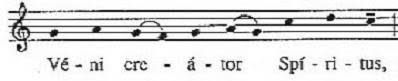
Of course, for most of its existence, Veni Creator Spiritus was sung to plainsong chant (even up to the present), and some of the English translations have also used that melody, partially pictured here.


But plainsong was not always in fashion in many places over the last thousand years, so other tunes have been used too. This particular tune I discovered this week, in preparation for the birthday of William B. Bradbury (which was October 6, and I never finished writing it). I like it because it would seem to have great potential in the hands of a skillful musician; it builds in intensity and reaches its peak in the cascading notes of the last line. It seems made for a text like this one, which is a prayer of supplication.


Two Years Ago: Samuel Johnson

Thursday, October 7, 2010

Charles Crozat Converse

Composer Charles Crozat Converse was born today in Warren, Massachusetts, in 1834 (some sources say 1832). After his secondary schooling in upstate New York, he went to Germany to study music, where he became acquainted with composers Franz Liszt and Louis Spohr. He returned to this country and entered law school in Albany, NY, graduating in 1861.

Though he practiced law in Erie, Pennsylvania, he was also composing tunes for Sunday school music and compiling songbooks in association with William B. Bradbury. During these early years he published his music under various pseudonyms, such as "Karl Reden" in this example, perhaps to keep it separate from his law career. Converse composed in other forms besides Sunday school music, including cantatas, oratorios, string quartets, and two symphonies, all unknown today. He also wrote a training manual for the guitar.

This is Converse's only surviving tune but it has been a favorite of many people over the hast hundred and fifty years. Author Joseph Scriven first published it anonymously, and his authorship was only revealed thirty years later, after the song was a great success.

What a Friend we have in Jesus,
All our sins and griefs to bear!
What a privilege to carry
Everything to God in prayer!
O what peace we often forfeit,
O what needless pain we bear,
All because we do not carry
Everything to God in prayer.

Have we trials and temptations?
Is there trouble anywhere?
We should never be discouraged;
Take it to the Lord in prayer.
Can we find a friend so faithful
Who will all our sorrows share?
Jesus knows our every weakness;
Take it to the Lord in prayer.

Are we weak and heavy laden,
Cumbered with a load of care?
Precious Savior, still our refuge,
Take it to the Lord in prayer.
Do thy friends despise, forsake thee?
Take it to the Lord in prayer!
In his arms he’ll take and shield thee;
Thou wilt find a solace there.

Joseph H. Scriven, 1855
Tune:
ERIE (8.7.8.7.D.)
C.C. Converse, 1868


Apparently one additional stanza to this hymn exists, though I don't ever recall encountering it before.

Blessèd Savior, thou hast promised
Thou wilt all our burdens bear
May we ever, Lord, be bringing
All to thee in earnest prayer.
Soon in glory bright unclouded
There will be no need for prayer
Rapture, praise and endless worship
Will be our sweet portion there.


One additional unusual item about Converse comes from his Wikipedia entry -- he is said to have originated the intermediate, gender-neutral pronoun "thon" (the th pronounced as in they) to mean "his or her." He came to believe in its necessity through his writing for the law, and in fact it was adopted by two major American dictionaries for several years, as late as 1964. Clearly it never caught on with the general public, which is no surprise to me.


Two Years Ago: Henry Alford

One Year Ago: Henry Alford

Monday, October 4, 2010

Harriet Auber

Anglican hymnwriter Harriet Auber was born today in 1773. In 1829 she published The Spirit of the Psalms, a collaboration between herself, only referred to in the book as "the Author," and the editor, who wrote the preface of the book, and was only referred to as "A Clergyman of the Church of England." Years later it was learned that the unnamed editor was a Reverend Mr. Harvey (first name apparently still unknown) of Bristol, who was married to Auber's niece.

Harvey and Auber produced this book to offer a more modern look at the Psalms, which in many places in the Church of England were still being sung to the seventeenth-century verses of the New Version by Nahum Tate and Nicholas Brady. Harvey writes in the Preface to The Spirit of the Psalms:

Of the Authorized versions of the Psalms it is generally admitted, that they are unworthy appendages to (the) admirable Book of Common Prayer (...) deficient in poetical merit, often faulty in doctrine (...) alike unsatisfactory to the educated, the ignorant, and the devout.

In some cases, Auber took the Tate and Brady psalms and partially rewrote them, though mostly she wrote her own original texts. Generally her paraphrases were shorter and in more modern language, and the syntax was somewhat less convoluted. Still, she was clearly not trying to produce close paraphrases of the original.

Today's hymn is Auber's version of Psalm 61, 'in the spirit' of the original, at least.

O gracious Source of every good,
Our Savior, our defense,
Thou art our glory and our shield,
Our help and confidence.

When anxious fears disturb our rest,
When threatening foes are nigh,
To thee we pour our fervent prayer,
To thee for help we fly.

Blest Tow'r of strength, exalted Rock,
Whence living waters flow,
O Jesus Christ, the blessed hope
Of every soul below.

To thee we heavy laden come,
To thee our sorrows bring;
O hear! and save us from the storm
Beneath thy shelt'ring wing.

Harriet Auber, 1829; alt.
Tune:
MARTYRDOM (C.M.)
Hugh Wilson, 1800

Though some of her texts did appear in many other hymnals (a few until the present day), The Spirit of the Psalms did not supplant the older paraphrases. However, she was neither the first nor the last hymnwriter to believe that better versions of the psalms were desirable, and even today, hymnwriters are still producing their own paraphrases for modern congregations to sing.


Two Years Ago: Harriet Auber